India Moves to Predictive Disease Surveillance with AI: What Government Teams Need to Do Now
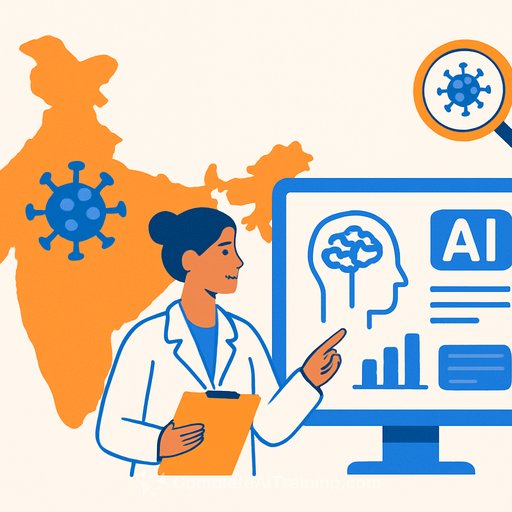
India is upgrading its disease surveillance-from chasing outbreaks to predicting them. The plan brings AI, real-time analytics, and digital intelligence into the public health stack so signals are flagged early and action happens faster.
The National Centre for Disease Control (NCDC) has already introduced AI-based event surveillance under the Integrated Health Information Platform (IHIP). NCDC Director Prof. Ranjan Das has noted that AI-enabled surveillance paired with rapid response can save lives by enabling timely, targeted interventions. This direction supports the Government's vision for a future-ready public health system, with stronger readiness for infectious diseases and climate-linked health risks.
Why this matters for government leaders
- Earlier detection: Spot unusual spikes and clusters before they spread.
- Faster response: Automate triage and route alerts to the right teams.
- Better resource use: Direct beds, kits, and staff where they're needed most.
- Climate-health resilience: Track heat, floods, air quality, and vector patterns alongside case data.
How the predictive model works
- Event-based surveillance via IHIP: Media, labs, facilities, and field reports feed a single platform.
- Signal detection: AI models flag anomalies and unusual symptoms across geographies and time.
- Geospatial clustering: Hotspots appear on maps with confidence scores and trend direction.
- Automated triage: Priority scoring moves high-risk signals to human review fast.
- Linked response: Standard operating procedures trigger verification, sampling, and containment.
Immediate actions for ministries and states
- Set up a central program office (PMU) with state cells for governance, risk, and delivery.
- Publish SOPs: signal thresholds, verification steps, escalation paths, and public communication templates.
- Standardize data: use common case definitions, coding, and metadata across facilities and labs.
- Close data loops: ensure field feedback, lab results, and outcomes flow back into IHIP within 24-48 hours.
- Run monthly drills: table-top and live exercises that test detection-to-response within 72 hours.
- Budget for uptime: 24x7 monitoring, redundancy, cybersecurity, and incident response.
Data protection and ethics
- Privacy by design: collect minimum necessary data, use de-identification, and role-based access.
- Audit trails: log who accessed what and why; enable quick investigations.
- Bias checks: review models for gaps by region, language, or facility type; retrain on diverse data.
- Oversight: constitute an ethics and safety committee to review use-cases and datasets.
Technology and interoperability
- APIs first: make it easy for labs, hospitals, and state systems to plug in without rework.
- Open standards: adopt common formats to avoid lock-in and speed integration.
- Hybrid deployment: support cloud and on-prem options, with offline modes for low-connectivity districts.
- Clear SLAs: latency targets for ingestion, alerting, and dashboard refresh.
Workforce and training
- Epidemiology: train teams to interpret AI signals, not just raw counts.
- Data science: maintain models, validate performance, and tune thresholds.
- Field ops: rapid verification, sampling, and risk communication.
- Leadership: decision frameworks for surge staffing, triage, and public advisories.
For departments building internal capability, structured upskilling helps speed adoption and reduce errors. Explore practical options for role-based AI skills here: AI courses by job.
KPIs to track in Year 1
- Detection lead time: days shaved off between first signal and first verified case.
- Time to field verification: percentage of high-priority alerts verified within 24 hours.
- False positives vs. missed signals: tracked monthly and used to recalibrate models.
- Coverage: share of districts, facilities, and private labs contributing usable data.
- Response speed: time from verification to containment measures and public advisory.
- Training completion: percent of staff certified on SOPs and platform use.
Procurement and compliance checkpoints
- Security: encryption in transit and at rest; regular penetration tests; CERT-In aligned practices.
- Data residency: comply with national policies; document cross-border flows if any.
- Vendor transparency: model cards, error rates, and update cadence included in contracts.
- Exit clauses: guaranteed data export and support for migration.
What success looks like in 12 months
- Meaningful reduction in outbreak size due to earlier detection.
- Verified alerts moving from days to hours.
- Uniform reporting across states with fewer data gaps.
- Public communication that is clear, timely, and trusted.
The foundation is already in place through IHIP and NCDC's work. With disciplined execution-governance, data quality, testing, and training-India can move from reacting to predicting, and do it at national scale.
Learn more about NCDC programs and disease surveillance updates here: NCDC official website.
Your membership also unlocks: