Indian Navy validates AI system for detecting debris on carrier flight decks
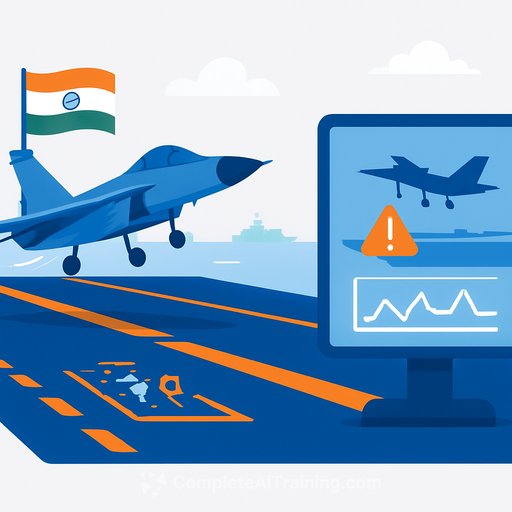
The Indian Navy has completed an operational demonstration of an artificial intelligence system that detects foreign object debris on aircraft carrier flight decks in real time. The trial aboard an operational carrier confirmed that fixed cameras combined with AI analysis can continuously monitor the deck, identify debris and alert crews without interrupting flight operations.
Skylark Labs supplied the technology. The demonstration is the first validation of such a system in both land-based and carrier aviation environments under real operational conditions.
Why FOD detection matters on carriers
Foreign object debris-any item from loose hardware to broken materials-poses a serious risk during flight operations. A small bolt can damage an engine. A fragment can puncture a tyre or injure deck crew. At sea, these incidents are harder to manage in isolation.
The Indian Navy operates two aircraft carriers, INS Vikramaditya and INS Vikrant, in demanding maritime conditions with constant wind, salt spray and vibration. Traditionally, crews conduct manual "FOD walks" before flight operations begin. The process is time-consuming and prone to human error.
How the system works
Ruggedised cameras mounted across the flight deck feed high-resolution imagery into Skylark Labs' AI system. Convolutional neural networks trained to recognize debris against the textured carrier deck surface detect objects as small as a few centimetres.
The system does more than flag movement. It classifies each detected object by type-metal fasteners, composite fragments, tools, organic material-and assesses the risk to operations. High-risk items near critical areas like catapult tracks trigger immediate alerts. Lower-risk debris is logged with reduced urgency.
Once identified, the system transmits precise deck coordinates and classification data to operators. Crews can remove debris rapidly without pausing flight operations. All processing happens on edge-based hardware installed onboard the carrier, eliminating reliance on external connectivity and ensuring low-latency response.
Each detection is time-stamped and geo-located within the deck's coordinate system, creating a detailed operational record.
From immediate safety to predictive maintenance
The system's data collection opens a path toward predictive maintenance. By tracking debris patterns over time, crews can identify where and when debris is most likely to occur and address underlying causes before they escalate into safety risks.
Patterns linked to wear and tear, component fatigue or specific operational cycles become visible. Crews gain a clearer understanding of recurring hotspots-whether caused by specific aircraft movements, maintenance practices or areas of deck deterioration.
The system also automates reporting, removing manual documentation so crews can focus on operational tasks.
Broader implications for naval operations
The trial builds on earlier work under India's Innovations for Defence Excellence (iDEX) framework. Skylark Labs was awarded a project in December 2022 to develop automated FOD detection for both airfields and carrier decks.
The technology runs on edge devices and incorporates on-device learning, allowing continuous adaptation to changing environmental conditions without extensive retraining. This approach matters in military settings where connectivity is limited and systems must remain resilient.
Amarjot Singh, founder and CEO of Skylark Labs, said: "Aircraft carriers are among the most unforgiving environments in naval aviation. This demonstration validated that our fixed detection system can continuously monitor carrier decks, filter environmental noise unique to at-sea operations, and deliver precise alerts so flight crews can act immediately. Because the same intelligence layer runs across our entire network-carriers, airfields, and mobile vehicles-every deployment makes the whole system smarter."
As carrier operations become more complex and sortie rates increase, automating routine but critical safety functions becomes more valuable. The successful trial is likely to draw interest from other naval operators managing high-tempo aviation operations.
For operations professionals implementing AI in safety-critical environments, understanding how systems like this integrate into existing workflows is essential. Learn more about AI for Operations or explore the AI Learning Path for Operations Managers to understand how AI systems drive predictive maintenance and process optimization.
Your membership also unlocks: