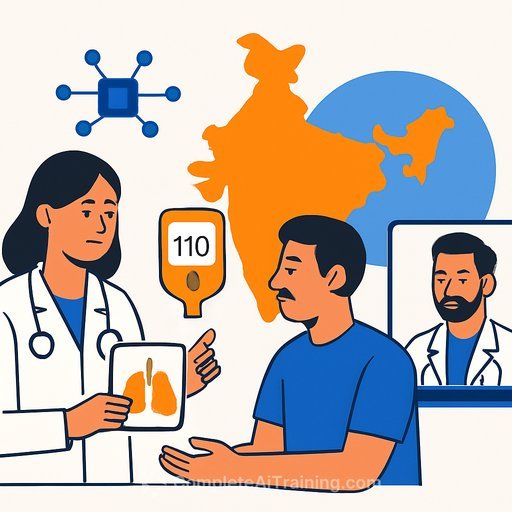
India accelerates AI adoption to rebuild how care is delivered
India is scaling artificial intelligence across public and private healthcare to expand access, raise quality, and reduce costs. Early results show stronger disease detection, faster triage, and better surveillance, with AI now embedded in national programs and day-to-day clinical workflows.
For healthcare leaders, this is less about hype and more about measurable outcomes. The focus is clear: earlier detection, better decisions at the point of care, and safer systems-at population scale.
What's changing across care delivery
- TB outcomes: AI tools in the National TB Elimination Programme contributed to a 27% decline in adverse outcomes.
- Outbreak alerts: The Media Disease Surveillance system has issued 4,500+ alerts since April 2022 by scanning national digital news sources for symptom clusters.
- Telemedicine at scale: e-Sanjeevani logged 282 million consultations between April 2023 and November 2025, with AI-assisted diagnoses helping 12 million patients.
- System-wide adoption: AI is now active across TB, diabetic retinopathy, disease surveillance, telemedicine, nutrition monitoring, and fraud detection.
Program highlights to know
- TB care: Predictive analytics flag patients at high risk of treatment failure. DeepCXR automates chest X-ray reads to find presumptive TB in eight states and union territories, reducing dependence on limited radiology capacity.
- Diabetic eye screening: MadhuNetrAI lets non-specialists capture retinal images that AI grades to prioritize urgent referrals-benefiting 7,100 patients across 38 facilities. India launched its first AI-driven community screening program in December 2025.
- Traditional medicine: Ayurgenomics and the Ayush Grid combine genomics with Ayurveda to identify disease markers-recognized by the WHO in July 2025 as a model for pairing AI with traditional knowledge systems.
- Cancer: A national imaging biobank with 20,000+ patient profiles is in development to train high-accuracy tools for early detection and disease management.
- Fraud prevention: Under Ayushman Bharat PM-JAY, AI is used to spot suspicious transactions and deter fraud in real time.
- Nutrition and public health: In Etapalli, Maharashtra, an AI vision system audited school meals using image recognition and 2,100+ data points, revealing missing components and poor preparation. Compliance and vendor accountability improved, with the model replicated across multiple schools.
Digital rails and governance are in place
- Ayushman Bharat Digital Mission (ABDM): 799 million digital health IDs issued as of August 2025; 410,000+ facilities and 670,000+ professionals registered; 671 million health records linked.
- Centres of excellence: AIIMS Delhi, PGIMER Chandigarh, and AIIMS Rishikesh were designated in March 2025 to support safe, standardized deployments.
- Model validation: The National Health Authority and IIT Kanpur are building a national federated learning platform to validate AI health models.
- Ethics and governance: Deployments follow Indian Council of Medical Research's 2023 guidelines and Ministry of Electronics and IT frameworks, with a sector-specific Strategy for AI in Healthcare underway.
Context matters: India identified AI's potential early. NITI Aayog's 2018 strategy framed AI, robotics, and connected devices as a "new nervous system for healthcare." See the public document from NITI Aayog here. ICMR's ethical guidelines are available here.
National mission and momentum
- IndiaAI mission (March 2024): A whole-of-government effort to support inclusive development and better public services, including healthcare, backed by a budget outlay of 10,371.92 crore rupees.
- Shortlisted healthcare solutions: AI-based lung screening, wearable diagnostics, early diabetic eye screening devices, cancer staging platforms, and personal health assistants.
- Global convenings: India will host the Global South's first international AI summit in New Delhi from Feb 16-20. The Regional Open Digital Health Summit 2025 (Nov 19-20) convened policymakers from Sri Lanka, Nepal, Bhutan, Bangladesh, and Timor-Leste to discuss AI-enabled surveillance, diagnosis, and outbreak prediction.
What this means for clinicians and administrators
- Expect more AI-assisted triage, imaging reads, and risk scoring in routine workflows-especially in TB, diabetes, oncology, and primary care.
- Telemedicine plus AI will keep shifting first-contact care online. Build referral and escalation protocols that capture AI recommendations in the patient record.
- Data quality is now clinical quality. Standardize coding, ensure clean imaging protocols, and link records via ABDM to improve model performance and auditability.
- Use federated validation and local QA to vet tools before scale. Track accuracy, false positives/negatives, time-to-diagnosis, and outcome deltas by site and subgroup.
- Refresh consent, privacy, and bias safeguards. Align with ICMR guidelines and establish clear lines of accountability for model outputs.
- Invest in staff training for frontline users. The goal: shorter learning curves, fewer alert overrides, and reliable adoption in low-resource settings.
- Procurement tip: require published validation data, post-deployment monitoring plans, integration support (ABDM compliance), and exit terms if performance drifts.
Practical next steps for health systems
- Start with high-yield pilots: TB X-ray triage, DR screening, and AI-supported telemedicine triage. Measure turnaround time, referral accuracy, and treatment initiation rates.
- Embed AI outputs into case sheets and electronic records. If you can't action the insight inside the workflow, it won't stick.
- Stand up an AI governance group with clinical, data, legal, and patient representation. Review risk, drift, and fairness quarterly.
- Integrate ABDM IDs and facility registries to streamline patient movement across levels of care and support longitudinal analytics.
- In public programs, extend AI-enabled audit tools to nutrition, sanitation, and water safety to improve outcomes beyond the clinic.
- For payers and TPAs, deploy anomaly detection for claims to curb fraud without blocking legitimate care.
Bottom line
India is proving that AI can scale when it rides on strong digital infrastructure, clear guardrails, and pragmatic use cases. The opportunity now is execution: pick problems that matter, validate locally, integrate tightly, and measure what changes at the bedside and in the community.
Looking to upskill teams on practical AI for healthcare operations, analytics, and clinical workflows? Explore curated learning paths by role: AI for Healthcare, the AI Learning Path for CIOs, and the AI Learning Path for Regulatory Affairs Specialists.
Your membership also unlocks: