AI Impact Summit 2026: What Government Teams Need to Know Now
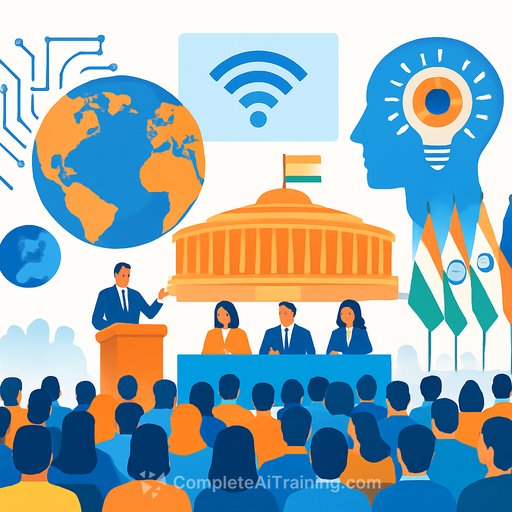
India is gearing up to host the AI Impact Summit at a scale comparable to the 2023 G20. Officials expect 15-20 heads of state and around 100,000 participants for the main event in February 2026. Over 300 "pre-summit" events worldwide have already been tagged to the initiative.
Participation has surged since the first AI summit at Bletchley Park in 2023, then Seoul in 2024, and Paris in 2025-where India was handed the reins for 2026. China will be invited, and several countries from the Global South are set to join. Leading labs, including Anthropic and Google DeepMind, are expected to participate.
Why this matters for government
- Policy signal: This is a global stage to shape AI access, safety, and markets-India included.
- Capacity push: Compute, data, and model access are center stage. Departments will be asked where they stand and what they need; CIOs and IT leaders can orient planning with the AI Learning Path for CIOs.
- Global coordination: With more than a dozen heads of state confirming, expect commitments that have downstream effects on procurement, standards, and compliance.
- Global South inclusion: India is positioning equitable access as a core theme, with tangible implications for funding and infrastructure sharing.
India's stated priorities
- Broad access to AI: AI should not be concentrated in a few geographies or companies. Access to compute, models, data, and practical applications should be widespread "to support development of humankind as a whole."
- Balanced governance: A framework that protects against downsides while enabling opportunity. "We need to approach AI with a positive mindset," alongside clear guardrails, with special emphasis on the Global South.
Working tracks you can plug into
- AI and work: Workforce impact, skilling, and transition plans.
- Trust and safety: Model evaluation, safety protocols, and responsible deployment.
- Sector use-cases: Health, agriculture, education, public service delivery, logistics, and urban governance.
Action checklist for ministries and states (next 60 days)
- Nominate focal points: One policy lead and one technical lead per department to engage with summit working groups; technical leads may find the AI Learning Path for Technology Managers a practical primer.
- Map compute and data: Inventory current GPU/CPU capacity, cloud contracts, and critical datasets; identify gaps for research and service delivery.
- Propose 2-3 pilots: Short, measurable pilots per sector (e.g., grievance triage, disease surveillance, crop advisory, road safety analytics) with clear evaluation criteria.
- Procurement guardrails: Draft checklists to avoid lock-in and ensure interoperability: model transparency, domain evals, safety testing, privacy-by-default, and exportable logs.
- Data governance: Classify datasets; set access tiers; add audit trails; prepare synthetic or de-identified data where needed for model training and testing.
- Security and risk: Run tabletop exercises for misuse scenarios (model hallucination, prompt abuse, data leakage); define rollback plans and escalation paths.
- International engagement: Prepare 1-page briefs for bilateral slots: your priority asks (compute, funding, research exchanges) and offers (datasets, pilots, standards work).
- Public communication: Draft plain-language summaries of pilots and safeguards; assign spokespersons; align messaging with the national framework.
- Upskilling: Identify staff who need AI literacy vs. hands-on training; schedule short courses before February. For quick options by role, see AI courses by job, or consider role-focused tracks such as the AI Learning Path for Software Engineers.
Scale and participation: what to expect
Officials report a sharp rise in participation since 2023: about 27 countries took part initially, with 28 signing the Bletchley declaration; by 2025, more than 100 countries were engaged in different forms. For February 2026, the expectation is higher interest across both governments and industry.
Heads of state representation is confirmed from over a dozen countries so far. France is in; others are pending public confirmation. Industry attendance will include top researchers and executives from major AI labs.
How to align your work with summit outcomes
- Anchor projects to the two core themes: broad access to AI infrastructure and balanced governance.
- Prioritize shared infrastructure models: pooled compute, open evaluation suites, and common datasets for public-good use cases.
- Document impact: baseline metrics now (cost, time, accuracy, coverage) so improvements are defendable during and after the summit.
- Engage standards early: adopt evaluation protocols for safety and performance that can feed into the summit's trust and safety track.
Useful references
Bottom line
This summit isn't just a conference-it's a coordination moment. Get your teams ready with clear pilots, data and compute plans, and a stance on governance that protects citizens while enabling real deployment.
Your membership also unlocks: