India's AI push: $1.7 trillion by 2035 - what government teams should do now
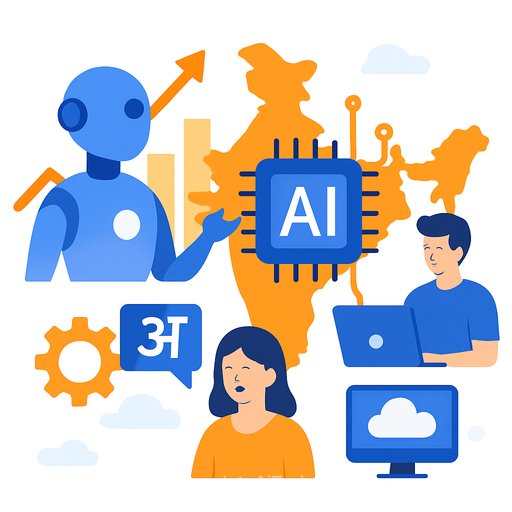
Government estimates suggest AI could add up to $1.7 trillion to India's economy by 2035. The IndiaAI Mission, backed by ₹ 10,300 crore over five years, is the engine: build compute, fund startups, develop indigenous models, and scale skills nationwide.
The plan is simple: raise productivity across public services, expand affordable infrastructure, and make solutions work in every Indian language. Compute capacity has already been scaled from 10,000 to 38,000 GPUs, with subsidised access for startups and researchers.
Where AI will move the needle for the state
- Healthcare: faster triage and disease detection, referral support, claims scrutiny.
- Agriculture: advisory in local languages, pest alerts, price and weather guidance.
- Manufacturing and MSMEs: quality checks, predictive maintenance, vendor screening.
- Financial services: fraud analytics, credit scoring for underbanked users.
- Education: personalised practice, teacher assist, content translation.
- Governance: citizen query assistants, file summarisation, grievance triage.
- Climate services: localised forecasts, early warnings, resource planning.
Jobs, skills, and capacity building
India's tech workforce stands at over six million. Government data indicates AI will create new roles even as existing jobs evolve.
Industry estimates point to the AI talent pool more than doubling to over 12.5 lakh professionals by 2027. On skilling, more than 18.5 lakh candidates have enrolled on FutureSkills PRIME, with over 3.37 lakh completing courses in AI and related fields.
- Roles to staff in government: AI product leads, data stewards, ML engineers/MLOps, AI assurance and ethics officers, domain experts paired with analysts, and prompt engineers for workflows.
- Immediate upskilling: pick a core team per department; mandate a 6-8 week learning sprint aligned to live pilots.
Affordable infrastructure that actually gets used
Under the IndiaAI Mission, access to 38,000 GPUs can lower barriers for pilots and proofs of concept. Prioritise workloads with measurable ROI and citizen impact.
- Book compute slots early; standardise on shared services and AI for Operations to cut procurement delays.
- Use API-first architecture; keep data minimal, encrypted, and logged.
- Adopt data retention and model update policies from day one.
Inclusion by default: Indian languages and mobile-first
Government-backed platforms like Bhashini and models such as BharatGen aim to make AI accessible across Indian languages. NITI Aayog highlights the opportunity to support 490 million informal workers through voice-based, mobile-first tools-training, health, finance, and real-time advisory in local languages.
Teams implementing local-language interfaces should consider AI Translation Courses to guide translation and localization efforts.
- Offer voice and chat interfaces in major state languages; ensure offline/low-bandwidth modes.
- Run field tests with women, elderly, and persons with disabilities; fix friction before scale-up.
- Track adoption by rural and first-time internet users, not just total usage.
Guardrails that build trust
- Risk assessment before deployment; publish model and data provenance notes.
- Human-in-the-loop for critical decisions (health, welfare eligibility, law and order).
- Bias testing across gender, caste, language, and region; document and mitigate.
- Grievance and appeal channels visible in every interface; log and close the loop.
- Privacy by design: data minimisation, consent records, audit trails.
Quick wins for 2025-26
- Multilingual citizen assistants for schemes, documents, and application status.
- Document digitisation, translation, and file-note summarisation for faster movement.
- Eligibility screening and fraud analytics for subsidies and benefits.
- Hospital triage assistants and appointment optimisation.
- Crop advisory and market intelligence via voice bots.
- Land record extraction and dispute flagging.
- Permit and license processing with auto-checklists and data validation.
- Classroom content support and question generation for teachers.
- Early warning alerts for heat, flood, and air quality at ward/block level.
- Multilingual IVR upgrades for helplines.
Funding, platforms, and where to plug in
- Track programme updates and opportunities via the Press Information Bureau and line ministries. PIB
- Use language resources and APIs from the national language platform. Bhashini
Start this quarter: a 6-step plan for departments
- Appoint an AI lead and a 10-person cross-functional squad.
- Inventory top 20 workflows; pick three with clear metrics (TAT cut by 30%, error rate down by 50%, or citizen satisfaction up).
- Secure compute credits; set up sandbox data with privacy safeguards.
- Build quick prototypes; run 4-6 week field tests with real users.
- Create an assurance checklist: accuracy thresholds, bias tests, escalation paths.
- Publish results and scale one use case per quarter.
AI isn't a side project anymore. With funding in place, language tech maturing, and clear demand from the field, the next move is execution-small pilots, fast learning, and scale where it works.
If you're setting up structured upskilling for your team, consider the AI Learning Path for Training & Development Managers.
Your membership also unlocks: