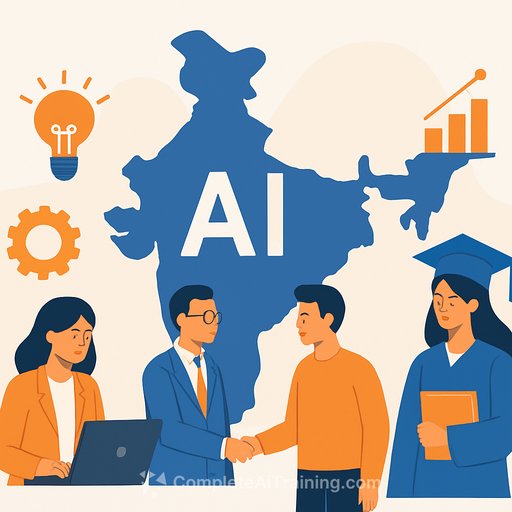
Skilling for AI: A Government Playbook from MSDE's High-Level Meeting
India's skilling engine needs tighter coordination and faster execution. That was the clear signal as Union Minister for Skill Development and Entrepreneurship Jayant Chaudhary chaired a high-level meeting on Skilling for AI in New Delhi. The brief: embed AI skills across education, vocational training, and the workforce to lay the groundwork for Viksit Bharat.
The mandate is simple-move in step with technology while keeping access broad and training relevant. Government, industry, academia, and training institutions must work as one system, not four separate tracks.
What This Means for Government Agencies
AI skills can't sit in a silo. Departments need shared standards, common curricula integration, and clear pathways from training to jobs. That includes aligning schools, ITIs, PMKVY partners, and sector skill councils with demand from industry and public services.
Public governance is a priority use case. Think faster service delivery, better targeting, and smarter operations-always with safeguards for ethics, privacy, and accountability.
Programs Reviewed and Where They Fit
- IndiaAI Mission - FutureSkills: Framework to scale AI capabilities across the country, from basics to advanced roles.
- AI Careers for Women (TechSaksham 2.0): Expands access for women to AI-aligned roles and employability pipelines.
- PMKVY 4.0 - AI-focused training: Adds AI modules to frontline skilling with an eye on industry needs and public-sector use cases.
These initiatives aim to widen participation, especially for women and young learners, while building job-ready talent across the AI value chain.
Core Focus Areas Agreed in the Meeting
- Integrate foundational AI concepts into existing vocational curricula and higher education.
- Strengthen institutional infrastructure-labs, compute access, datasets, and trainer capacity.
- Expand early-stage AI literacy in schools and community programs - for curriculum examples, see the AI Learning Path for Primary School Teachers.
- Deepen industry partnerships for internships, capstone projects, and apprenticeship models.
- Maintain regulatory flexibility so training can keep pace with technology shifts.
- Embed responsible and ethical AI as a non-negotiable standard across all skilling efforts.
Priority Sectors for Applied Training
- Healthcare: Triage support, diagnostics assistance, operations planning.
- Manufacturing: Quality checks, predictive maintenance, supply planning.
- Services: Citizen support, document processing, analytics.
- Public governance: Grievance redressal, benefits targeting, fraud detection-with clear oversight.
Practical Actions You Can Start This Quarter
- Map 10-15 high-impact government job roles that will use AI tools within the next 12-18 months; define skill standards for each.
- Nominate master trainers across departments; set up a train-the-trainer schedule with state skill missions and sector skill councils.
- Sign MOUs with local industry and universities for projects, apprenticeships, and guest faculty support.
- Stand up an AI ethics and risk checklist for procurement and pilots; require documentation of datasets, bias testing, and audit trails.
- Launch short AI literacy sprints for frontline staff-2-6 hours per cohort-focused on daily workflows and public-service outcomes.
- Fund shared labs at District Skill Committees for hands-on practice, not just theory.
- Add AI-skilling KPIs to program dashboards: enrollments, completions, certifications, and job or project placements.
Inclusion and Accountability
Access must be broad, affordable, and practical. Women, rural learners, and career switchers should see clear entry points and support systems. Ethics isn't an add-on-make it part of every module, assessment, and pilot review.
Why This Matters Now
The meeting marked a step up in scale and coordination. MSDE reaffirmed its role in building national capabilities so India's workforce can compete-and lead-as AI becomes standard across public and private roles.
Useful Links
Optional Planning Resources
- AI Learning Path for Production Planners for curriculum mapping in manufacturing and operations.
- AI Learning Path for Supply Chain Analysts to inform analytics and supply-focused roles.
Your membership also unlocks: