
AI news ·
India's creative industry leaders urge government to protect voluntary licensing rights as DPIIT proposes mandatory AI training framework
India's film, music, and media industries formally opposed a government plan to force mandatory licensing of copyrighted works for AI training. Sixteen industry groups want consent, transparency, and market-set pay to remain the standard.
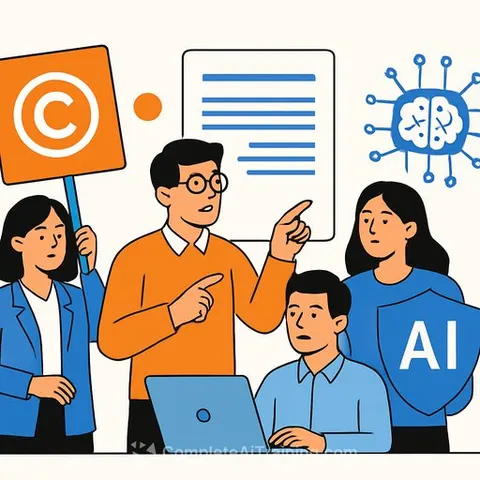
India's Creative Industries Challenge Proposed AI Training Licensing Framework
India's film, music, television, and media leaders presented formal objections to a government proposal requiring mandatory licensing of copyrighted works for AI training. The roundtable, held at NITI Aayog in New Delhi on April 28, brought together executives from major studios, production companies, and industry associations to challenge the Department for Promotion of Industry and Internal Trade's (DPIIT) December 2025 working paper titled "One Nation One License One Payment."
Sanjeev Sanyal, Member of the Economic Advisory Council to the Prime Minister, attended the closed-door session led by Supirya Suri, founder of the Creative Economy Forum. Participants included leaders from Annapurna Studios, Shemaroo Entertainment, the Motion Picture Association, the Producers Guild of India, and the Indian Music Industry.
The Core Dispute
The DPIIT proposal would replace voluntary licensing with a mandatory blanket license model. Under the plan, a government-appointed Rate Setting Committee would determine flat royalty rates, effectively compelling rights holders to license their works to AI developers without consent.
Industry representatives argued this strips creators of foundational rights. The current voluntary model allows rights holders to negotiate terms, withhold consent, and set conditions on how their work is used. A mandatory system, they said, would eliminate price discovery through market mechanisms.
Constitutional and Economic Concerns
Participants raised questions about Articles 19(1)(a) and 19(1)(g) of the Indian Constitution, which protect freedom of expression and the right to trade. They argued mandatory licensing with government-set rates violates these protections.
The industry also noted structural gaps in how the DPIIT committee was formed. It did not include representatives from the Ministry of Information and Broadcasting or regional creative industry stakeholders, potentially skewing recommendations toward AI developers.
Market Data and Alternative Framework
The global AI training dataset licensing market reached approximately $2.62 billion in 2024 and is projected to reach $18.5 billion by 2034, according to industry figures. Voluntary licensing, participants said, is not slowing AI development-it's the mechanism that allows both innovation and creator compensation.
Sixteen major industry associations presented an alternative framework built on three principles: Consent (prior permission required for using copyrighted works in AI training), Credit (transparency in how AI developers disclose training data sources), and Compensation (fair market-determined remuneration through voluntary licensing).
Additional Risks Cited
Participants raised brand safety concerns. Without rights holders' ability to set conditions on intellectual property use, they said, there are risks of misuse of branded characters and creative content, potentially affecting child protection.
The industry also flagged inconsistency with India's stated AI strategy and international obligations under the Berne Convention, TRIPS, and the WIPO Copyright Treaty, which emphasize consent-based approaches.
Learn more about Generative AI and LLM and how it intersects with creative work, or explore resources for AI for Creatives.