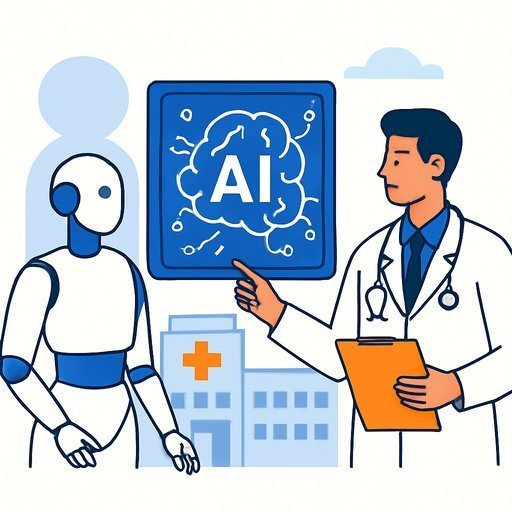
India's First Government AI Clinic: What It Is And How It Will Improve Patient Care
India's public healthcare system just took a practical step forward. The Government Institute of Medical Sciences (GIMS), Greater Noida, has opened the country's first government-based AI clinic to support early detection and treatment of cancer, and heart, kidney, and liver diseases.
The clinic brings AI and genetic screening together to assess blood tests, scans, and genomic data. The goal is simple: spot risks earlier, treat faster, and improve outcomes across busy government hospitals.
What the clinic will do
Brigadier (Dr.) Rakesh Kumar Gupta, director at GIMS, said, "The clinic will use artificial intelligence along with genetic screening to analyse diagnostic inputs, including blood tests, imaging scans and other clinical data."
AI systems will review X-rays, ultrasounds, CT scans, MRI reports, and lab investigations to support doctors with quicker and more accurate assessments. The institute also expects this to open doors for healthcare startups to build useful tools that reach patients and clinicians directly.
What is an AI clinic?
An AI clinic uses algorithms and automation to improve diagnostics, treatment planning, and patient management. It can be a compact unit or integrated into an existing hospital department.
These systems analyse symptoms and test results in real time and support triage, so urgent cases move faster. For remote or underserved areas, AI clinics can extend specialist-level support without requiring patients to travel long distances.
Why this matters for government healthcare
- Faster triage and reporting: Shorter queues for imaging and lab results, especially in high-volume OPDs and emergency units.
- Early detection at scale: Consistent screening protocols for NCDs-cancer, cardiac, kidney, and liver diseases-across districts.
- Better resource use: AI-generated preliminary reports free up specialists for complex cases.
- Data-backed decisions: Aggregated insights support planning, procurement, and quality improvement.
- Access for rural facilities: Hub-and-spoke models let smaller centers tap into AI-assisted reads and guidance.
How AI clinics improve patient care
- AI for X-rays, CT scans, and MRIs: Algorithms flag fractures, lung nodules, and subtle tumors quickly. Preliminary reports can improve radiologist efficiency by up to 40% and surface life-threatening issues in near real time.
- AI for pathology: Digital analysis spots patterns and inconsistencies that may be missed in manual review, improving sensitivity and speeding up complex cases.
- AI for early cancer detection: Deep learning helps reduce false positives and negatives, supports risk classification, and increases chances of diagnosing cancers at treatable stages.
- AI for treatment personalisation: By combining medical history, lifestyle, and genetic data, AI can suggest dosing and therapy options. In oncology, matching patients to targeted therapies has shown 20-25% better success rates.
- AI in genomics: Large-scale analysis identifies biomarkers and predicts treatment response, enabling plans that reduce side effects and improve efficacy.
- AI for remote monitoring: Wearables and apps track vitals and alert caregivers to irregularities. This helps prevent complications and can reduce readmissions.
Implementation checkpoints for administrators
- Clinical validation: Benchmark every AI tool against local datasets and follow ongoing audits.
- Data governance: Ensure consent, de-identification, and strict access controls under national policies.
- Cybersecurity: Enforce security standards for devices, PACS, and EHR integrations.
- Workflow fit: Integrate with existing RIS/LIS/EHR systems so clinicians get value without extra clicks.
- Training and SOPs: Provide clear protocols for use, escalation, and human-in-the-loop oversight.
- Equity and bias checks: Monitor performance across demographics to avoid skewed outcomes.
For policy alignment and ethics, refer to India's ICMR Ethical Guidelines for AI in Healthcare.
Opportunities for public sector and startups
This model can encourage PPP projects, local innovation, and targeted pilots in high-burden districts. Vendors that meet validation, interoperability, and audit standards can be onboarded faster.
Hospitals can start with radiology and oncology, then expand to pathology and remote monitoring. A phased rollout with clear KPIs-turnaround time, readmission rates, diagnostic accuracy-keeps projects accountable.
Upskilling the workforce
Clinicians, administrators, and IT teams need shared literacy on AI use, limits, and safety. Short, role-specific programs help teams evaluate tools and implement them responsibly. Data scientists and clinical informaticists can follow the AI Learning Path for Data Scientists to build practical skills for healthcare AI projects.
Explore practical AI courses by job role
Bottom line
GIMS's AI clinic is a clear signal: early detection and smarter workflows are becoming standard in public healthcare. With the right guardrails, this approach can save time for clinicians and deliver faster, more consistent care for patients across India.
Disclaimer: This article provides general information and is not a substitute for professional medical advice. Always consult a qualified doctor for any health concerns.
Your membership also unlocks: