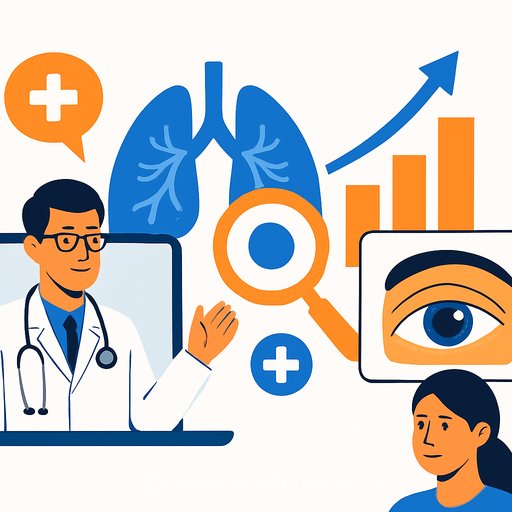
Ministry of Health Accelerates AI Rollout Across National Healthcare Programmes
India's Ministry of Health and Family Welfare is scaling artificial intelligence across priority public health programmes. AIIMS Delhi, PGIMER Chandigarh, and AIIMS Rishikesh have been named Centres of Excellence for Artificial Intelligence, with projects spanning imaging-led screening and clinical decision support.
These centres are working with the Central Tuberculosis Division, National Centre for Disease Control, CDAC-Mohali, ICMR, MeitY, IISc, and the National Health Systems Resource Centre. Wadhwani AI is providing technical support across several deployments.
What's live now
- MadhuNetrAI (diabetic retinopathy): Enables non-specialist health workers to run retinal screenings using AI analysis of fundus images. The model is live in 38 centres across 11 states, has reviewed more than 14,000 images, and supported over 7,100 persons.
- eSanjeevani (telemedicine): AI integrated in April 2023 to standardise data capture and offer differential diagnosis suggestions. It has supported over 282 million consultations, improving consistency across facilities.
- "Cough against TB" (community screening): Deployed under the national TB elimination programme, the tool screened more than 1.62 lakh people between March 2023 and November 2025 and improved case detection by 12-16 per cent compared with conventional methods.
Centres and partnerships
The Centres of Excellence-AIIMS Delhi, PGIMER Chandigarh, and AIIMS Rishikesh-are coordinating with national bodies and research institutions to move AI from pilots to routine practice. Partnerships span surveillance (NCDC), TB control (CTD), public health systems (NHSRC), compute and engineering (CDAC-Mohali), and research (ICMR, IISc), with MeitY guiding digital standards and governance.
Why this matters for healthcare teams
Workflows are shifting from specialist-only screening to point-of-care triage with AI assistance. The aim is clear: earlier detection, consistent documentation, and faster routing to the right level of care without adding burden to clinicians.
Practical actions for hospital and public health leaders
- Choose fit-for-purpose use cases: Start where tools already exist-diabetic retinopathy screening, TB community screening, and AI-supported teleconsults.
- Tighten data capture: Standardise fundus imaging protocols, cough recording quality, and structured clinical forms so models receive clean, complete inputs.
- Integrate, don't parallel-run: Connect AI outputs to eSanjeevani and your EMR to avoid duplicate documentation and ensure traceability.
- Upskill the workforce: Train non-specialist staff to operate devices and interpret AI flags, with clear escalation pathways to specialists.
- Clinical governance: Keep humans in the loop, document override policies, and audit model recommendations against outcomes.
- Monitor performance locally: Track sensitivity, specificity, referral accuracy, and time-to-treatment; re-calibrate if performance drifts in your population.
- Privacy and security: Implement consent, role-based access, audit logs, and de-identification in line with national requirements.
- Plan for scale and uptime: Define SLAs, device maintenance, connectivity fallback, and data backup; budget for ongoing model updates.
Compliance and standards
According to the Ministry, all AI applications conform to existing national regulations, including MeitY's AI governance rules, ICMR's ethical guidelines for biomedical AI, the Information Technology Act, the Digital Personal Data Protection Act 2023, and the health ministry's information security standards.
- ICMR Ethical Guidelines for AI in Biomedical Research and Healthcare
- Digital Personal Data Protection Act, 2023 (MeitY)
What to watch next
- Expansion of screening sites: More primary care and community settings coming online for diabetic eye disease and TB.
- Decision support maturity: Broader clinical pathways in eSanjeevani as structured data capture improves.
- Outcome-linked funding: Procurement tied to measurable gains-earlier detection, fewer missed cases, shorter wait times.
If your team is building AI skills for clinical workflows and public health operations, you can explore role-based learning paths here: AI courses by job.
Your membership also unlocks: