Health Ministry Accelerates AI Adoption Across Public Healthcare
India's Ministry of Health is moving fast on AI deployment across public systems. New Centres of Excellence anchored at AIIMS Delhi, PGIMER Chandigarh, and AIIMS Rishikesh will push research, validation, and implementation at scale.
The initial focus is practical: strengthen telemedicine (eSanjeevani), speed up TB screening, and scale diabetic retinopathy (DR) screening. Advanced diagnostic models will sit inside routine workflows, not next to them.
What's being rolled out
- Centres of Excellence: Clinical AI development, validation on Indian populations, and shared playbooks for deployment.
- Telemedicine decision support: AI-assisted triage and routing inside eSanjeevani to reduce wait times and improve referrals.
- TB screening at scale: AI-enabled chest X-ray triage to prioritize cases for confirmatory testing and faster treatment initiation.
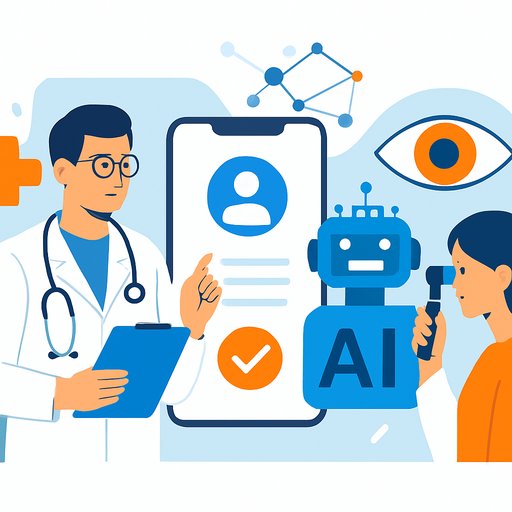
- DR screening in outreach: Point-of-care retinal imaging with AI to flag referable DR, integrated with referral and follow-up.
- Data and governance: Common evaluation protocols, audit trails, and quality assurance across sites.
Why this matters for clinicians and administrators
- Earlier detection: More cases identified in primary care before complications set in.
- Workload relief: Automated triage filters routine negatives so specialists focus on likely positives.
- Consistent quality: Standardized reads reduce inter-observer variation across facilities.
- Access: Rural and remote populations get specialty-grade screening via telemedicine and community sites.
AI is assistive. Final clinical decisions remain with qualified staff, with clear escalation paths for edge cases.
Clinical guardrails to enforce from day one
- Validation on local data: Sensitivity/specificity verified on Indian cohorts; re-validate after updates.
- Bias checks: Monitor performance across age, sex, comorbidities, and device types.
- Human-in-the-loop: Mandatory review for positives, low-confidence scores, and out-of-distribution images.
- Integration: Embed into HIS/LIS/PACS with single sign-on; no copy-paste workflows.
- Safety and security: Role-based access, encryption, uptime SLAs, and incident response plans.
- Consent and transparency: Clear patient communication on AI use; document overrides and reasons.
What hospitals should do now
- Appoint accountable leads: One clinical and one IT/biomed lead per site; define escalation contacts.
- Pick focused use cases: Start with TB triage, DR screening, or tele-triage before expanding.
- Set measurable KPIs: Diagnostic accuracy, turnaround time, referral yield, cost per screen, and patient follow-up rates.
- Prepare a procurement checklist: Regulatory status, data residency, integration APIs, model update policy, support and training.
- Train the workforce: Short modules for clinicians, nurses, technicians, and administrators. Refresh quarterly.
- Monitor and improve: Weekly dashboards, monthly audits, and a simple incident log for continuous fixes.
Key metrics to track
- TB: Screens completed, sensitivity/specificity, PPV at site level, time from screen to confirmatory test, treatment initiation.
- DR: Imaging quality rate, referable-DR detection rate, false positives, referral completion within 30 days.
- Telemedicine: Triage accuracy, average wait time, consult duration, reconsults within 7 days.
- Operations: Downtime, model confidence distribution, override rates, and clinician satisfaction.
Interoperability and data foundations
Adopt national digital health standards for patient identity, consent, and data exchange to avoid vendor lock-in and siloed deployments. Shared vocabularies and APIs will reduce integration time across states and programs.
For policy context and standards under India's digital health stack, see the Ayushman Bharat Digital Mission resources here.
Clinical workflow design tips
- Place AI at the decision point: before referral, not after.
- Use clear thresholds and "uncertain" buckets to avoid forced calls on low-quality data.
- Automate the boring parts: pre-fill forms, attach images, and push structured summaries into the EMR.
- Close the loop: referral SMS, follow-up reminders, and visibility for community health workers.
Training and change management
Short, scenario-based sessions work better than thick manuals. Rotate early adopters as peer trainers, and reward teams that improve metrics, not just volume.
If you need structured learning paths for clinical and admin teams adopting AI, explore job-focused options here.
External references
- WHO guidance on AI for TB chest X-ray triage: WHO TB and digital health
What to expect next
- Phased deployments starting with high-burden districts and high-volume facilities.
- Standard evaluation protocols, shared datasets for benchmarking, and external quality assurance.
- Clear procurement frameworks and service-level expectations across states and central institutions.
The direction is clear: build AI into everyday care, validate it rigorously, and make it easier for clinicians to do the right thing, faster. Keep it practical, measurable, and safe.
Your membership also unlocks: