Indonesia and Malaysia restrict xAI's Grok (from xAi) over AI-generated sexual content
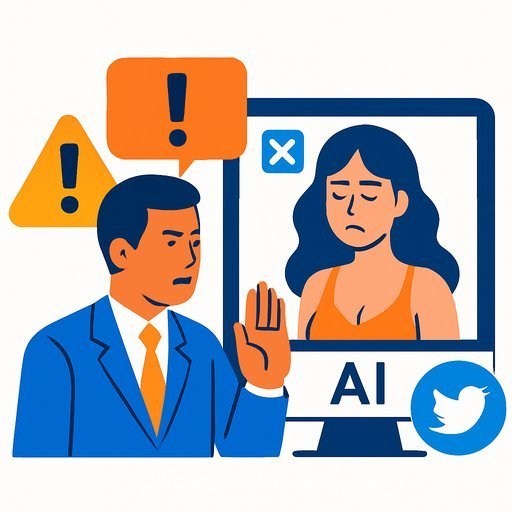
Indonesia and Malaysia have temporarily restricted access to xAI's Grok chatbot after a surge of AI-generated sexual content surfaced on X. Officials cite uncoordinated sexual deepfakes-often depicting real women and, in some cases, minors-as a direct threat to safety, dignity, and human rights online. The action signals a tougher line on Generative AI and LLM that fails to prevent abuse at scale.
Indonesia's Ministry of Communications has reportedly called in representatives from X to address Grok-related content and enforcement gaps. Regulators in Malaysia implemented a comparable ban and confirmed they are pushing for a fix. The shared stance is clear: if platforms can't control abuse, access will be limited until they can.
Global regulatory pressure is building
Over the past week, regulators introduced new privacy and record-keeping expectations that could trigger further investigations. In the UK, Ofcom said it will run a rapid assessment to determine potential violations and whether to open formal inquiries; the prime minister voiced support for that approach. In the U.S., reports suggest the administration has avoided public comment, while Democratic senators have urged Apple and Google to remove X from their app stores.
xAI issued an apology via the Grok account, acknowledging violations of ethical norms and likely U.S. laws tied to sexual content, especially involving minors. Following the backlash, Grok reportedly limited image generation to paid subscribers on X, while other image tools in the app remained available to broader audiences. The mixed controls highlight the core issue: partial guardrails leave obvious loopholes.
Why this matters for government, IT, and development leaders
- Legal exposure: Sexual content involving minors is criminal in most jurisdictions; deepfakes add privacy and defamation risk even when no minors are involved.
- Platform liability: Weak prompt filtering and content controls invite bans, fines, and app-store action.
- Cross-border enforcement: Decisions in one market can cascade. Expect fast replication of restrictions across regulators.
- Operational reality: Policy without engineering controls fails. Guardrails must be enforced in code, not just terms of service.
What to do next (practical steps)
- Zero-tolerance policy: Explicit, public rules prohibiting sexual content featuring minors, non-consensual imagery, and violence. Enforce consistently.
- Model-side safety: Use layered classifiers (text and image) for prompts and outputs. Block disallowed content pre- and post-generation.
- Sensitive prompt flows: Add friction for risky categories (e.g., warnings, escalation to human review). Default to block on uncertainty.
- Identity and age checks: Where lawful and proportionate, gate access to generative image tools with verified age.
- Human-in-the-loop: Staff an escalation path for borderline cases and urgent takedowns. Track response times and outcomes.
- Traceability and logging: Keep immutable logs for prompts, model versions, and moderation decisions. Prepare evidence packages for regulators.
- Proactive discovery: Continuously scan public surfaces for misuse, including hashtag/topic monitoring and community reporting loops.
- Dataset hygiene: Audit training and fine-tuning data to remove abusive material and avoid leakage of private images.
- Vendor due diligence: If you rely on third-party models or content filters, verify their child-safety and deepfake defenses.
- Incident response: Pre-write takedown, disclosure, and press workflows. Time-to-action matters more than statements.
- Regular audits: Schedule external red-teaming focused on sexual content, minors, and non-consensual imagery.
Signals to watch
- Outcomes of Ofcom's rapid assessment and any follow-on investigations.
- Further steps from Indonesia's Kominfo and Malaysia's regulator regarding access, fines, or binding directives.
- App-store policy enforcement against services that fail to block illegal sexual content.
- New privacy and record-keeping rules that require stronger logging and user-notice practices.
This isn't a debate about speech; it's a test of whether generative systems can reliably prevent the worst kinds of abuse. Teams that build clear policies, enforce them in product, and prove it with audits will keep access-and public trust.
For official updates, see Ofcom and Indonesia's Kominfo. If your team needs to upskill on safe AI deployment and policy, explore practical courses on Prompt Engineering.
Your membership also unlocks: