Indonesia bets US$2.7m on "Trade AI" to tighten customs and tax controls
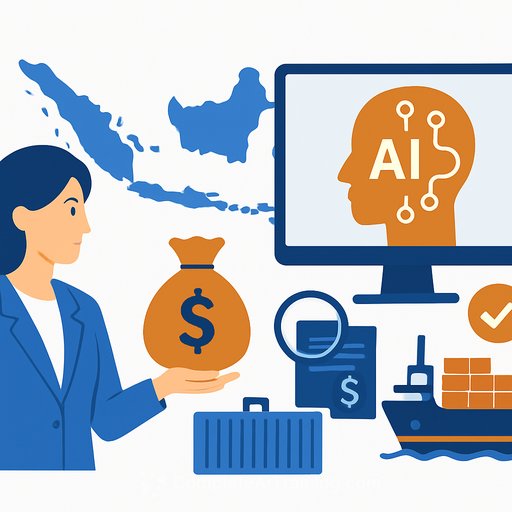
Indonesia's Ministry of Finance is putting 45 billion rupiah (about US$2.7 million) into Trade AI, an AI system for the Directorate General of Customs and Excise. The goal: faster import analysis, better detection of under/over-invoicing, and stronger money-laundering screening tied to trade. Trade AI will plug into CEISA 4.0 to speed decisions and sharpen oversight across import declarations.
Minister of Finance Purbaya Yudhi Sadewa noted the team is building on current resources, with fresh funding earmarked for upgrades. Automations target customs value analysis, product classification, and document verification-areas where errors and manipulation cut straight into state revenue.
Why finance leaders should care
Misinvoicing has been costly. In 2016 alone, Indonesia's potential tax loss was estimated at US$6.5 billion-around 6% of government revenue. Misinvoiced goods hit US$38.5 billion, or 13.7% of total trade, with high-risk goods including essential oils (from Singapore), plastics (from China), and vehicles (from Japan and China). A separate civil society report flagged profit shifting in wood pulp from 2007-2018 with losses above US$150 million.
Put the budget in context: US$2.7 million is roughly 0.04% of that 2016 loss. If Trade AI helps recover even a sliver-say 0.5%-you're looking at ~US$32.5 million in potential upside. That math alone signals more scrutiny is coming for import pricing, HS codes, and supporting documents.
What changes for finance teams
- Higher scrutiny on declared values and HS codes, especially for historically high-risk items.
- Faster decision cycles via CEISA 4.0 integration-less time to fix errors before a shipment gets flagged.
- Pressure to adopt pre-clearance compliance tools that self-check values, documents, and classifications before filing.
- Tighter alignment needed between finance, tax, logistics, and your customs broker to avoid delays and penalties.
Action checklist for CFOs, controllers, and heads of trade finance
- Run a self-audit on customs value methodology (transaction value, adjustments, related-party pricing, transfer pricing links).
- Validate HS codes for top SKUs; document rationale and precedents. Keep a quick-reference file ready.
- Map invoice, packing list, purchase order, and incoterms data end-to-end; remove inconsistencies that trigger red flags.
- Pre-clearance tools: pilot internal checks before broker submission to cut amendments and holds.
- Broker governance: define SLAs for rework, escalation, and evidence retention. Spot-check declarations monthly.
- High-risk items: apply enhanced review to essential oils, plastics, and vehicles if they're in your portfolio.
- AML alignment: link trade finance, sanctions screening, and unusual pricing patterns into one review path.
- Scenario planning: quantify the cash impact of 24-72 hour holds; build buffers in working capital forecasts.
For vendors and data firms
There's a clear market for pre-submission self-audit tools and valuation/HS validation services. Learn CEISA 4.0 APIs and integration pathways to embed into importer workflows and broker systems. Use early high-risk categories for product-market fit, then expand coverage.
Risk screening frameworks already exist. For context, see Global Financial Integrity's GFTrade approach to customs risk screening here.
What to watch next
- CEISA 4.0 integration milestones and any new data fields required in submissions.
- Published risk indicators (values, origins, HS ranges) that hint at the model's focus areas.
- Enforcement patterns: targeted audits, penalties, and how quickly holds are resolved.
- Expansion beyond initial high-risk goods to broader product sets.
Bottom line
Trade AI won't replace fundamentals-it will enforce them faster. If your import valuations, HS codes, and documents are tight, you reduce friction, protect cash flow, and avoid nasty surprises at the border. If they're not, now is the time to fix the plumbing.
Helpful resources
- Explore practical AI tools that support finance and compliance workflows: AI Tools for Finance
Your membership also unlocks: