Indonesia Needs Its Own AI Ecosystem - Here's How to Build It
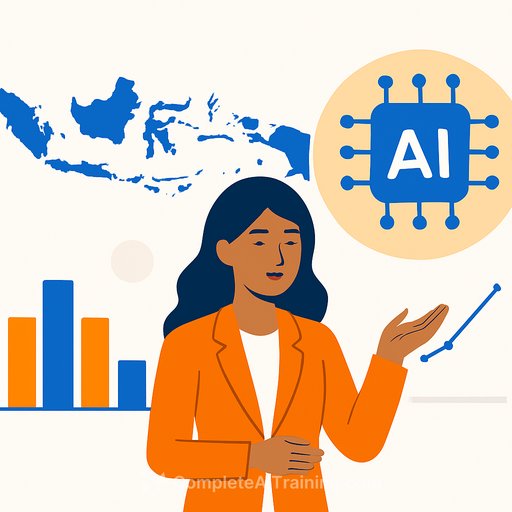
Indonesia can't afford to be just an AI consumer. That was the core message from global AI expert Anima Anandkumar during the 2025 ADIPEC event in Abu Dhabi. Her point was simple: build an independent ecosystem built around local needs - infrastructure, data, and talent - or risk falling behind in Southeast Asia.
This isn't a branding exercise. It's a technical, economic, and strategic decision. If we want long-term leverage, we need to control compute, data pipelines, and the skills to ship models and products that fit Indonesia's context.
Why Independence Matters
Relying on foreign platforms keeps costs high and control low. You inherit their priorities and constraints. You also export your data value while importing their margins.
Anandkumar's push is clear: build data centers, secure GPU supply, and train engineers to create AI that feels "native" - built with Indonesian languages, users, and regulations in mind.
The Core Stack Indonesia Should Build
- Compute: Scale local GPU clusters across universities, government, and industry. Support multi-tenant scheduling (Slurm or Kubernetes), multi-GPU training, and mixed precision. Prioritize energy efficiency and grid-aware scheduling.
- Storage and Data: Data lakes with object storage, clear lineage, and access controls. Build shared corpora for Bahasa Indonesia and regional languages. Standardize metadata and labeling practices so datasets are reusable and auditable.
- Models: Start with open models (Llama, Mistral, Mixtral, etc.), fine-tune with local data, and evaluate for Indonesian contexts. Quantize for lower-cost inference. Ship small, fast models for on-device and edge use cases.
- MLOps: Reproducible pipelines, model registries, CI/CD for ML, feature stores, offline/online parity, and observability (latency, drift, toxicity, bias).
- Safety and Compliance: Data residency, consent frameworks, audit trails, and red-teaming. Align with local privacy law and sector rules (finance, health, public sector).
Local Data Is the Advantage
The fastest way to create useful AI in Indonesia is to train and evaluate on Indonesian data: Bahasa Indonesia, Javanese, Sundanese, Balinese, and more. Build domain datasets: legal, healthcare, agriculture, logistics, public services, and MSMEs.
Make it a national effort. Universities, startups, enterprises, and ministries can co-invest in open datasets and shared benchmarks. Gotong royong applies here: shared data standards reduce duplicate work and lift quality across the board.
Open Models Lower the Barrier
Many high-performing models are openly available. That's an entry point for developing countries to adapt and improve them locally. Start with open weights, run targeted fine-tunes, and measure outcomes on Indonesian tasks before scaling.
- Use parameter-efficient methods (LoRA/QLoRA) to cut costs.
- Build RAG pipelines using local corpora and vector indices for Bahasa and regional languages.
- Publish evaluation harnesses so results are comparable and repeatable.
Explore the broader ecosystem of open models and datasets on platforms like Hugging Face.
Don't Centralize Everything in Big Cities
AI should close gaps, not widen them. Concentrating compute and programs in Jakarta alone creates a new form of digital inequality. Spread GPU clusters and training programs across major islands and second-tier cities.
Local universities and polytechnics can run community clusters for research and SMEs. Small grants, shared labs, and remote access programs can help distribute opportunity.
6-12 Month Action Plan for Practitioners
- Set up the infra baseline: Kubernetes or Slurm cluster, secure storage, secrets management, monitoring, and cost tracking. Target reproducibility from day one.
- Ship a bilingual RAG service: Bahasa + English. Use a small embedding model, a vector DB (FAISS/Milvus), and domain documents. Aim for latency under 500 ms.
- Fine-tune one foundation model: Choose a 7B-13B model, run QLoRA on local domain data, and compare against a strong baseline. Track hallucinations and bias.
- Build evaluation suites: Task-driven benchmarks for Indonesian use cases: tax, logistics routing, agriculture advisories, eKYC, compliance checks. Automate regression testing.
- Data governance MVP: Define consent, retention, and access policies. Log provenance for each dataset. Run a lightweight privacy review on every new data source.
- Security pass: Secrets rotation, network segmentation, model input/output filters, and abuse prevention. Red-team prompts in Bahasa and local slang.
- Talent pipeline: Upskill internal teams on prompt design, data labeling standards, fine-tuning, and evaluation. Partner with universities and bootcamps.
Education and Upskilling: Make It Continuous
Indonesia needs thousands of engineers who can move from prototype to production: data engineers, ML engineers, MLOps, inference engineers, and evaluators. Short courses and modular training work best - fast to ship, immediately useful on the job.
To speed this up, browse role-based learning paths and hands-on programs here: AI courses by job.
Policy Signals That Matter
- Data residency and privacy: Keep sensitive data local. Enforce consent and clear usage boundaries.
- Open data with guardrails: Create national datasets that are accessible for research and startups, with strict privacy protections.
- Compute access: Grants or credits for universities and SMEs to access national GPU clusters.
- Standards and audits: Require transparent evaluation and incident reporting for AI systems used in public services.
What "Inclusive AI" Looks Like in Practice
- Interfaces in Bahasa and key regional languages.
- Mobile-first experiences that work offline or with weak connections.
- On-device or edge inference for privacy and cost control.
- Community review boards for local-context alignment and safety.
Bottom Line
Anandkumar's message is a wake-up call: invest in infrastructure, local data, and talent so Indonesia sets its own direction. The opportunity is real because open models and tools lower the barriers - but the advantage goes to those who execute.
Build the stack, share the datasets, train the people, and ship products that serve Indonesian needs first. Do that, and Indonesia won't just join the AI conversation - it will help lead it across Southeast Asia.
Your membership also unlocks: