Could light-based computers cut AI's energy bill?
AI's gains come with a steep energy tab. Some analyses project data centers could draw over 13% of global electricity by 2028, largely from running and cooling AI hardware. A Penn State team reports a compact optical module that processes data with light instead of electronic circuits, published in Science Advances, and it points to meaningful drops in energy use and latency for core AI workloads. For broader context on related developments, see Research.
The idea is simple enough: route information through lenses, mirrors and other passive optics so the light itself performs the computation. No dense transistor grids. Minimal heat. Results are captured with a microscopic camera as a final, simplified output.
What's new here
Most prior optical accelerators handled only linear math, then shipped the "decision" part of the model back to electronics or used specialized materials with high optical intensity. That round trip kills efficiency and adds complexity.
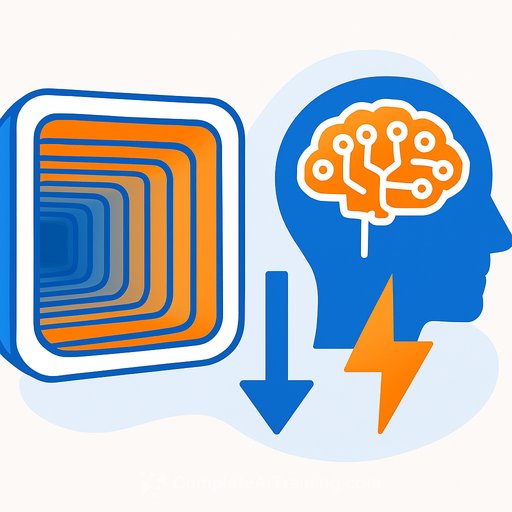
The Penn State approach builds the needed nonlinearity inside a compact, multi-pass loop - think an "infinity mirror" for data. Light reflects repeatedly through off-the-shelf components (similar to what's in LCDs and LEDs), gradually shaping a nonlinear mapping between input and output without exotic materials or high-intensity lasers.
How it works (at a glance)
- Input data is encoded into light and injected into a tiny optical loop.
- Each pass through lenses and modulators refines the light pattern, effectively "learning" a nonlinear transform.
- A microscopic camera captures the final pattern, which corresponds to the computation's output.
Because photons don't typically interact, many signals can move through the system simultaneously. Transformations occur at light speed, with much of the work happening in minimally powered or passive elements.
Why this matters for AI teams
Electricity and cooling are now the gating factors for scaling AI - often more than chip availability. If the heaviest math can be offloaded to a small optical module, facilities can deliver the same throughput with lower energy budgets and less thermal overhead.
Edge devices also benefit. Smaller, cooler hardware means more on-device inference for cameras, sensors, vehicles, robots and medical tools. That cuts latency, keeps sensitive data local and reduces dependence on constant connectivity.
What's next from the researchers
The current setup is a proof of concept. The team is working toward:
- A programmable, robust module with tunable behavior for different tasks.
- A compact form factor that plugs into standard computing platforms with minimal electronic overhead.
- Scaling to larger, more realistic workloads.
The vision isn't to replace electronics. Conventional chips would still handle control, memory and general-purpose logic. The optical unit would take on specific, math-heavy kernels that dominate AI's energy use.
Practical notes for R&D leaders
- Benchmark the right metrics: joules per inference, end-to-end latency (including I/O), and accuracy versus GPU baselines.
- Integration path: define how outputs feed into existing model graphs (e.g., PyTorch/TensorFlow ops) and what calibration is needed over time.
- Reliability: characterize noise, drift, and temperature sensitivity; establish auto-calibration cycles.
- Workload fit: target model segments with high linear algebra density and simple dataflow, then layer the optical nonlinearity where it yields the most gain.
Citation and funding
Paper: "Nonlinear optical extreme learner via data reverberation with incoherent light," Science Advances, 11-Feb-2026. DOI: 10.1126/sciadv.aeb4237
Authors include researchers from the Penn State School of Electrical Engineering and Computer Science and Voyant Photonics. Support came from the Air Force Office of Scientific Research and the U.S. National Science Foundation.
Bottom line
Light-based computation that achieves effective nonlinearity without exotic materials is a credible path to lower energy use and shorter latency for AI. If it proves programmable, compact and stable, it could become a practical accelerator module that lets data centers and edge devices do more with less energy.
Your membership also unlocks: