A DOGE Recruiter Is Staffing a Project to Deploy AI Agents Across the US Government
A startup founder recently shared a bold plan with a group of former Palantir employees: using artificial intelligence (AI) agents to handle the work currently done by tens of thousands of federal workers. The reaction was mixed, with many skeptical responses reflecting concerns about such widespread automation in government roles.
About the Project and Its Ambitions
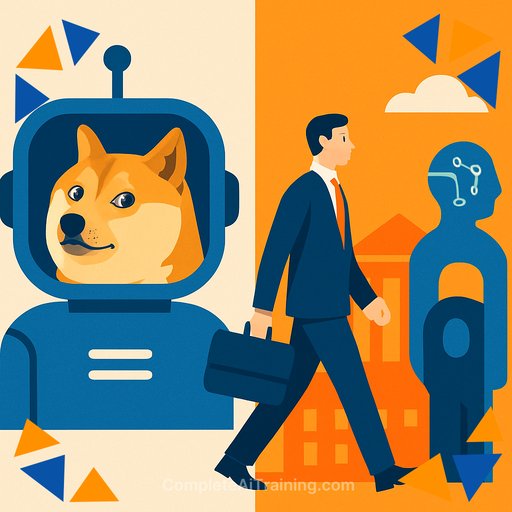
Anthony Jancso, cofounder of government tech startup AccelerateX and an early recruiter for Elon Musk’s Department of Government Efficiency (DOGE), is actively hiring technologists for a new initiative. According to a message posted in a Slack channel for around 2,000 Palantir alumni, the project involves designing benchmarks and deploying AI agents to take over live workflows in federal agencies.
Jancso claims that over 300 standardized federal roles have been identified as suitable for AI automation, potentially freeing up at least 70,000 full-time employees (FTEs) to focus on higher-impact work within a year. These AI agents are autonomous software programs designed to perform tasks without human input.
The new hires for this project would be stationed in Washington, DC, and interestingly, would not require security clearances. The exact employing agency remains unclear, and Palantir, Jancso's former employer, declined to comment on the matter.
Community and Industry Reaction
The announcement met with skepticism and even ridicule. Some Slack members responded with clown emojis and other custom reactions expressing distrust and criticism. Comments ranged from concerns about job losses to doubts about the actual effectiveness of AI agents replacing government employees.
- One comment pointed out that DOGE’s goal might not be to find “higher impact work” for federal staff but to reduce the workforce.
- Another noted the risk of AI-generated outputs being unreliable, sarcastically calling the replacements “shitty autocorrect.”
- Concerns were raised about oversight and data security, questioning if these AI systems would require external supervision or use existing credentials improperly.
Background on AccelerateX and Partnerships
AccelerateX began as AccelerateSF, initially focusing on using AI to address San Francisco’s social issues, such as simplifying permit applications to reduce housing costs. The company shifted its focus in 2024, rebranding to AccelerateX and targeting modernization of outdated government technology systems that currently hinder efficiency and inflate costs.
Sources confirm that AccelerateX signed a partnership with Palantir in 2024. The startup has also received support from OpenAI’s Converge 2 Accelerator. Some cofounders have moved on to roles at OpenAI, indicating close ties between AccelerateX and leading AI organizations.
DOGE’s Role in AI Deployment Across Government
Since its inception early in the second Trump administration, DOGE has been actively promoting AI integration in federal agencies while simultaneously pushing for significant cuts in federal employment.
- At the Department of Veterans Affairs, AI has been proposed to help write website code.
- The General Services Administration launched GSAi, an AI chatbot for agency use.
- Tools like AutoRIF have been developed to automate processes such as firing employees.
- At the Department of Housing and Urban Development, AI is being used to analyze and suggest regulatory changes.
Challenges and Expert Opinions
Experts warn that replacing the work of 70,000 federal employees with AI agents is highly ambitious and likely impractical. A federal employee familiar with government contracting explained that agency procedures vary considerably, making large-scale AI deployment complex and difficult.
Oren Etzioni, cofounder of AI startup Vercept, highlighted that while AI agents can assist with specific tasks—like online research—their outputs often lack reliability and require human validation. He emphasized that government services must remain dependable rather than act as experimental testing grounds for AI technologies.
Etzioni also pointed out that AI works best as a tool to augment human tasks, not as a direct one-for-one replacement for jobs. The claim that AI could fully replace the functions of tens of thousands of workers is doubtful without questionable assumptions.
Who Is Anthony Jancso and What Is His Role?
Jancso was among the earliest recruiters for DOGE before the second Trump administration began. He used his connections within Palantir’s alumni network to find tech talent for DOGE’s mission to build an “efficient government” and reduce the federal budget by a third.
He and other DOGE members have been active in Washington, DC, working with various federal agencies, including the Consumer Financial Protection Bureau, National Labor Relations Board, Department of Labor, and Department of Education.
Palantir’s Government Ties
Palantir, cofounded by Peter Thiel, has long-standing contracts with multiple government agencies such as the Department of Defense and Department of Homeland Security. During the second Trump administration, Palantir has been involved in creating a “mega API” to connect IRS data with other agencies and developing a surveillance platform for Immigration and Customs Enforcement.
The close relationships between Palantir, DOGE, and startups like AccelerateX illustrate a growing ecosystem aiming to introduce AI-driven efficiency—and significant workforce changes—across federal government operations.
What This Means for Federal Employees
If AI agents are deployed as planned, many routine, standardized roles across government agencies could see automation. However, the road to widespread AI adoption faces several hurdles, including procedural diversity, reliability concerns, and workforce implications.
For government employees, understanding how these AI tools might integrate into workflows is essential. Those interested in expanding their AI skills may consider exploring specialized training in AI automation and tools tailored for public sector applications.
Explore AI training resources at Complete AI Training to stay informed and prepared for potential changes in government technology and job functions.
Your membership also unlocks: