Rivian's AI Assistant: Architecture, Integration, and What Devs Should Watch Next
Rivian has spent almost two years building an in-vehicle AI assistant that sits outside its multibillion-dollar joint venture with Volkswagen. There's no public launch date yet, but leadership hinted at a year-end target. Expect more detail during the "AI and Autonomy" online event on December 11 at 9:00 AM Pacific.
This isn't a simple chat layer bolted onto the head unit. The assistant is being wired into vehicle systems with conflict resolution, safety guardrails, and orchestration logic that needs to hold up under real-world constraints.
Why this matters for engineers
Rivian is building an agentic system that has to make smart decisions across many subsystems in real time. That means tight coupling with the car's platform, predictable latency budgets, and a control strategy that avoids race conditions or unsafe states.
Architecture at a glance
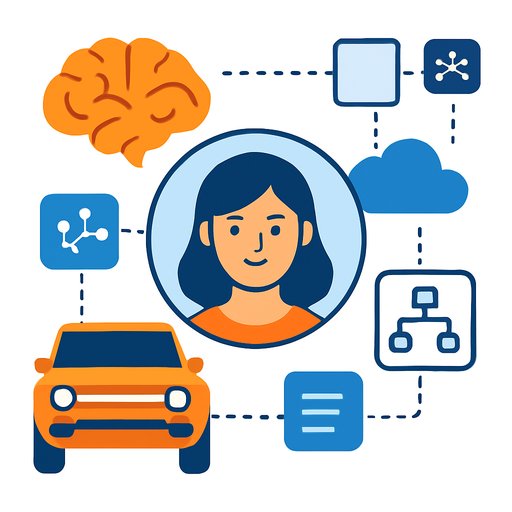
- Single, model-agnostic architecture: one platform that works across vehicle lines instead of per-model silos.
- Agent framework: task-specific agents coordinated by a supervisory layer to handle intent, routing, and arbitration.
- Orchestration layer: switches between models, manages tools, resolves conflicts, and enforces policy/safety constraints.
- Hybrid compute: on-device for low-latency/mission-critical flows; cloud for heavier workloads that need more compute capacity.
- Vertical integration: RTOS, thermal, safety and ADAS, plus the infotainment layer all developed in-house or tightly controlled.
The embedded AI team in Palo Alto prioritized this architecture early so the assistant can work with different model families and evolve without rewriting the stack. The result is a platform inside the car, not a single-purpose app.
Edge vs. cloud: how workloads may split
Expect the assistant to keep time-sensitive operations at the edge: wake words, basic NLU, controls that touch safety-critical paths, and fallback modes. Cloud calls can serve larger models, longer reasoning chains, or data-heavy queries when connectivity is available.
Key questions: how they cache, degrade gracefully offline, protect data, and schedule updates. If they share OTA cadence and telemetry boundaries, you'll have a clearer picture of operational risk.
Integration surface area
Rivian refreshed the R1T and R1S in 2024, reworking the battery system, suspension, electric architecture, sensor stack, and the UI. That groundwork matters because the assistant needs consistent hooks into these layers.
- Battery/thermal: actionable insights without degrading range or comfort.
- Sensor fusion: context for dialog and controls without leaking sensitive data.
- UI/UX: multimodal prompts, confirmations, and human-in-the-loop overrides.
- Zone-based compute: deterministic routing and isolation across vehicle domains.
Models and tooling
Rivian says it's using a mix of models for specific tasks, with an in-house orchestration layer coordinating them. Some partner components are in the loop for targeted capabilities.
The near-term goal is straightforward: increase driver trust and engagement. For now, the assistant stays inside Rivian's ecosystem.
What the Volkswagen joint venture covers-and what it doesn't
The JV announced in 2024 (up to $5.8B) focuses on base electric architecture, zone-based compute, and infotainment. It began operating in November 2024 and targets delivering software and electric architecture to Volkswagen Group by 2027.
Rivian's AI assistant and autonomy programs sit outside the JV today. There's a chance they come together later, but they currently live in different orgs and jurisdictions.
What to watch at the December 11 event
- Latency budgets: on-device vs. cloud paths, cold-start times, and offline behavior.
- Safety posture: guardrails for actuation, confirmation flows, and rollback strategies.
- Privacy/data: what's processed locally, retention policies, and opt-outs.
- Developer surface: SDKs, tool catalogs, or third-party hooks (if any).
- Ops playbook: telemetry, OTA cadence, and incident response for agent failures.
For background reporting on Rivian's AI efforts, see coverage at TechCrunch. You can also monitor official updates at Rivian.
If you're building agent-based systems or moving workloads between edge and cloud, this curated index of AI learning paths can help: AI courses by job role.
Your membership also unlocks: