Are Intel's Leadership Shifts and AI Rumors Quietly Rewriting Its Washington Strategy?
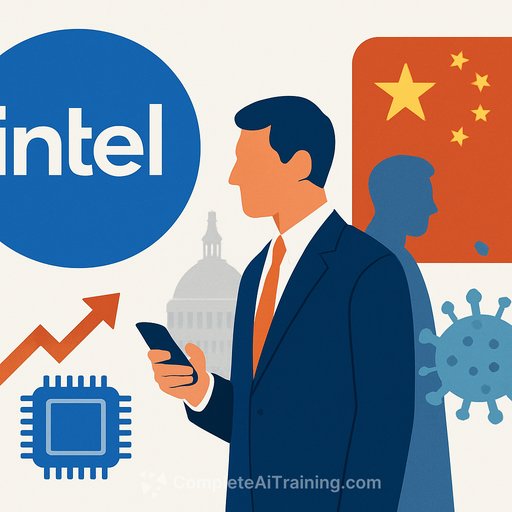
Intel has moved pieces across government affairs, marketing, and advanced technology strategy at the same time it's facing questions from U.S. lawmakers over China-linked tooling and exploring reported talks to acquire SambaNova. That's not coincidence. It looks like a coordinated push to strengthen influence in Washington while speeding up the AI platform story.
For executives, the signal is clear: AI for Executives & Strategy underscores that Intel is optimizing its DC posture and portfolio narrative in tandem. The company is trying to close perceived AI gaps while containing political and regulatory exposure.
Why the leadership shuffle matters in DC
Government affairs changes suggest Intel wants tighter feedback loops with regulators and policymakers as export controls, subsidies, and security reviews intensify. Marketing and advanced tech updates point to a cleaner AI platform message-something Wall Street has been asking for.
The practical upshot: more disciplined message management, faster issue escalation, and a clearer link between policy outcomes and product roadmaps.
SambaNova talks: what Intel is really solving
The reported discussions with SambaNova are the most strategic piece. SambaNova's full-stack AI racks could let Intel offer more complete platforms, not just components-closing a gap often cited versus rivals.
If a deal advances, expect tighter packaging around Gaudi accelerators, Xeon, networking, and software into turnkey systems for data centers. That simplifies buying decisions and could shorten proof-of-concept cycles, though it raises integration risk and capital demands.
Regulatory pressure: material or headline risk?
Scrutiny over China-linked equipment and national security oversight looks meaningful as a governance and headline issue. Right now, it doesn't appear like an immediate earnings shock, but it can slow decisions and add friction to supplier choices.
Any SambaNova transaction would likely face review, potentially through CFIUS. That introduces timeline risk and integration uncertainty that leaders should bake into planning.
The investment narrative in numbers
Intel's current narrative projects roughly $58.1 billion in revenue and $5.2 billion in earnings by 2028. That math implies a $37.27 fair value-about a 3% upside from the current price.
More bullish views see a path to about $62.1 billion in revenue and $8.7 billion in earnings by 2028. The spread highlights how much hangs on AI platform execution, foundry progress, and discipline on OpEx and CapEx.
Operator's read: what to watch next
- DC influence map: Who owns export control dialogue, subsidy applications, and congressional engagement? Expect faster cycles and tighter message control.
- M&A timing: Build scenarios with CFIUS and integration gates. Add buffers for technical validation of SambaNova stacks with Intel silicon and networking.
- Platform coherence: Track how Intel bundles accelerators, CPUs, interconnect, and software into standardized racks. Look for clear SKUs and service overlays.
- Capital intensity: Watch updates on foundry spending, utilization, and cost takeout. The AI story only lands if cash burn stays contained.
- China exposure: Supplier choices and equipment audits will keep drawing attention. Expect more documentation, attestations, and board-level oversight.
What smart peers can copy
- Run a real DC operating system: policy horizon scanning, risk scoring, and pre-wired relationships that feed right into product and supply chain decisions.
- AI for Product Development: platformize AI offers-sell outcomes via reference racks and services, not parts. Make POC-to-deploy repeatable.
- Stage-gate big bets: acquisition terms tied to technical milestones, integration sprints, and customer pilots before broad rollout.
- Message like an operator: one narrative for regulators, investors, and customers-tight, consistent, and backed with telemetry.
Bottom line
Intel's leadership moves and the SambaNova talks point to a tighter Washington strategy and a bolder AI platform push. The risk isn't invisible-policy scrutiny and integration complexity can slow momentum-but the direction is deliberate.
If Intel proves it can turn AI stacks into standardized platforms while keeping spend in check, the upside case strengthens. If not, the gap between narratives and numbers will widen.
Note: This analysis is general commentary based on public information and forecasts. It is not financial advice or a recommendation to buy or sell any security.
If you're building your own AI platform strategy and want structured upskilling by role, see curated options here: AI courses by job.
Your membership also unlocks: