
AI news ·
Investigation reveals New Zealand songs used in AI training without consent
An investigation found songs by 128,000 New Zealand musicians were scraped without consent for AI training. The discovery sparked calls for stricter copyright laws.
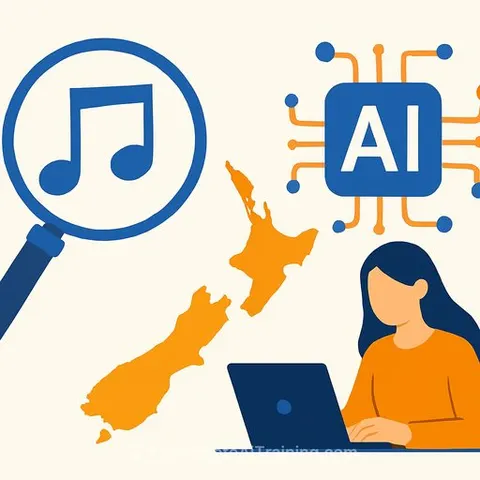
An investigation using The Atlantic's AI Watchdog tool has revealed that songs by 128,000 New Zealand musicians were taken without consent to train AI models, including tracks from an artist who discovered their own work in the dataset while on tour in Europe. The finding has intensified calls for stronger copyright protections and renewed debate over the unlicensed use of creative work by AI companies.
The dataset, called "Sleeping-Disco 9M," was uncovered by a journalist who then alerted a musician on tour. The artist had been performing across the EU and UK, opening for Aldous Harding, when an email with the subject line "Songs used in AI training" arrived. "When I opened my email… my stomach dropped," the musician said. Two of their songs, "Carpenter" and "Broadway/Junction," were among the works scraped without any license or payment.
"To think this song could be stripped of all its context, heart and used in any way to train AI, made me sick but also felt really irresponsible," the musician said. The track "Broadway/Junction" contains lyrics about a moment of crisis-"I wanted to jump at Broadway/Junction, feel the tracks against my back"-and the artist noted that themes like that, without careful human understanding, could be mishandled by machines.
What the dataset contains
Alex Reisner of The Atlantic, who built the search tool, explained why the contents of AI training sets matter. "How, exactly, AI models are trained is hugely consequential-and not only because AI companies have trained their machines on an enormous number of copyrighted works without the consent of writers, musicians, podcasters, filmmakers, and others," he said. "The works undergirding an AI's behavior may also include misinformation, conspiracy theories, and material that some people may find objectionable: racist text, pornographic media, step-by-step instructions for committing acts of violence, and so on."
The fact that the data collection was done in secret, only coming to light through the AI Watchdog tool, is intentional, the musician argued. "AI companies want weakened copyright protections and exemptions for data mining," they said. "They don't care about us. They don't care about our music, our culture, our history. Their only interest is to maximise profit."
Impact on Māori cultural heritage
The indiscriminate scraping poses a particular threat to Māori music and identity, said Dame Hinewehi Mohi, director of Māori membership at Apra Amcos. "The theft of our music strikes at the very heart of our identity and cultural heritage. Once taken, its integrity cannot truly be restored. Through the indiscriminate scraping of AI systems, our music is stripped of its context, distilled, diluted, and disconnected from its origins."
That erosion of context is what worries many artists. The musician on tour pointed out that songs like "Broadway/Junction" carry heavy personal and communal meaning-lyrics that sparked conversations and emotional exchanges with fans at the merch table. A machine cannot comprehend that weight, they said.
A call to strengthen copyright law
Despite the anger, the musician struck a hopeful note about the community of listeners, technicians, and fellow artists who sustain the industry. But that hope depends on action. "I reject a future where musicians and artists don't have claim or control over their own works," they said. "We HAVE to strengthen our copyright laws and protect our creatives. If we don't draw a line in the sand now, then when? I'm exhausted, I'm pissed off and I'm ready to fight."
The push is not just about individual songs but about the principle that creators should always hold the right to say who can use their work. The musician stressed that the issue affects the next generation of artists in Aotearoa, who deserve to own and be compensated for what they make.
Why this matters for creatives
For musicians, songwriters, and other creative professionals, the incident is a clear signal that existing copyright frameworks have not kept pace with AI development. Understanding how models are trained and where your work might end up is no longer optional. Structured learning resources, such as the AI Learning Path for Vocal Artists & Songwriters, can help artists build the knowledge needed to navigate these changes and advocate for their rights. The immediate step is to stay informed, support organisations pushing for legal reform, and refuse to accept a future where creative control is surrendered by default.