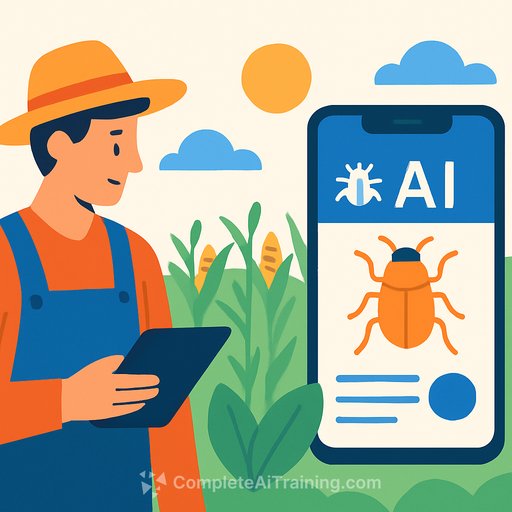
Iowa State Develops AI Tool to Identify Pests in Real Time
Farmers can now photograph an unknown insect or weed in the field and receive identification and management advice within seconds. Iowa State University researchers have built PestIDBot, an AI system trained on 31 million images that identifies pests and answers follow-up questions about treatment timing and control methods.
The tool combines two specialized applications: Insect ID, trained on 16 million images to recognize roughly 4,000 species, and Weed ID, trained on 15 million images to identify 1,600 weed species. The system can detect pests at early stages, including egg masses.
Localized Information Cuts Search Time
A farmer in Iowa searching online for pest information might find advice relevant only to southern states. PestIDBot narrows results to regional threats and incorporates management practices verified by University Extension scientists.
Arti Singh, who leads the research team, said the tool provides "information tailored to the user's specific location" rather than generic web results.
Conversational AI Replaces Expert Phone Calls
Once the app identifies a pest, farmers can ask contextual questions directly. They can inquire about spray timing, whether treatment is necessary, or specific management steps based on what they observe.
If the system identifies spotted lanternfly eggs, for example, it doesn't just provide species details. It advises the farmer to contact the Iowa Department of Agriculture and Land Stewardship.
Soumik Sarkar, the co-lead researcher, said: "Rather than searching for a human expert while the clock is ticking, you can ask your first questions directly to the app."
Built-In Safeguards Prevent False Identifications
Early versions of pest-identification AI struggled with difficult visual scenarios: insects on green leaves or pests on brown bark and soil. The team implemented guardrails to prevent the system from confidently providing wrong answers.
When the AI encounters something outside its training data-like a human face-it says "I don't know" rather than guessing. When uncertain about a pest, it offers several likely options instead of a single identification, allowing farmers to narrow possibilities before consulting an expert.
Global Disease Database Aims to Prevent Future Outbreaks
The team's next project, funded by the National Science Foundation, tackles crop diseases caused by bacteria, viruses, and fungi. These diseases are harder to identify because quality expert-verified images are scarce.
Researchers are partnering with colleagues in Australia, Japan, and India to build a global disease dataset. Sarkar said threats emerging in Africa or Asia "will eventually show up on our shores," so training models on global data now prepares U.S. farmers for future threats before they arrive.
Precision Spraying Reduces Chemical Use
By identifying exactly which part of a field needs treatment, farmers can avoid blanket chemical spraying across entire acres. This approach cuts input costs and protects water systems.
Singh and Sarkar are also using the technology to engage young people in agriculture through workshops and gamified modules for K-12 and 4-H youth. They see teaching kids to identify invasive species as a first step toward building a generation of agricultural innovators.
Learn more about how AI for Management can improve decision-making in your organization, or explore AI Data Analysis techniques that extract insights from large datasets.
Your membership also unlocks: