Iran to launch 15 AI labs: what IT and dev teams should expect
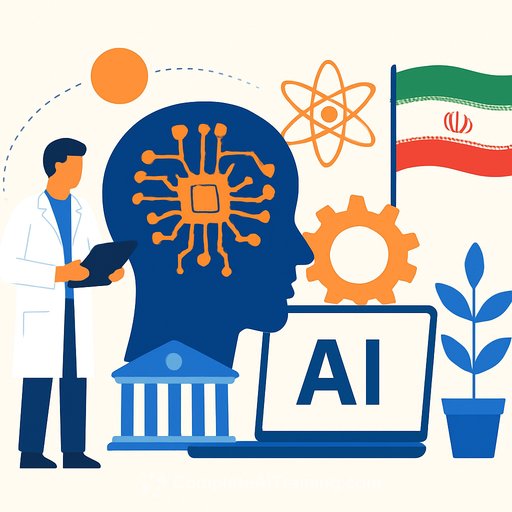
The Ministry of Science, Research, and Technology plans to set up 15 AI laboratories across universities to build and test fundamental AI models. A central headquarters for AI technology development is already in place to coordinate standards, compute access, and research priorities.
Reference labs will be assigned to top universities based on output: publications, products, and the depth of their faculty and student base. This creates a tiered network-general labs for experimentation and reference labs for benchmarking and model validation.
Talent pipeline and curricula
A specialized working group will design new AI courses with an interdisciplinary focus. Expect AI and digital transformation to become mandatory for engineering undergrads and supplementary for other majors, with new AI-focused tracks at the postgraduate level. For research-oriented course examples and curricula, see AI Research Courses.
For teams hiring in-country, this means a steadier flow of graduates who can move from research to production without a long ramp-up.
Funding, data governance, and compliance
The plan includes an AI development fund and a push to address privacy, security, data governance, and regulatory compliance. A secure national platform for collecting and sharing research and educational datasets is also on the way-key for reproducibility and safer model training.
Translated: more resources, but higher expectations around audits, lineage, and documented risk controls for models you train or deploy.
Momentum by the numbers
- Nature Index: national ranking in AI-related scientific output improved from 33 to 30. See the Nature Index for methodology and subject coverage.
- Oxford Insights Government AI Readiness: 91st of 188 countries (up from 94). Strongest pillar is Data & Infrastructure with a score of 66.29 (up from 55.88), including infrastructure (70), data availability (43), and data representativeness (121). Full report: Government AI Readiness Index 2024.
- Near-term priorities include a national AI platform and an AI assistant initiative.
The national AI action plan: pillars that affect builders
The AI action plan-finalized with support from the Vice Presidency for Science, Technology, and Knowledge-Based Economy and unveiled in a meeting attended by First Vice-President Mohammad-Reza Aref-centers on five pillars. Here's what each means in practice for engineering leads, researchers, and founders.
1) Education and human capital
- Interdisciplinary AI curricula rolled out across undergrad and graduate programs.
- Expectation: graduates who can work across data, product, and compliance-not just model training.
2) Research and innovation capacity
- Five national laboratories in selected universities, complementing the 15 new AI labs.
- Shared compute, standardized evaluation suites, and stronger research-to-production pathways.
3) Promoting and commercializing AI
- Select universities designated as national AI R&D hubs.
- Support for at least three fundamental AI models (language and vision) trained on domestic data.
- Secure data-sharing platform to reduce duplicated effort and improve dataset quality.
4) Science diplomacy and international cooperation
- Faster pathways for AI startup formation and national competitions.
- Academic ties with top universities in Shanghai, BRICS members, and OIC countries.
- Work on AI regulations, standards, and engagement with Iranian experts abroad.
5) Improving scientific standing
- Maintain or improve international AI rankings; index at least eight Q1-Q2 journals.
- Increased backing for top researchers, patents, scientific associations, and national AI networks.
What this means for IT leaders and dev teams
- Plan for partnership: watch for calls from reference labs and R&D hubs; co-develop benchmarks, contribute eval datasets, and align on MLOps standards.
- Data readiness now: set up data contracts, PII redaction, consent tracking, and retention policies to meet emerging compliance requirements.
- Compute strategy: map workloads to expected lab resources; prioritize mixed-precision training, efficient fine-tuning, and inference cost controls.
- Model quality: invest in evals for local languages/domains; build red-teaming and bias audits into your CI/CD.
- Talent pipeline: collaborate on capstone projects and internships; recruit from programs that teach deployment, monitoring, and incident response.
- Community: join upcoming competitions; publish reproducible baselines to get early access to shared datasets and lab compute.
Near-term actions
- Prepare a one-pager on your org's AI use cases, data assets, and compliance posture-use it to pitch lab partnerships.
- Spin up a lightweight model governance checklist: data lineage, eval metrics, risk log, rollback plan.
- Shortlist domestic datasets you can share under safe licenses; document schema, provenance, and known limitations.
- Skill up your team on LLM fine-tuning, retrieval, monitoring, and secure data handling. If you need structure, browse our latest AI courses or pick by role via courses by job.
Bottom line
The state is backing more labs, more data, and clearer guardrails. If you build software, this is a nudge to raise your bar on evals, governance, and collaboration-so your models ship faster and age well in production.
Your membership also unlocks: