Israel launches 13 AI projects across government ministries
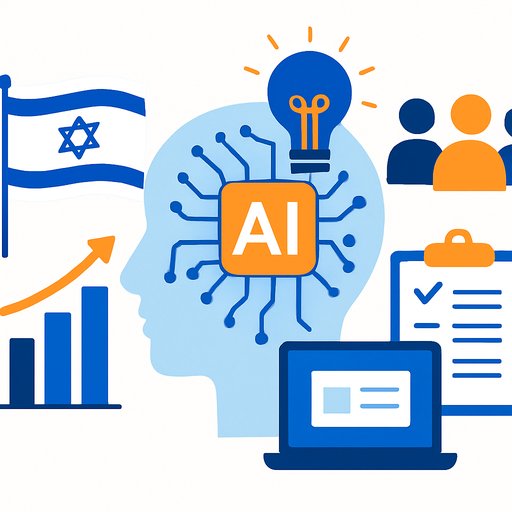
On Monday, the National Digital Directorate and the Ministry of Innovation, Science and Technology announced 13 new government projects selected in the second call to integrate artificial intelligence across ministries and trust units.
The program carries an investment of about NIS 40 million, led by the Ministry of Innovation, Science and Technology and the National Digital System. The goal is straightforward: improve services to citizens, streamline day-to-day operations, and move public service delivery into an AI-enabled model with clear guardrails.
What this means for government leaders
- Faster service delivery: think proactive eligibility checks, quicker case triage, smarter routing, and shorter queues.
- Operational efficiency: automate summaries, translation, classification, and form processing so staff can focus on complex cases.
- Quality and oversight: AI augments decisions, while humans review edge cases and maintain accountability.
- Data readiness becomes a priority: clean records, clear ownership, and privacy protections move from "nice to have" to "required."
- Skills shift: frontline teams, analysts, and policy staff will need practical AI training and new SOPs; consider the AI Learning Path for Production Coordinators for hands-on roles and the AI Learning Path for Business Unit Managers for leadership and governance readiness.
Support included in the program
- Professional guidance from AI experts in the public sector and academia.
- Dedicated training for ministry teams to safely deploy and operate AI solutions.
- Regulatory guidance to ensure responsible use, including privacy, ethics, and transparency expectations.
How to prepare your ministry or unit
- Start with high-friction services: long backlogs, repetitive reviews, or routine citizen requests.
- Map your data: sources, quality gaps, access controls, retention rules, and consent requirements.
- Define human oversight: who reviews AI outputs, when to escalate, and how to log decisions.
- Set measurable outcomes: processing time, accuracy, cost per case, and satisfaction scores.
- Pilot small, then scale: limited scope, clear risk checks, and tight feedback loops.
- Align procurement and security early: vendor standards, model evaluation, and incident response.
- Be transparent with the public: explain where AI is used, how it's supervised, and how to appeal decisions.
Budget and next steps
The initiative totals approximately NIS 40 million across the selected projects. Expect staged rollouts as teams complete training, implement controls, and validate results in production.
For official updates, follow the Ministry of Innovation, Science and Technology. If you're planning team upskilling, see practical options by role here: AI courses by job.
Governance reminders
- Use clear risk tiers: lower-risk automations can move faster; high-impact decisions need stricter review.
- Document everything: data sources, model choices, test results, known limits, and change logs.
- Test for fairness and accessibility: evaluate across demographics and ensure inclusive service design.
- Maintain strong incident playbooks: rollback plans, citizen communication, and rapid fixes.
AI is becoming part of core government operations. The ministries that win will keep it simple: pick problems that matter, measure what changes, and keep humans in control.
Your membership also unlocks: