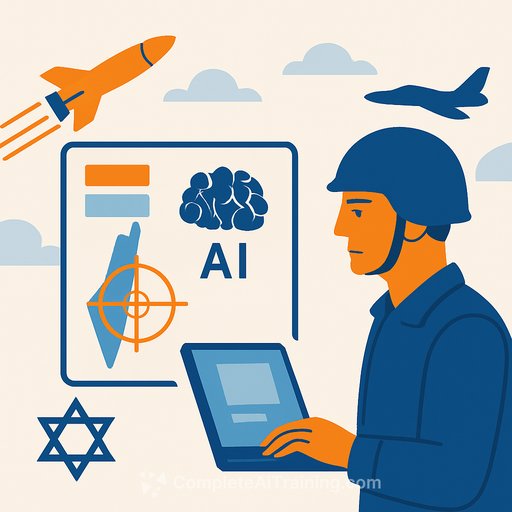
Israel refines air raid alerts with AI to reduce shelter time
Israel has deployed artificial intelligence to make its missile warning system more precise, allowing residents to spend less time in shelters during repeated attacks. The shift from city-wide sirens to localized alerts marks a significant change in how the country manages life under constant threat of missile fire.
During the 2025 war with Iran, every air raid siren applied to entire cities. Now the system identifies which neighborhoods face actual danger, triggering alerts only for those areas. Sarah Chemla, a Tel Aviv resident, said her children no longer wake for every siren. "If a projectile is heading for the south of the city, I only get a pre-alert and no longer have to wake my children," she said.
From 25 zones to 1,700
The expansion reflects how Israeli civil defence has restructured alert coverage. Nearly 20 years ago, during the 2006 war with Hezbollah, the country divided into 25 alert zones. Today there are 1,700, according to a Home Front Command official.
This fragmentation prevents millions of people from sheltering unnecessarily during frequent alerts. Major cities now split into sub-zones to match the precision of incoming threats.
AI processes millions of data points
Since October 7, 2023, more than 60,000 missiles, rockets, drones and aerial threats have been fired at Israel, according to former air defence commander Ran Kochav. Each launch receives full analysis-trajectory, timing, weather, launch angle, radar signature-and that data is processed with AI.
The system performs what experts call data fusion: gathering millions of data points at speeds beyond human capacity. "AI provides strategic planning and forecasting tools at levels the human brain cannot reach, thereby supporting decision-makers," said Yehoshua Kalisky, a researcher at Tel Aviv's Institute for National Security Studies.
Israel's defence firm Elbit Systems deploys its "SkyEye" system to analyze launches. The platform continuously monitors vast areas and maintains multiple regions of interest under constant surveillance with high spatial resolution.
Multiple channels reach the public
The Home Front Command reaches residents through street sirens, a dedicated website, media outlets, and a silent radio frequency for observant Jews who avoid phones during the Sabbath. But smartphones have become the primary tool.
An app downloaded on more than four million phones in a country of 10 million delivers real-time geo-located alerts, the time needed to reach shelter, and all-clear messages. In June 2025, the military added cell broadcast technology, enabling alerts to reach all switched-on phones within range of relay antennas.
Chemla described the improvements as "life-saving." The refined system has made daily life under missile threat more manageable, even as the underlying stress remains.
Learn more about AI for Government and AI Data Analysis applications in critical infrastructure.
Your membership also unlocks: