What Is Jamie Dimon's AI Strategy for JPMorgan Chase?
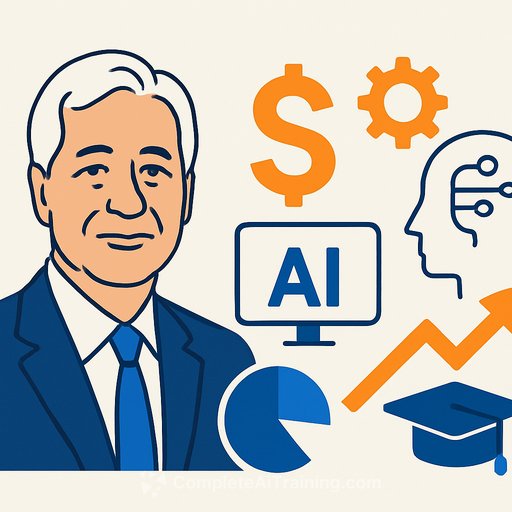
Jamie Dimon is sending a clear message to leaders: prepare for workforce disruption, invest in technology, and move fast. As he told investors, "I'm not predicting [it] can be a problem. I'm simply saying now's the time to start thinking about what you do if it does."
The stance is pragmatic-face the challenge head-on, don't bury your head in the sand. Build capability now so you're not reacting later.
Lead Through Technology, Not Theory
JPMorgan Chase is putting real money behind AI-reportedly US$2bn annually. More than 60% of its workforce uses in-house AI tools across 450+ use cases, from streamlining performance reviews and drafting content to research-heavy analysis.
The bank built its own LLM suite to summarize long, complex documents (like SEC filings) and generate reports. For investment research, it developed a multi-agent system called "Ask David" (data, analytics, visualization, insights, decision-making) to automate multi-step research tasks.
Redeploy People, Don't Discard Them
Dimon's philosophy is blunt: support employees through the shift. JPMorgan has "huge redeployment plans" and openly acknowledges AI has displaced some roles-then proactively offers other jobs to affected employees.
The company's "AI Made Easy" program trains staff on core AI concepts, prompt writing, compliance rules, and department-specific use cases. As Chief Analytics Officer Derek Waldron put it, training is segmented: first, get the broad employee base comfortable using AI daily; then go deeper by function.
Why This Matters for Executives
Public and private sectors are moving. The UK Government has launched foundational AI training with an ambition to equip 10 million workers-clear signal that baseline AI literacy is becoming standard. See the program details on GOV.UK.
JPMorgan's approach is a workable blueprint: invest, deploy, measure impact, and pair automation with redeployment. It's defensive and offensive at the same time.
A Practical Playbook You Can Borrow
- Set intent: Define the 2-3 outcomes AI must deliver this year (e.g., cost per seat reduction, faster research cycles, better risk controls).
- Map work, not jobs: Break roles into tasks, rank them by automation potential and risk, and target quick wins first.
- Fund an internal AI stack: Secure data, in-house models where needed, safe prompts, and audit trails by default.
- Make a redeployment pledge: Publish internal pathways for displaced roles before announcing automations.
- Stand up tiered training: Company-wide basics, function-specific tracks, and expert paths for builders and risk owners.
- Create a control tower: A cross-functional AI office to approve use cases, manage vendors, and track ROI and risk.
- Ship small, ship often: Move from pilots to production quickly; retire low-value experiments on a schedule.
- Communicate like a product launch: Clear FAQs, manager toolkits, and visible wins to build trust.
What to Measure
- Adoption rate by team and tool
- Cycle time and cost reductions per use case
- Error rates and compliance incidents
- Reskilling completion and time to productivity
- Redeployment rate and retention of displaced employees
- Share of work augmented vs. fully automated
Risk, Compliance, and Trust
Dimon's model bakes in controls: training includes compliance rules, the LLM suite sits close to sensitive data, and multi-step automations have oversight. That balance-speed with guardrails-is what most enterprises miss.
If you move fast without controls, you court risk. If you over-engineer controls, you stall adoption. The win is disciplined speed.
Executive Takeaway
AI strategy isn't a memo-it's capital allocation, operating rhythm, and people decisions. JPMorgan shows that you can automate aggressively and still back your workforce through redeployment and skills.
Start with clear outcomes, fund the stack, train by segment, and measure what matters. Then compound the gains quarter by quarter.
Further Reading and Resources
Your membership also unlocks: