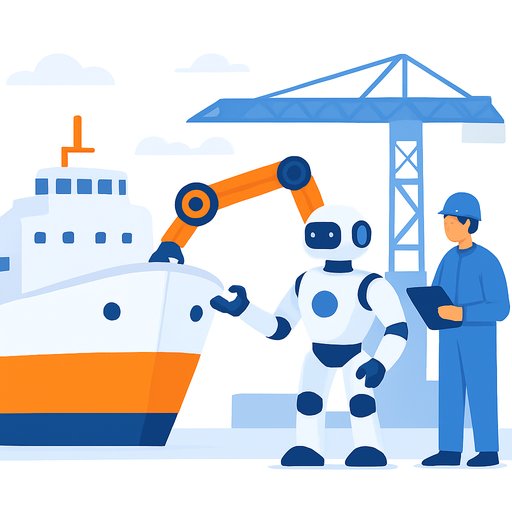
Japan backs AI robots to keep shipbuilding on schedule
Japan is moving to fund AI-powered robots for domestic shipyards to ease a growing labor shortage. A government plan is due this month, public bidding could open as early as February, and the target is operational systems within about a year.
The National Maritime Research Institute will channel funding across five workstreams: bending, welding, painting, cleaning/logistics, and inspections. The approach centers on model training where robots learn procedures and nuance directly from veteran technicians.
Scope of automation (and why it's hard)
- Bending: High-precision forming of thick plate with varying springback; benefits from force/torque sensing, vision, and learning from expert demonstrations.
- Welding: Long seams, constrained spaces, and heat distortion; needs seam tracking, adaptive control, and defect detection.
- Painting: Large surfaces with complex curvature; requires path planning, overspray control, and environmental monitoring.
- Cleaning/logistics: Material movement, surface prep, consumables; ideal for mobile robots and task orchestration.
- Inspections: Visual and NDT checks across vast hull sections; combines vision, acoustic/ultrasonic sensing, and anomaly detection.
What this means for IT and development teams
- Learning from experts at scale: Expect behavior cloning and teleoperation-driven data collection to capture skilled workflows. Plan storage for high-fidelity video, force/torque, and time-synced metadata.
- Edge-first AI: On-robot inference will be standard to handle poor connectivity in yards. Architect for model updates over flaky networks and offline-first telemetry buffers.
- Safety by design: Integrate risk assessment and standards compliance from day one (e.g., ISO 10218/13849 principles). Sandbox hazardous motions and implement conservative fallbacks.
- Domain variability: Steel grade, thickness, temperature, and jig tolerances shift constantly. Your models need strong data augmentation and fast fine-tuning loops per yard and task.
- Systems integration: Connect robots with PLM/MES, work orders, and QA pipelines. Use digital IDs for parts, revision control for procedures, and clear traceability for audits.
MVP architecture that can ship in 12 months
- Data capture flywheel: Short expert sessions recorded via teleop/teach pendant + tool-mounted cameras and force sensors. Auto-segment and label via weak supervision to speed iteration.
- Simulation where it counts: Validate motions and collision risks in a digital twin, then reality-check on physical rigs. Use sim to create rare edge cases and stress-test policies.
- Perception + policy split: Separate detection/segmentation (seam, edge, defect) from control policies. Swap perception models per environment without retraining control.
- Guardrails: Geofencing, speed/force limits, and supervised autonomy. Operators approve tasks and take over on exceptions through a simple HMI; invest in HMI and guardrail design (see AI Design Courses).
- MLOps for robotics: Version datasets, models, and motion libraries; run staged rollouts; capture continuous feedback from operators to reduce drift. For dataset, simulation, and pipeline best practices, see AI Research Courses.
Where to start (practical steps)
- Pick one narrow task per cell: Example: a repeatable bend on a common plate spec, or a specific weld seam type.
- Capture 20-50 high-quality demos: Prioritize clean sensor sync, clear labeling, and outcome metrics (tolerance, rework rate, cycle time).
- Close the loop with QA: Tie model versions to inspection results to measure real impact on defects and rework.
- Train operators as co-pilots: Build UI for approve/adjust/resume. Their feedback is your fastest dataset growth lever.
Timeline and opportunity
The government's detailed plan is expected in January with bidding potentially in February. With a one-year runway to "operational," vendors that already have data pipelines, safety cases, and edge deployment playbooks will have an advantage.
Strategic context
Japan's roadmap to revive shipbuilding includes a 350 billion yen fund through 2035, with labor-saving robots flagged as an early priority. For an island economy where marine transport underpins supply security, stable ship output is critical. See the National Maritime Research Institute for context on ongoing maritime R&D efforts: National Maritime Research Institute. Broader shipping importance is outlined by the International Maritime Organization.
Skills and tooling
- Core: robot perception, motion planning, force control, behavior cloning, dataset versioning, and safety engineering.
- Nice-to-have: digital twin simulation, mobile manipulation, and vision-based defect detection.
- Upskilling: targeted AI + automation courses can speed up internal capability building. Curated options: Latest AI courses.
Bottom line: the work is concrete, the scope is clear, and the window is tight. Teams that turn expert demos into deployable policies, prove safety, and integrate with yard systems will win these bids and set the standard for AI in heavy industry.
Your membership also unlocks: