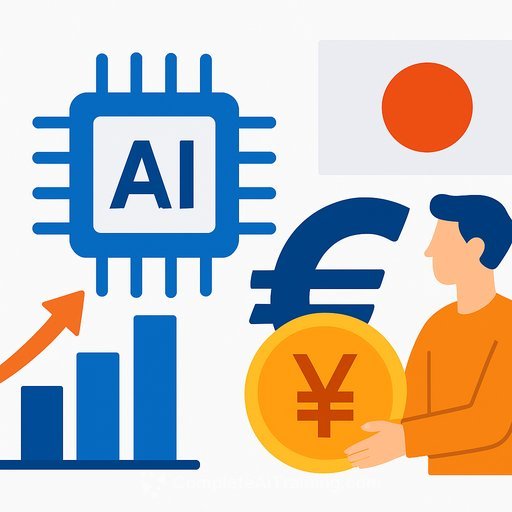
Japan Sets Up ¥3 Trillion Public-Private Push for Domestic AI, With SoftBank at the Core
Japan is moving to build its largest foundation model to date. A new company backed by more than 10 firms - with SoftBank in a central role - is planned for launch as early as next spring. The project totals ¥3 trillion, combining government support and private investment to close the gap with the U.S. and China.
The structure: who's paying for what
- The Economy, Trade and Industry Ministry (METI) plans about ¥1 trillion in support over five years starting in fiscal 2026, with over ¥300 billion earmarked in the fiscal 2026 budget.
- SoftBank plans an additional ¥2 trillion over six years for AI-focused data centers and infrastructure.
- More than 10 Japanese companies are expected to co-found the new entity; headcount will be around 100 at the start, drawing AI engineers mainly from SoftBank and Preferred Networks.
METI will subsidize part of the development and data acquisition costs. The government is also weighing the use of "GX economic transition bonds" to support energy-efficient AI operations.
METI (Ministry of Economy, Trade and Industry)
Technical targets and stack
- Model size: Targeting a foundation model with around 1 trillion parameters, on par with leading global systems.
- Compute: Large-scale procurement of high-performance semiconductors from Nvidia, and a dedicated training platform built on top.
- Energy: Focus on lower electricity consumption vs. overseas peers, pushing for efficiency at both the model and data center levels.
Two major data centers - in Tomakomai (Hokkaido) and Sakai - are under construction and slated to begin operations by fiscal 2026. Expect phased capacity ramp-ups aligned with enterprise demand.
Access and use cases for dev teams
The model will be made available to Japanese companies for integration into products and internal systems. The endgame is AI that can power robotics and on-device inference for industrial and service applications.
- Language and context: Strong Japanese support and domain-tuned variants are likely, a common pain point with imported models.
- Latency and data residency: Domestic inference endpoints can reduce latency and simplify compliance for sensitive workloads.
- APIs and tooling: Expect standard REST/gRPC endpoints, SDKs, and enterprise controls for logging, quotas, fine-tuning, and evals.
Why this matters for engineering leaders
- Supply certainty: Local compute and procurement reduce exposure to export restrictions and global GPU shortages.
- Compliance: Easier alignment with Japanese regs on privacy, critical infrastructure, and defense-adjacent use cases.
- Cost control: If energy efficiency goals land, training and inference TCO could improve over time.
- Ecosystem pull-through: New SaaS, on-prem offerings, and robotics stacks will need integrations, agents, and ops pipelines.
What to watch next
- Training schedule: When initial checkpoints are released for pilot access, and the roadmap for parameter counts and multimodality.
- Fine-tuning routes: Options for supervised fine-tuning, LoRA, and retrieval strategies with enterprise data.
- Model guardrails: Safety layers, eval metrics (toxicity, bias, hallucinations), and red-teaming programs.
- Pricing: Token pricing, on-prem licensing, and committed-use discounts for high-volume customers.
- Robotics path: Interfaces for control policies, sim-to-real workflows, and latency budgets for closed-loop tasks.
Risks and open questions
- Vendor lock-in: Heavy Nvidia reliance could limit flexibility; watch for diversification into alternative accelerators.
- Data strategy: Quality and licensing of training data will determine downstream performance and legal posture.
- Talent scale-up: 100 staff is a start; sustained hiring and partnerships will be necessary to reach the target model size and throughput.
- Governance: Clear disclosure on evals, incident handling, and model cards will be key for enterprise adoption.
Action items for teams
- Inventory workloads that benefit most from Japanese language accuracy, strict data locality, or lower latency.
- Prototype retrieval pipelines and fine-tuning workflows now, so you can swap in the domestic model with minimal refactoring.
- Plan for multi-model inference. Keep abstractions (wrappers, prompt templates, eval harnesses) portable across providers.
- Run early energy and cost benchmarks. Efficiency claims matter only if they show up in your bill and SLOs.
Bottom line: this is an infrastructure move with real implications for product teams in Japan - from compliance and latency to access to domestic compute. If your roadmap depends on reliable Japanese language performance or robotics integration, start preparing your stack.
Get targeted training and role-specific guidance: AI Learning Path for Supply Chain Managers, AI Learning Path for CIOs Chief Information Officers, and AI for Operations.
Your membership also unlocks: