
AI news ·
Japanese voice actor Kenjiro Tsuda sues TikTok operator over AI-generated imitation of his voice
Japanese voice actor Kenjiro Tsuda sued TikTok in November 2025 over 188 videos that allegedly used AI to clone his voice without consent. The Tokyo District Court case may be Japan's first involving unauthorized AI voice replication of a celebrity.
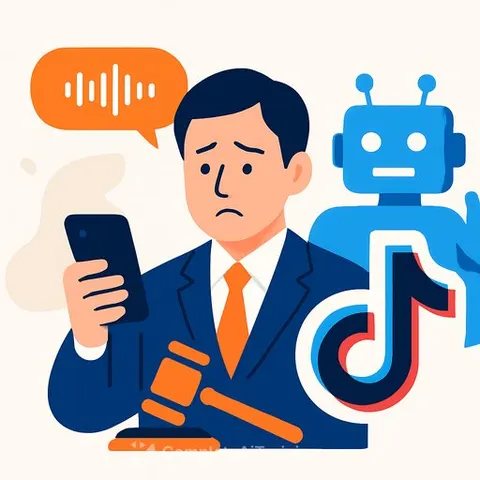
Japanese Voice Actor Sues TikTok Over AI-Generated Impersonation
Kenjiro Tsuda, a prominent Japanese voice actor, filed a lawsuit at the Tokyo District Court in November 2025 seeking removal of TikTok videos that his legal team says used generative AI to replicate his voice without permission. The complaint names at least 188 videos posted between July 2024 and November 2025.
The videos covered urban legends and trivia and were uploaded by an unidentified account. According to reporting, the uploader generated between ¥500,000 and ¥750,000 per month from the content.
Legal Claims and Defense
Tsuda's lawsuit invokes Japan's Unfair Competition Prevention Law and the "right of publicity" - a legal doctrine that protects individuals from unauthorized commercial use of their identity or likeness.
The TikTok operator has disputed the claim, arguing the narrations used a "universal male voice" rather than an AI recreation of Tsuda's distinctive low, mellow tone. The defendant said the voice model was trained on a friend's voice sourced from an external site.
Three closed-door clarification proceedings have occurred. The Tokyo District Court is expected to hold the first oral argument this summer.
What the Case Tests
This appears to be Japan's first lawsuit alleging unauthorized AI voice cloning of a celebrity. The outcome will clarify how existing intellectual property and publicity frameworks apply to synthetic media.
Key evidentiary questions include: Can acoustic similarity be proven? What disclosures did the uploader make about the AI model's origin? How much revenue was generated? And what responsibility does the platform bear for moderating AI-generated content?
The court's reasoning will likely influence enforcement practices and content-moderation policies across Japan and inform similar litigation elsewhere.
Technical Context
Generative audio models have made realistic voice synthesis widely accessible, lowering barriers to high-volume content production. Creators typically use voice samples or third-party services to train models, though detection and attribution of synthetic voices remains technically difficult at scale.
Litigation in this area tends to focus on usage patterns, distribution channels, and monetization rather than acoustic similarity alone - factors that may prove central to how the Tokyo court evaluates Tsuda's claims.
For legal professionals, this case signals emerging questions about platform liability, creator compensation, and remedies for AI-generated content. The intersection of voice synthesis technology and publicity law will likely generate follow-on cases and policy discussions.
Learn more about Text-To-Speech technology and its applications, or explore how AI for Legal professionals applies to emerging litigation.