AI Can't Replace Human Creativity: What Writers Can Take From Javed Akhtar's Message
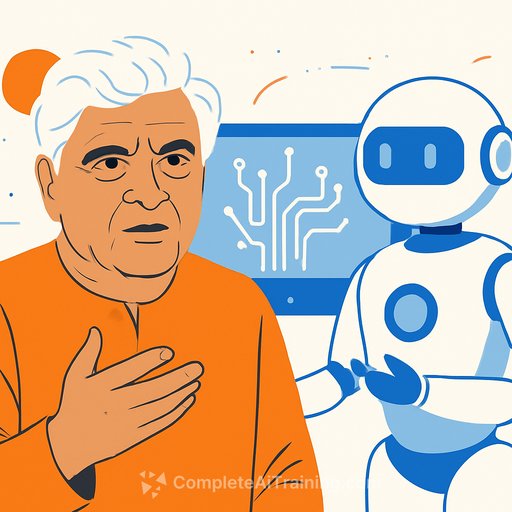
Bhubaneswar - At a literary festival, Javed Akhtar said AI can't match the innate creativity of human beings. "I cannot predict the future, but for now, AI cannot replace human creativity in any way," he noted. He added that AI has no conscience and depends on data-and on how people use it.
He compared AI to nuclear energy: technology itself isn't good or bad; intent and use decide the outcome. History shows new tools often trigger fear-the steam engine did too-before society figures out where they fit.
Akhtar highlighted current limits: "At present, it is dependent on data… today there is absolutely no threat to human creativity." For writers, that's a cue to lean into what models can't produce on command: lived experience, taste, and moral judgment.
Culture as a Creative Advantage
He described language, culture, mythology, poetry, and art as India's durable resources. He recalled how early post-Independence India struggled to make basic goods and later became an industrial nation. In that push, some treated culture like baggage to drop. His point: pick it back up-it's your strongest material.
Festival Highlights
Akhtar received the first SOA Sahitya Samman-a citation, a shawl, a silver idol of Goddess Saraswati, and ₹7 lakh. The award, instituted this year, recognises exemplary creativity, excellence, and intellectual depth.
Odisha Governor Hari Babu Kambhampati opened the festival and felicitated Akhtar, praising a five-decade contribution to Indian literature and cinema. He added that while technology keeps changing, it cannot replace the depth of human experience: empathy, ethics, and imagination still set the terms.
The programme, organised by the SOA Centre for Preservation, Propagation and Restoration of Ancient Culture and Heritage of India (PPRACHIN), brought together more than 100 poets, writers, playwrights, and media professionals. The theme-"Culture, Creativity and Artificial Intelligence"-explored how new tools are influencing creative work and literature.
What This Means for Your Writing Practice
- Use AI for research, summaries, and draft scaffolding. Keep your edits ruthless. Voice stays in your hands.
- Collect lived moments: keep a journal of scenes, smells, and conflicts. Models can remix; they can't live your life.
- Write with constraints: a specific reader, a tight premise, a fixed form. Constraints create style; generic inputs create generic outputs.
- Anchor pieces in culture, myth, and place. Specificity beats data averages.
- Fact-check names, dates, and quotes. Treat the model like an eager intern-useful, fallible.
- Audit ethics: consent for training data you rely on, disclosure when AI materially contributes, and vigilance on bias.
A Simple, Repeatable Workflow
- Outline with prompts: key ideas, counterpoints, examples, and questions worth answering.
- Draft the opening and closing without AI. Set tone and thesis yourself.
- Generate alt headlines, taglines, or ledes with AI. Pick, remix, and rewrite.
- Run a clarity pass: shorten sentences, cut filler, replace abstractions with concrete images.
- Read aloud. If it doesn't sound like you, it isn't done.
Further reading: the history of the steam engine shows how new tools settle after initial fear.
If you're assembling an AI stack for writing, here's a curated list of AI tools for copywriting.
Bottom line for writers: AI is a tool. Your stories, ethics, and taste are the moat.
Your membership also unlocks: