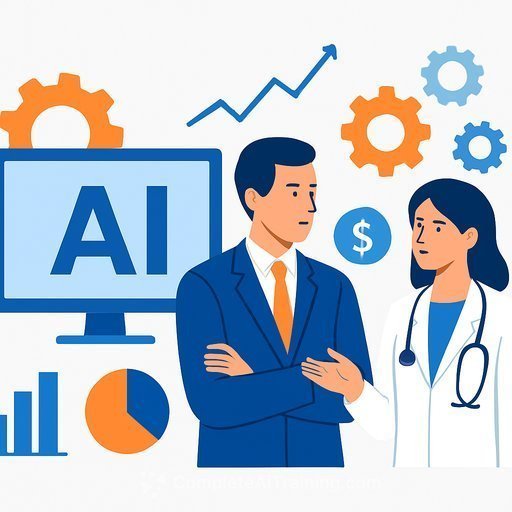
AI Will Enhance Efficiency, Not Replace Humans: Leadership Takeaways From Karan Adani
At the Platinum Jubilee Foundation Day of the All India Management Association in New Delhi, Karan Adani shared a clear stance: AI won't replace people wholesale. It will increase output per person. The transition will be messy at times, and leaders must own the responsibility to retrain their teams.
What This Means for Managers
AI is an efficiency layer. Expect smaller teams delivering more, faster. Also expect short-term job displacement before reskilling catches up. The difference between growth and churn will come down to how well you manage change.
- Define the work: Map high-volume, rules-based workflows. Prioritize areas with measurable outcomes (turnaround time, throughput, error rates).
- Pilot fast: Run 60-90 day pilots with clear baselines and target lifts (e.g., +25% productivity, -30% cycle time). Keep scope tight.
- Change management: Pair every pilot with communication, process updates, and role clarity. Don't "drop" tools into broken workflows.
- Reskill upfront: Budget for training before rollout. Tie learning to specific tasks and KPIs, not generic courses.
- Governance: Create a light process for data security, quality checks, and tool approval. Avoid bottlenecks, keep audit trails.
- Redeploy talent: Use the time saved to move people to higher-value work-customer, safety, optimization, revenue.
For playbooks and examples by function, see AI for Management.
Reskilling Is Non-Negotiable
As Karan Adani put it, large organizations carry a responsibility to retrain and upskill employees as part of structured change. Treat reskilling like a core project with owners, milestones, and budget-not an afterthought.
- Build role-based curricula: prompts, tool use, QA, exception handling.
- Measure skill adoption: certifications, time-to-proficiency, on-the-job outcomes.
- Involve HR early: workforce planning, internal mobility, and incentives.
If you're shaping the people strategy behind AI rollout, explore AI for Human Resources.
Performance Mindset: Lessons Beyond AI
Karan Adani spent three formative years in a missionary school, learning discipline, independence, and how to work across backgrounds. That foundation shows up in how he thinks about teams and execution.
He's also a Formula 1 fan-drawn to a sport where every millisecond counts, especially during Michael Schumacher's era. For operators, that mindset is useful: focus on small, compounding gains at every handoff. If you care about throughput, F1 thinking tracks with process excellence. Learn more about the sport at the official Formula 1 site.
F1 in India: Exposure With Broader Value
On the possibility of F1 returning to India, he noted that global events offer exposure-but today the benefits are limited to a few. If India hosts again, it should showcase Indian heritage and widen who benefits across the value chain.
For leaders, the principle is simple: if you host big moments (events, launches, partnerships), design them so suppliers, partners, local talent, and customers all gain-not just the front row.
Ground-Up Leadership at Mundra Port
After college, he asked to join the ports business-and was sent to Mundra the same night. The first year had no office or desk. He walked the operations, learned the pain points, and understood the work before touching strategy.
- Go see the work: Frontline time beats slide decks for finding constraints.
- Fix flow, then add tech: AI accelerates whatever exists-good or bad.
- Stay grounded: Humility and curiosity keep teams honest and engaged.
The Manager's Bottom Line
AI is a force multiplier, not a replacement plan. Your job is to set a clear target, redesign the workflow, reskill your people, and measure the lift. Start with a focused pilot, prove the value, then scale with discipline.
Your membership also unlocks: