Kazakhstan Pivots From Energy To Compute: What Government Leaders Need To Know
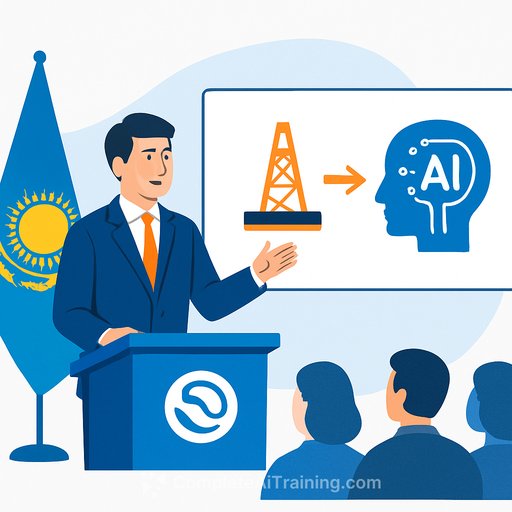
At the World Government Summit 2026, Kazakhstan laid out a clear goal: convert abundant energy resources into large-scale computing capacity and AI infrastructure. The plan centers on building high-performance data centers and "AI factories" to serve regional and global demand.
The delegation was led by Deputy Prime Minister and Minister of Artificial Intelligence and Digital Development Zhaslan Madiyev. Their message to partners was straightforward-Kazakhstan is ready to move fast with capital, sites, and policy alignment.
The Pitch: Export Energy As Clean Compute
Rather than exporting raw energy alone, Kazakhstan wants to export ready-to-use computing resources backed by low-carbon power. Talks with the UAE focused on building energy-efficient, low-emission data centers that can scale without derailing climate commitments.
This model favors long-term power contracts, advanced cooling, and proximity to renewable generation. It also calls for shared standards on carbon accounting, data residency, and service reliability across borders.
Who Kazakhstan Sat Down With
- Strategic capital and infrastructure: Discussions with Sheikh Tahnoun bin Zayed Al Nahyan, CEO of G42 Holding, on expanding data storage and processing capacity.
- Energy and sustainability: Meeting with UAE Minister of Energy Suhail Mohamed Al Mazrouei on low-carbon, energy-efficient data center builds.
- Intergovernmental ties: A memorandum of understanding with the UAE Cabinet of Ministers; coordination with UAE Minister of AI Omar Sultan Al Olama and Minister of Foreign Trade Thani bin Ahmed Al Zeyoudi.
- Regional leaders: Conversations with Estonian President Alar Karim and Advisor to the President of Uzbekistan Sardor Umurzakov.
- Tech stack and operations: NVIDIA (advanced training architectures); Aleria and Phoenix Group (scaling Kazakhstan's Data Center Valley); Masdar and Gulf Data Hub (energy-efficient data centers); Yandex, VisionLabs, and Botim (AI applications); Oracle (hybrid cloud); Mastercard (AI integration).
- Finance and venture: BlackRock and MGX (capital attraction); DIFC, Dubai Future District Fund, and Sirius Holding (venture ecosystem); Mohammed bin Rashid Space Centre (low-altitude economy and unmanned logistics).
Why This Matters For Governments
- Diversification with accountability: Turning energy into compute can grow GDP and jobs, but only if grid stability, emissions, and water use are governed from day one.
- Service sovereignty: Hosting regional compute hubs reduces exposure to distant supply chains and supports compliant AI workloads closer to constituents.
- Procurement leverage: Cross-border alliances allow shared standards on uptime, security, and carbon intensity, lowering risk for public-sector buyers.
- Regional cooperation: Bilateral agreements can lock in renewable PPAs, data-transfer frameworks, and investor protections-speeding deployment.
Government IT leaders can consult the AI Learning Path for CIOs for governance, IT strategy, and leadership considerations relevant to public-sector AI compute and data infrastructure initiatives.
Policy And Procurement Checklist
- Power and grid: Secure long-duration PPAs tied to renewables; model peak load, grid congestion, and flexibility (demand response, storage).
- Site selection and water: Favor cooler climates or efficient designs; specify water-saving cooling and heat reuse into district systems where viable.
- Carbon accounting: Require verifiable hourly (not annual) matching to clean energy; publish emissions intensity for workloads.
- Data governance: Align on residency, cross-border transfers, and auditability; require clear incident reporting and exit plans.
- Security and supply chain: Enforce vetted hardware, firmware integrity, segmentation, and third-party risk controls.
- Incentives and tariffs: Use clear, time-bound incentives linked to job creation, training, and sustainability KPIs.
- Service quality: Bake SLAs into contracts-latency, throughput, availability, and cost ceilings indexed to energy inputs.
- Workforce: Fund specialized training for facility ops, AI engineering, and compliance; partner with universities and industry. See the AI Learning Path for Training & Development Managers for curated upskilling programs and role-based curricula.
Immediate Actions For Public-Sector Teams
- Map high-priority AI workloads that need sovereign or regional compute (health, border, finance, disaster response).
- Run a total-cost-of-compute model that blends capex, O&M, energy, and carbon costs; stress-test 5-10 year scenarios.
- Pilot hybrid architectures with clear data-classification rules; keep sensitive workloads near jurisdictional control.
- Stand up an interagency task force to manage grid, water, permits, and environmental review on a single timeline.
Technology leads should review the AI Learning Path for Technology Managers to help design pilots and manage delivery of large-scale AI and data-center programs.
Risks To Manage
- Grid strain and public perception: Compute growth must not push consumer prices higher or cut reliability.
- Water and local impact: Cooling strategies should minimize freshwater draw; monitor heat and noise for nearby communities.
- Lock-in: Avoid one-vendor dependencies; require portability across clouds and on-prem.
- Geopolitical shifts: Build clauses that handle sanctions, export controls, and data-transfer changes without service disruption.
What To Watch Next
- Site announcements and PPAs tied to new data center zones and "AI factories."
- Details of the Kazakhstan-UAE MoU-especially around clean energy guarantees, incentives, and data frameworks.
- Joint ventures with G42 and energy partners like Masdar for low-carbon builds and grid integration.
- Pilots for exporting "clean compute" with standardized SLAs and carbon reporting.
The World Government Summit continues to be a proving ground for cross-border digital projects and public-private alliances. For background on the forum's agenda and participants, see the official site at World Government Summit. For energy-efficient buildout strategies referenced in these talks, review materials from Masdar.
Your membership also unlocks: