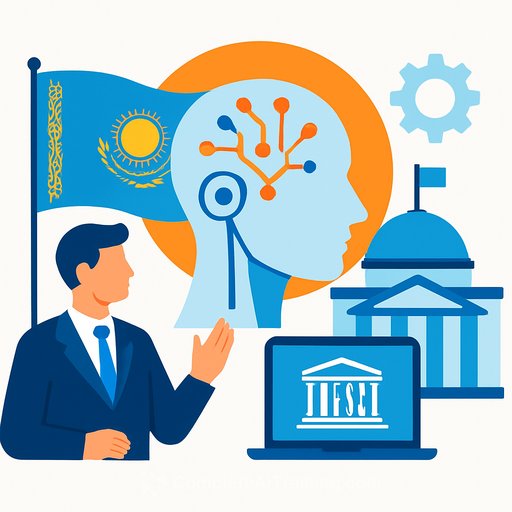
Kazakhstan Advances Human-Centered AI: What Legal Teams Need to Know
On Jan. 18, Kazakhstan's Law on Artificial Intelligence took effect, creating a full legal framework for developing and using AI with a clear priority on individual rights, freedoms, and well-being. The law codifies core principles-fairness, equality, transparency, explainability, accountability, oversight, data protection, privacy, security, and reliability.
Citizens must be informed about automated data processing, its potential consequences, and how to protect their rights. Responsibilities are defined across AI lifecycles for owners, proprietors, and users.
Scope, guardrails, and baseline duties
AI use is permitted only if personal data protection, information security, energy efficiency, and reduced environmental impact requirements are met, according to the Ministry of Artificial Intelligence and Digital Development. Transparency is mandatory, including clear labeling of synthetic content.
Systems are classified by both risk level (minimal, medium, high) and degree of autonomy. High-risk systems face information security requirements equivalent to state-owned systems.
Prohibited practices
- Manipulating behavior or exploiting human vulnerabilities.
- Discrimination in any form.
- Emotion detection without consent.
- Violations of data protection law.
- Generation of banned content.
Transparency and IP rules you'll need to operationalize
Label synthetic content wherever AI is used in outputs. Establish explainability processes and records that match the risk and autonomy profile of the system.
Copyright: works created with human creative input are protected, and prompts are protected as well. Using copyrighted materials for AI training is allowed unless a rights holder explicitly prohibits it-so rightsholder opt-outs matter. Update data licensing, training-data governance, and model documentation accordingly.
Practical compliance checklist for counsel
- Map roles: Document owner/proprietor/user responsibilities across the lifecycle (design, training, deployment, monitoring, decommissioning).
- Risk + autonomy classification: Classify each system; apply high-risk controls where required, including state-grade information security.
- Data protection: Confirm lawful basis, minimization, retention, cross-border rules, and security measures; update DPAs with vendors.
- Transparency: Implement user notices, impact explanations, and mandatory synthetic content labels.
- Testing and monitoring: Establish bias testing, performance validation, incident response, and audit logs proportional to risk.
- IP and content: Track training datasets, license terms, and rights-holder restrictions; define policy for prompts and co-authorship claims.
- Environmental and energy: Record energy-efficiency measures and efforts to reduce environmental impact for training and inference.
- Procurement and contracts: Bake in compliance warranties, security obligations, access for audits, and deactivation protocols.
Regulatory teams responsible for policy, data protection, and compliance automation can explore the AI Learning Path for Regulatory Affairs Specialists to align processes and documentation with evolving legal requirements.
Public sector rollout: AI Governance 500
On Jan. 19, Kazakhstan launched the first cohort of the AI Governance 500 strategic program to prepare executives to implement and scale AI in the public sector. Around 100 executives from central and local bodies and the quasi-public sector are participating.
The program is building a pool of digital officers who can deliver data-driven projects on a unified architecture with end-to-end processes, supporting interdepartmental initiatives under Digital Kazakhstan. It supports the declaration of 2026 as the Year of Digitalization and Artificial Intelligence. Executives seeking structured guidance on governance and scaling AI efforts may consider the AI Learning Path for CIOs.
UNESCO readiness assessment
Kazakhstan has also begun a UNESCO-led assessment of national AI readiness using UNESCO's Readiness Assessment Methodology (RAM). The review spans legal and regulatory frameworks plus sociocultural, economic, scientific, educational, and technological dimensions.
A National Stakeholder Team brings together ministries, academia, the private sector, civil society, and international partners to strengthen cross-sector coordination. Results will feed practical recommendations for a human-centered AI ecosystem grounded in international cooperation and human rights. Learn more about UNESCO's AI work here.
Implications for companies and vendors
If you deploy AI in Kazakhstan-or supply AI to the public sector-expect high assurance demands: classification, explainability, security parity for high-risk systems, and strict labeling. Contracts should address role allocation, compliance evidence, data rights, model updates, and incident reporting.
Internal governance matters as much as legal text. Set up an AI register, name accountable owners, and require pre-deployment reviews for medium and high-risk systems.
What to watch next
- Secondary regulations, technical standards, and ministry guidance on testing, documentation, and labeling specifics.
- Templates for risk assessments, record-keeping, and public notices.
- Procurement rules for public-sector AI and sector-specific requirements (health, finance, critical infrastructure).
Upskill your team
If your legal function is building AI fluency for policy, contracts, and compliance operations, consider curated learning paths by role, for example the AI Learning Path for Training & Development Managers.
Your membership also unlocks: