What Role Should AI Play in Our Children's Education?
AI won't replace teachers. It can't. Growth comes from doing hard things - wrestling with a math proof, crafting a clear paragraph, finishing the last lap when you're tired. That kind of effort is fueled by people with expectations, care and moral authority. Software doesn't offer that. Students get bored with chatbots. Robots won't earn their respect.
So let's stop pretending AI will teach for us and use it where it actually helps schools thrive. That means supporting teachers, strengthening core learning practices and preparing students to build systems - not just prompt them.
1) Put AI to work for teachers (so teachers can spend time on students)
AI is useful for the work that steals time from teaching: drafting parent updates, building exemplars, analyzing exit tickets, organizing data and catching patterns across classes. Use it to decrease busywork, not human contact.
One high-impact shift: assign more paper-based work. Handwriting engages more of the brain than typing and often leads to deeper learning. If you need a research anchor, see Mueller & Oppenheimer (2014) on longhand vs. laptop note-taking.
Modern AI can score or pre-score scanned handwritten work with teacher oversight. That gives you the convenience of auto-grading without pushing students onto screens. Keep the human in the loop, spot-check often and use AI feedback to target small-group instruction.
2) Use AI's economic tailwind to staff schools the way top systems do
AI will increase productivity across industries and, in some places, reduce headcount. If tax revenues rise and some workers need new roles, education is the best place to deploy both dollars and people.
Top-performing countries don't ask teachers to spend most of their day delivering instruction. They protect time for planning, feedback, collaboration and learning. For context, review TALIS results from the OECD on teacher time allocation: OECD TALIS 2018.
Redirect budget gains into humans: paraeducators, data coaches, family liaisons, attendance teams and specialists who increase instructional quality. AI should free teachers to do what only they can do - build trust, diagnose misconceptions and push students through productive struggle.
3) Teach students to build with AI, not just chat with it
Basic prompting is table stakes. The real opportunity is turning students into creators who wire AI into systems that solve meaningful problems. Start with lightweight tools and APIs so they can prototype quickly.
- Data + feedback loops: Use AI to classify lab reflections and flag misconceptions for reteach.
- Assistive tooling: Build a reading helper that summarizes complex texts and asks comprehension questions tuned to each student.
- Operations support: Create an attendance triage tool that drafts outreach based on patterns and context.
Keep it multidisciplinary. Pair computer science with math modeling, science inquiry and ELA argument. Students should document assumptions, test bias, measure errors and iterate - the same habits they need in any serious field.
A practical plan for districts and schools
- Policy and privacy: Approve a short list of AI tools. Disable data retention where possible. Prohibit uploading student PII unless covered by contract.
- Handwriting-first core: Use paper for note-taking, drafts and problem sets in ELA, math and science. Scan and pre-score with AI; teachers finalize.
- Teacher time: Audit staff calendars. Target 25-40% non-instructional time for planning, feedback and collaboration. Fund roles that make this possible.
- AI build track: Launch an "AI systems" elective or unit series using APIs. Require model cards, error analysis and documentation for every project.
- PD that sticks: Train staff on prompt strategy, rubric-aligned feedback and data use. Then train a smaller group to build simple AI tools for campus needs.
- Screen-time guardrails: Default to paper in K-8 for core practice; use screens for simulations, creation and feedback - not passive drills.
- Assessment integrity: Require process artifacts (notes, drafts, outlines) and oral defenses for major work. AI detection is not enough; verify thinking.
Guardrails that actually matter
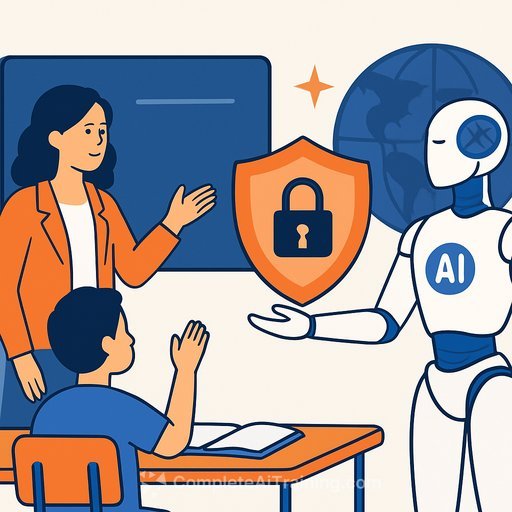
- Human oversight: AI can suggest, summarize and pre-score. Only educators evaluate, decide and communicate grades.
- Transparency: Ask models to show steps, cite sources when possible and flag uncertainty.
- Fairness: Test prompts on diverse inputs. Track error types. Adjust rubrics to avoid penalizing dialect or neurodivergent expression.
- Security and compliance: Minimize data sharing. Use district accounts. Keep a log of prompts and outputs used for high-stakes decisions.
What to do this semester
- Run a 6-week pilot: AI-assisted scoring for handwritten exit tickets in two grades. Measure time saved and feedback quality.
- Stand up an educator "AI studio": 5-8 teachers meet weekly to build small tools for real campus problems.
- Launch one student build: API-based project in grades 7-12 with a public demo day and rubric focused on accuracy, ethics and impact.
- Reclaim teacher time: Reallocate duties or hire one support role per grade band using freed minutes and small grants.
- Publish a two-page AI use guide for families and students. Clarity builds trust.
Bottom line: Keep teaching deeply human. Use AI to give teachers time, give students better feedback and give schools the capacity they've been missing. And teach young people to build systems that solve real problems - that's how they'll thrive long term.
If your team needs structured upskilling paths, explore curated options by role here: Complete AI Training - Courses by Job.
Your membership also unlocks: