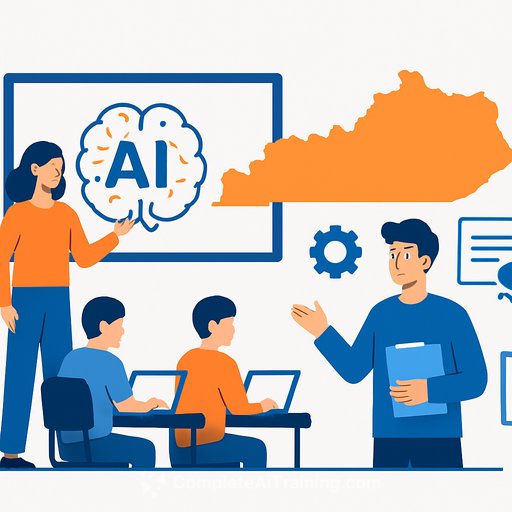
AI in Kentucky CTE: What's Changing and What to Do Next
Kentucky's Career and Technical Education (CTE) Advisory Committee met in November to look squarely at where artificial intelligence fits in CTE. Members acknowledged AI will play a larger role across programs and classrooms in the coming decades. Many reflected on how technology has moved over their lifetimes and what that means for students entering skilled careers.
One theme was clear: use AI to extend teacher capacity, not replace it. As Mike Hesketh of Superb IPC put it, teachers are short on time and students still need extra support. "Seeing AI applied to this teaching is extremely exciting… I'm amazed at how well it gives me very reasonable and helpful answers to solving technical problems," he said.
What CTE Could Look Like by 2050
Tom Thompson, director of KDE's Division of Student Transition and Career Readiness, asked several AI models to forecast CTE's future. The consensus points lined up with where many districts are already headed:
- Primary focus: Today's 16 Career Clusters integrate academics, work-based learning, and credentials. By 2050, pathways may lean into adaptable technical skills, AI and automation, green technologies, soft skills, and entrepreneurial thinking. See the current clusters at Advance CTE.
- Identity: CTE may be more fully integrated into K-12 and postsecondary as career-connected learning, with skills and innovation pathways embedded across subjects.
- Accountability and standards: Expect a shift from a heavy emphasis on industry credentials and dual credit to verified competency portfolios, micro-credentials, and transferable skills that keep pace with economic shifts.
- Delivery model: Hybrid and virtual options could become standard, with regional hubs offering specialized, advanced technology training.
- Technology integration: AI may become both a core tool and a subject. VR/AR, robotics, and data science could sit at the center of many pathways.
People Still Matter
AI will grow, but the human side of CTE isn't going anywhere. "It seems like people will never go out of fashion. We always have to have someone to do the physical work," said Gerald Brinson of Pulaski County Area Technology Center. His takeaway: teach students to use AI, but keep hands-on skills and judgment front and center.
Policy Update: Easier Entry for Industry Experts to Teach
During the latest legislative session, KDE was asked to reduce barriers for occupation-based certification in electricity, plumbing, and HVAC. KDE's Office of Educator Licensure and Effectiveness and the Office of Career and Technical Education proposed a change to help schools recruit and keep expert instructors.
Professionals in these fields with a Kentucky-issued master license earned through proper assessment will no longer need an associate's degree to teach. They will enter at rank three, with the option to earn rank two by completing an associate's degree. Assessment requirements and participation in the New Teacher Institute remain. KDE filed the plan with the Legislative Research Commission on Sept. 15; it continues through the regulatory process.
New Pathways: Health, Sports Medicine, and Statewide AI
KDE is adding two pathways in health science: behavioral and mental health, and sports medicine. In computer science, a new statewide AI pathway is coming. Standards will include ethical use of AI, general classroom use, and AI in the workplace, with program-area standards mapped to where AI directly affects each career pathway.
AI Fellowship: Classroom Trials and a Teacher Toolbox
KDE is partnering with the University of Louisville on an AI Fellowship starting in January. Participants will pilot AI-assisted classroom software, share their experiences in monthly meetings, and build a capstone that becomes an AI toolbox for CTE teachers. KDE is seeking eight participants; applications are due Dec. 1.
What Educators Can Do Now
- Audit courses for where AI can support standards, safety, and employability skills. Start building toward competency portfolios and micro-credentials.
- Plan for hybrid/virtual delivery and regional partnerships to give students access to specialized equipment and instruction.
- Train staff on practical classroom use and ethics. The U.S. Department of Education's brief on AI and teaching is a useful starting point: ed.gov/ai.
- Keep human-centered skills at the core: troubleshooting, communication, teamwork, and situational judgment-especially in labs and work-based learning.
Helpful Resource
If you're evaluating professional learning options for staff, here's a curated list of AI courses organized by role: AI courses by job. Use it to map training to your pathways and school goals.
Your membership also unlocks: