
AI news ·
Kevin O'Leary's proposed Utah AI data centre faces backlash from residents over environmental concerns
Kevin O'Leary is pushing to build a 7.5-gigawatt AI data centre on up to 13,000 acres in Utah's Box Elder County. Residents are fighting back, citing water scarcity and a fragile ecosystem near the shrinking Great Salt Lake.
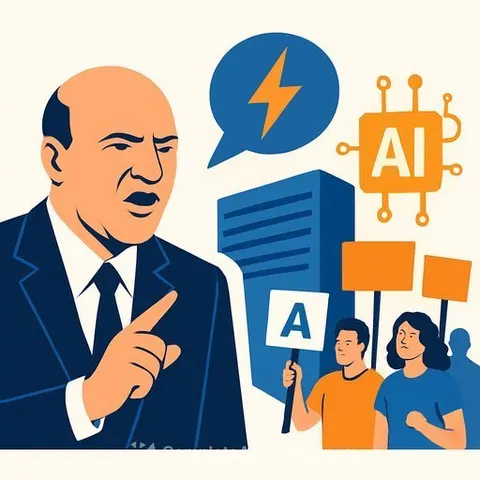
Kevin O'Leary plans 7.5-gigawatt Utah data centre amid environmental pushback
Celebrity investor Kevin O'Leary wants to build a massive artificial intelligence data centre in Box Elder County, Utah. The project would generate 7.5 gigawatts of computing power across 10,000 to 13,000 acres, mirroring a similar $70-billion facility he proposed for Alberta.
Box Elder County commissioners approved two resolutions on May 4 to advance the project. The decision triggered vocal opposition from residents concerned about environmental damage in a region already facing water scarcity and air quality problems.
Economic pitch versus environmental concerns
O'Leary says the data centre would create roughly 2,000 permanent jobs and generate additional tax revenue for the county. He argues the project would significantly increase U.S. computing capacity and productivity.
"The country that has the best AI will have the best productivity, the best education, the best military ordinance, the best of everything," O'Leary said in an interview.
Environmental experts and residents see different risks. The Great Salt Lake has dropped to record-low levels in recent years, and the proposed site sits in a desert valley with minimal precipitation.
Robert Davies, a physics professor at Utah State University who studies environmental change, said the development would produce "more than double the amount of energy in the entire state." He worries the extra heat and emissions would destabilize an already fragile ecosystem that depends on daily condensation for moisture.
Brenna Williams, a local resident, questions the water math. "We're already being told to ration our water," she said. "But all of a sudden we have all this excess water to provide the heat generation for that much power and cool down the data centre? I just don't see where there's the water to do that."
What O'Leary Digital says about water use
O'Leary's company says the centre would not draw new water from the basin. The design includes a closed-loop cooling system that reuses water and would "sharply reduce water consumption," according to project materials. The facility would also capture and reuse waste heat to lower overall energy demands.
Davies remains skeptical that existing environmental regulations were designed for a project at this scale. "I'm concerned that they're saying that environmental regulations will be followed, when it's not at all clear to me that those regulations are even built for a project like this," he said.
Residents push for a public vote
Some Box Elder County residents argue the approval process moved too quickly without adequate public input. Hundreds of people attended the contentious county meeting where commissioners voted to advance the project.
Brenna Williams and her son Tameron co-lead the Box Elder Accountability Referendum, a group calling for a public ballot measure on the project's future. "We want transparency, we want accountability," Tameron said.
The group needs just over 5,400 signatures from registered voters across four county areas to get the question on the November ballot. They have 45 days to collect signatures if county attorneys approve their referendum application, with a decision expected by month's end.
Box Elder County Commissioner Tyler Vincent said the commission's vote "isn't the end of the oversight process, but just the beginning."
Alberta project status
O'Leary's similar Wonder Valley data centre in Alberta, announced in December 2024, still requires permits. Alberta's government said in April it would not conduct a full environmental impact assessment because the project uses standard power and water systems. However, the province requires detailed technical assessments showing the project can be built and operated safely before construction begins.
O'Leary said he hopes construction on the Utah facility can begin by the end of next year if it clears environmental assessments. When asked about concerns from Utah residents, he said transparency would guide the process. "Everything we're going to do will be transparent and public in these applications. If any of them are struck down, that's fair," he said.
For IT and development professionals, these projects signal where computing infrastructure investment is heading - and the infrastructure constraints that large-scale AI systems face.