KIMM Fast Tracks AI System and Robotics Development
The Korea Institute of Machinery and Materials (KIMM) has introduced a robot task AI system that learns everyday repetitive work from human demonstrations. Led by Dr. Jeong-Jung Kim at KIMM's Research Institute of AI Robotics, the platform targets routine tasks like organizing items, clearing tables, and general object manipulation. It's built for homes, offices, retail stores, and logistics facilities where consistency and throughput matter.
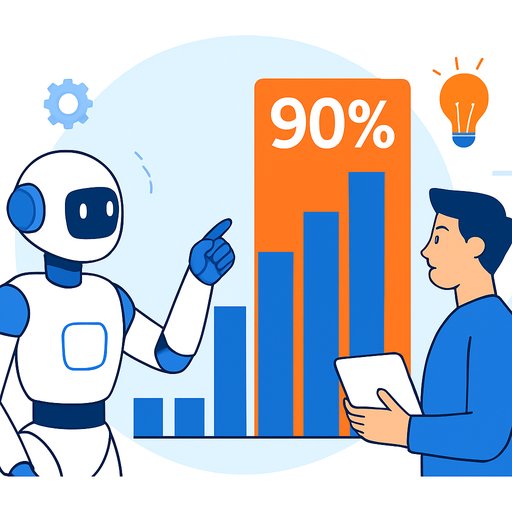
At its core is a hierarchical task execution framework. The system breaks complex jobs into ordered steps, learns those steps from human demos, and executes them reliably in changing environments. In testing across multiple tasks, it achieved success rates above 90%.
What's different
Many robot task systems focus on a single task or stop at simulation. KIMM's framework spans the full pipeline-dataset construction from human demos, training in virtualized environments, and validation with physical robots. That end-to-end scope is what makes the results transferable to real spaces with variable layouts and lighting.
Key components of the framework
- Task extraction: Converts human demonstrations into structured datasets. Think temporal segmentation of actions, object/affordance tagging, and trajectory encoding that can be replayed or adapted.
- Virtualized training environments: Simulates real-world conditions so policies learn under variable scenes, placements, and disturbances before hitting hardware.
- Hierarchical execution AI: A task graph coordinates sub-policies for perception, grasping, placement, and recovery. If a step fails, the system can re-plan or retry without restarting the entire job.
Why this matters for IT and development teams
Service robots are moving from one-off demos to dependable workflows. For teams building or integrating similar systems, the value is a clean handoff between data capture, training, and deployment-in a loop you can version, test, and ship.
- Data pipeline: Standardize demos into a schema (e.g., JSON/YAML for task graphs + binary for trajectories via ROS bag/HDF5). Track versions and context (scene, objects, tools, lighting).
- Simulation stack: Use a simulator that supports domain randomization and sensor models (RGB-D, IMU, force/torque). Keep assets synchronized with physical layouts.
- Training approach: Start with behavior cloning from demos, then fine-tune with policy optimization or constraint-based planners for edge cases. Balance success rate, time-to-complete, and reset cost.
- Execution layer: Implement a task graph with clear pre/post-conditions and fallbacks. Log every transition for post-mortem and active learning.
- Deployment: Containers for perception and control nodes, hardware abstraction via ROS 2, and a rollout strategy with remote diagnostics. Budget for on-device acceleration if latency is critical.
- Safety and ops: Define stop conditions, human presence detection, and clearances. Add telemetry, drift detection, and auto-retraining hooks.
Performance and reliability
KIMM reports success rates above 90% across varied tasks, even when conditions change. In practice, you'll want to instrument for success/failure by step, task completion time, and recovery frequency, then push the worst cases back into your simulation curriculum.
Where this applies first
- Retail merchandising: Shelf stocking, facing, and item realignment where SKUs and facings rotate.
- Warehouse logistics: Kitting, sorting, putaway, and consolidation with mixed objects and bins.
- Workplace support: Table clearing, meeting room resets, and light object handling in offices.
What to watch next
The team plans to release task datasets and virtualized models of real environments. That's a shortcut for your own training pipeline and a baseline for benchmarks. Prepare connectors now: define your demo schema, scene asset format, and evaluation harness so you can plug new data in quickly.
If you're setting up a pilot, aim for a 6-8 week loop: capture 50-200 demonstrations across varied scenes, train with domain randomization, validate on hardware, and iterate on failure modes. Keep your task graph small at first, then scale sub-policies as you add objects and behaviors.
For system architecture and deployment patterns similar to KIMM's hierarchical approach, see the AI Learning Path for Software Engineers.
KIMM official site for institutional background, and ROS documentation if you're mapping this to your robotics stack.
The KIMM research team behind the Robot General Task AI (RoGeTA) framework, led by Dr. Jeong-Jung Kim.
Your membership also unlocks: