Kindle Adds AI Q&A Without Author Opt-Out: What Writers Need to Know
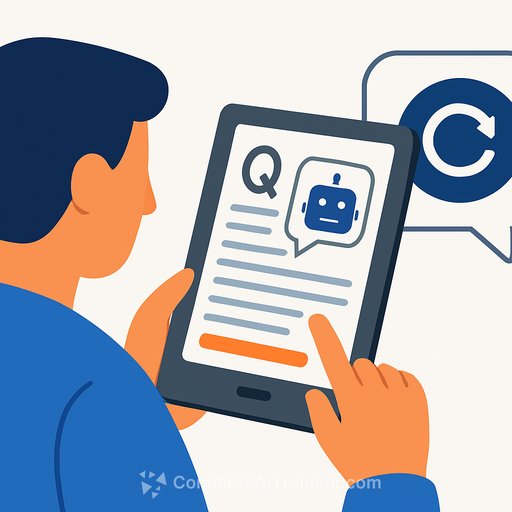
Amazon is rolling out Ask This Book, an AI Q&A inside the Kindle app that answers questions about characters, plot points, timelines, and themes for "thousands" of best-selling English-language titles. It launches first on iOS, with plans to reach Kindle devices and Android in 2026. You can highlight a passage or open Ask This Book from the on-book menu, ask a question, and get an answer without leaving the page.
There's a catch that matters for writers: there's no opt-out for authors or publishers. Amazon hasn't shared details on model architecture, training data, citations, or safeguards.
How Ask This Book Works for Readers
The tool acts like a built-in study guide. It can remind a reader who a minor character is, compress a dense chapter, clarify timing, or unpack a theme spanning multiple chapters. Readers can use suggested prompts, type their own, and continue with follow-up questions.
Think sprawling fantasy casts, classics with big character lists, or research-heavy nonfiction where context helps. What's unclear: whether responses cite page numbers, how spoilers are handled, and if answers are limited to information in the purchased book.
No Opt-Out: Why That Matters to Authors
Amazon says the feature is always on and titles can't be turned off. No licensing details or technical protections were shared.
That puts this squarely in an unsettled legal zone. The Authors Guild and others are pursuing cases related to AI training on copyrighted works, and the U.S. Copyright Office is examining when AI outputs may substitute for the original expression. Two issues to watch:
- Retrieval vs. learning: Is Ask This Book limited to your licensed copy (like searchable text/X-Ray), or can the system generalize beyond it?
- Market substitution: Could answers function like summaries or study guides that displace reading, which weighs on fair-use analysis?
For background, see the U.S. Copyright Office's overview on AI and copyright (copyright.gov/ai) and the Authors Guild's AI advocacy updates (authorsguild.org).
Accuracy, Citations, and Privacy Are Open Questions
Generative systems can get things wrong. When an AI misreads a character's motivation or confuses plot order, trust erodes. Competitors have leaned on retrieval-augmented answers, narrow scopes, and inline citations. Amazon hasn't said if Ask This Book will use similar guardrails.
Data handling also matters. What reading excerpts and queries are stored? For how long, and for what purpose? Kindle is about literature, not shopping; readers and rights holders will expect a higher bar on accuracy, consent, and disclosure.
Recaps: TV-Style "Previously" for Books
Alongside Ask This Book, Amazon is adding Recaps - short summaries of plotlines and character arcs for books you own or rent. On Kindle devices, use the View Recaps button on a series page. In the iOS app, press and hold the series grouping in your library. It's available in the U.S. now on Kindle devices and iOS.
Recaps could help readers return to a series months later without losing momentum. Paired with Ask This Book, Kindle is leaning into context on demand.
What This Means for Working Writers
Kindle's scale gives any AI feature huge reach. If always-on AI becomes the default for commercial ebooks, it will influence how readers consume narrative and nonfiction - and how your work is summarized, explained, and remembered.
The upside: faster comprehension and recall, plus accessibility for language learners and neurodiverse readers. The risk: opaque systems summarizing your work without clear licensing, attributions, or controls.
Practical Next Steps for Authors and Publishers
- Ask for clarity in writing: Request documentation from distributors on data sources, citations, spoiler handling, and whether responses are confined to a licensed copy.
- Push for controls: Advocate for opt-out options, or at minimum a setting for citations to page/location numbers and a spoiler toggle.
- Protect contract language: Work with your agent/publisher to update licensing clauses around AI uses, summaries, study-guide outputs, and derivative markets.
- Audit your catalog: Test your own titles when the feature appears. Screenshot incorrect answers, missing citations, or spoilers, and report them.
- Own the context: Add author's notes, glossaries, or official summaries in back matter to set the record straight and give readers a trusted reference.
- Watch the data trail: Look for disclosures on how reader queries and excerpts are stored and if they're reused for model improvements.
- Engage your audience: Encourage readers to report issues and share accurate references; consider a simple feedback link on your site.
What to Monitor Through 2026
- Rollout details: How iOS performance compares with Kindle devices and Android when those arrive.
- Guardrails: Whether Amazon adds citations, spoiler controls, and retrieval-limited answers.
- Legal movement: Outcomes that clarify fair use, licensing expectations, and model training boundaries.
- Market signals: Any impact on reading completion rates, reviews, or sales for series with active Recaps/Ask This Book usage.
Bottom Line
AI inside Kindle is here, and writers weren't given an opt-out. The feature could help readers stay engaged - or it could become a gray-market summary layer over your work. The difference comes down to transparency: licensing visibility, citations you can verify, spoiler controls, and privacy disclosures that hold up.
Until those show up in plain language, keep records, advocate for options, and guide your readers to trusted context. If you want to level up your own AI fluency for writing workflows and tool evaluation, you can explore curated options here: AI tools for copywriting.
Your membership also unlocks: