Korea sets sights on a global top-10 general AI model by 2026 - what IT and dev teams should plan for
South Korea's Ministry of Science and ICT has set a clear target for 2026: build a general-purpose national AI model, open source it, and push it into the global top-10. The plan was presented on Dec. 12 in Sejong with President Lee Jae Myung in attendance and framed as a pivot to AI-first operations across government, industry, and daily life.
The ministry's stance is straightforward: create a proprietary base model, release it for free use in business and academia, and ship sector-focused services for defense, manufacturing, and culture. Tangible outcomes and public access are core themes, not just headline goals.
What this means for engineers and product teams
- Expect an open-source base model you can fine-tune for enterprise workloads. Pay attention to license terms for commercial use and redistribution.
- Anticipate domain adapters and reference stacks for priority sectors (defense, manufacturing, culture). This is your cue to build connectors, eval suites, and safety layers early.
- Track benchmarks and reproducibility. Independent scores (for example, MLPerf) will signal maturity and performance trade-offs.
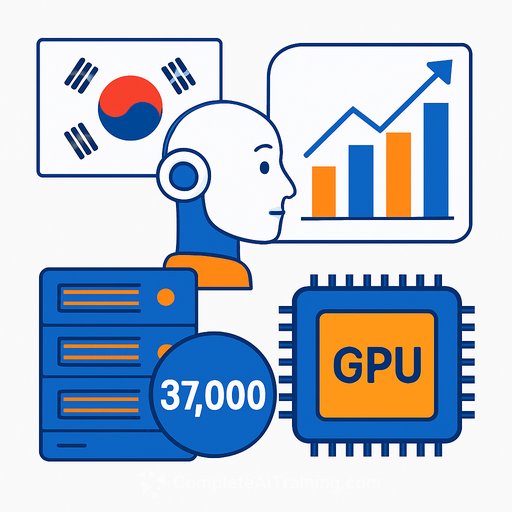
Compute: 37,000 GPUs and six supercomputers
The plan allocates significant public investment into AI infrastructure: 37,000 GPUs plus six supercomputers to support R&D and industrial demand. If you run long-context training, multi-node fine-tuning, or hybrid inference, this matters for capacity planning.
Expect priority programs for research groups, startups, and pilots that stress-test throughput, scheduling, and storage I/O. Start modeling your cost and time-to-train with and without public compute so you can move fast when access windows open.
Open-source base model + sector services
An open release means faster integration, yet the details will make or break adoption. Watch for tokenizer spec, context window, safety rails, eval coverage, and quantization support out of the box.
For production teams, plan for LoRA/QLoRA fine-tuning, retrieval layers, and policy enforcement at the adapter level. Standardize on prompt/input schemas and create unit tests for jailbreaks, PII exposure, and instruction drift.
Talent pipeline and startup funding
The ministry will stand up an AI-focused university and graduate school, while launching a KRW 3 trillion scale-up fund for AI startups by 2030. That points to a long-term pipeline of skilled practitioners and growth capital for teams with clear market fit.
- Founders: prepare diligence-ready documentation (model cards, data lineage, eval results, security posture, and customer references).
- Engineering leaders: formalize an internal training plan and carve out time for staff projects tied to public programs and future grants.
National AI competition in March
A nationwide competition will invite students, professionals, and the public to propose AI-driven ideas. Top entries will receive R&D support, commercialization help, and startup backing.
- Arrive with a working demo, a minimal risk assessment, and a compute plan. Keep your submission crisp: problem statement, approach, metrics, and deployment path.
Security and data protection: tighter accountability
Repeated corporate security incidents will bring fines, and CEO-level accountability will be formalized. The government also plans a system to detect AI-based threats and bolster hacking response capacity.
- Move now on model governance: incident runbooks, red-team reports, SBOMs for AI stacks, and centralized audit logs.
- Adopt a risk framework that your auditors understand. NIST's approach is a solid baseline: AI Risk Management Framework.
Your 90-day action plan
- Map 3-5 high-ROI use cases in your org (manufacturing QA, code assist, CX automation, threat detection) and define success metrics.
- Prepare for the open model: standardize data pipelines, labeling guidelines, eval harnesses, and safety tests.
- Benchmark alternatives now to speed adoption later (latency, tokens/sec, cost/1k tokens, and guardrail effectiveness).
- Line up fine-tuning infrastructure (parameter-efficient methods, retrieval, vector DB) and set budget thresholds for training vs. hosting.
- Strengthen security basics: secret management, prompt injection filters, egress controls, and PII minimization.
- Upskill your team with targeted tracks by role. A curated starting point: AI courses by job function.
- Founders: pre-draft grant/competition materials and a simple compliance pack (privacy, licensing, model limitations).
Bottom line
This agenda is explicit: build a strong open model, scale compute, train talent, back startups, and tighten security. For developers and IT leaders, the opportunity is to prepare integration, governance, and performance work now-so when resources and programs go live, you're first in and production-ready.
Your membership also unlocks: