
AI news ·
Korean language app Teuida surpasses 6 million downloads with AI-driven conversation simulations
Korean language app Teuida hit 6 million downloads by putting users inside AI-driven video conversations with native speakers. Built by a UC Berkeley grad, it skips grammar drills and has users speak aloud to handle real situations.
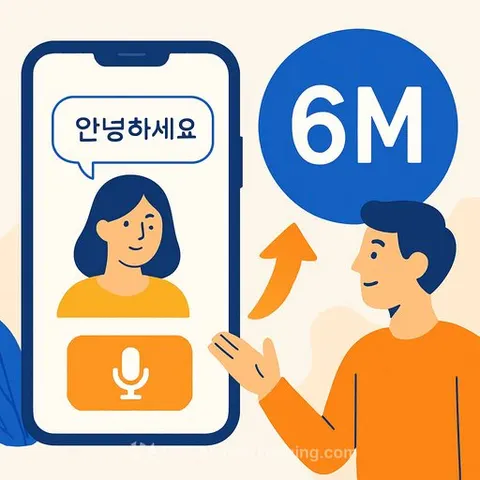
UC Berkeley graduate builds AI language app that simulates real-world Korean conversations
Teuida, an AI-powered language-learning app, has surpassed 6 million downloads since its 2019 launch by focusing on what most competitors avoid: getting users to actually speak.
The app uses speech-recognition technology to place learners inside interactive video scenarios with native speakers. Users respond aloud to real-world situations-ordering food, navigating a hospital visit, or navigating university life-rather than drilling vocabulary or grammar rules.
CEO Jang Ji-woong, a UC Berkeley graduate, built the company around a specific problem. Most language apps treat learning as an academic exercise. Teuida treats it as a simulation.
How the app works
Users encounter storylines that unfold through conversation. One scenario follows a chance encounter in Korea that develops into a budding romance. Another places users as exchange students managing group projects and campus social dynamics.
The AI evaluates pronunciation and conversational context before advancing the story. The goal is not fluency in reading or writing, but confidence speaking in everyday situations.
"We want people to experience what life in that country actually feels like," Jang said. "Even if they've never been to Korea, they can learn how to buy a subway ticket, navigate a hospital visit or travel around places like Bukchon."
Complete beginners can start speaking without first mastering grammar or writing systems. The app intentionally narrows its focus rather than attempting to cover every aspect of language learning.
Market timing and growth
When Teuida launched, Korean-language learning was a niche market. The global spread of K-pop, BTS, and shows like "Squid Game" changed that calculation.
American users now account for roughly 30 percent of Teuida's user base, followed by India and Vietnam. The app ranks first for Korean-language learning in the U.S. and U.K., despite offering lessons in Japanese, Spanish, and French as well.
In May 2026, Google invited Teuida to present at Google I/O, where the company met with executives overseeing Google's extended reality and U.S. Play businesses.
Why Jang built this
Jang studied political science at UC Berkeley with plans to work for an international organization expanding educational access. After graduation, he worked at a Silicon Valley e-learning startup and in global commerce marketing before returning to the original question that drew him to education: how do underserved communities gain stable access to quality learning?
A government-backed entrepreneurship program in Korea gave him the opportunity to test a startup idea in 2019. Teuida emerged from that program.
Jang sees the company as still early in a larger opportunity. "Advances in AI and the ease of international travel have lowered barriers in many ways," he said. "At the same time, demand for language learning is growing rapidly."
For educators and training professionals, the approach offers a lesson in how AI for Education can target specific skill gaps rather than attempting comprehensive coverage. The use of Speech-To-Text technology to simulate real conversations demonstrates one practical application of AI in language instruction.