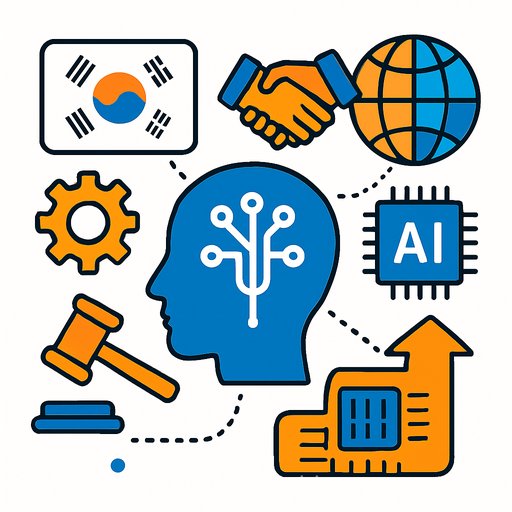
Korea's AI push in 2025: alliances, policy, and the memory supercycle
Korea hit escape velocity on AI in 2025. Global alliances, a first-mover legal framework, and a hardware upcycle aligned - creating a window for operators who can move with intent.
Global alliances: securing compute as a moat
Nvidia committed 260,000 Blackwell GPUs to Korea's public and private sectors - enabling AI factories, digital twins, and scaled data centers across Samsung, SK, Hyundai Motor, and Naver. The state will route capacity into a national computing center and sovereign foundation models, pushing compute access beyond a few players. Details on the architecture are public via Nvidia Blackwell.
OpenAI's multiple Korea visits paid off: Samsung Electronics and SK hynix joined the $500B "Stargate" infrastructure initiative in the U.S. and will supply roughly 900,000 wafers' worth of high-performance DRAM each month. The message is clear: compute and memory are now strategic assets, and Korea is locking in upstream leverage.
Policy clarity: AI Basic Law goes live Jan 22
Korea enacted the Framework Act on the Development of AI and the Creation of a Foundation for Trust - the first of its kind. It sets duties on safety, transparency, and accountability, defines high-risk AI, and creates governance across data use, human oversight, and liability. See the Ministry of Science and ICT overview here.
Expected upside: clearer rules, lower legal uncertainty, faster enterprise adoption. Real risks remain: fuzzy "high-risk" boundaries, labeling questions for AI-generated content, and compliance load for smaller vendors. Authorities are preparing enforcement decrees, coordination with industry and civil groups, and grace periods to keep innovation on track.
Sovereign AI as national strategy
The administration elevated AI to a top policy priority, naming an AI expert as science and ICT minister with deputy prime minister authority. A presidential council now coordinates national AI compute centers, power generation for those facilities, and an ecosystem around NPUs and non-GPU accelerators.
Budget tells the story: 10.1 trillion won ($6.94B) earmarked for AI, roughly triple the prior year. A competitive program to build a proprietary foundation model is underway - aiming to reduce dependence on foreign stacks while compounding domestic capability.
From models to outcomes: real-world and agentic AI
Enterprises shifted from model vanity projects to operations. Internal chatbots now route knowledge and customer requests; office workflows run on automated document handling, analysis, and demand forecasting; translation and interpretation unlock global service coverage. Early agentic systems are booking, purchasing, and handling simple transactions end-to-end.
On the factory floor, physical AI is embedding intelligence into production lines. Real-time anomaly detection and automated quality inspection are becoming standard, while robotics accelerates full-line automation and digital twin adoption.
Hardware: the memory supercycle is here
Data centers scaled to meet AI demand, and memory became the choke point. HBM supply stayed tight even at full capacity; HBM3E prices climbed ~20%, an unusual move with HBM4 mass production slated for next year. This is more than a blip - it's a capacity story.
General DRAM prices surged about 420% this year, from $3.75 in January to $19.50 in November (TrendForce). Expect spillover into device costs and fatter near-term earnings for Samsung and SK hynix. Watch for knock-on effects in low-power memory, ASICs, system semis, and NAND as buyers rebalance stacks.
What executives should do next quarter
- Secure compute and memory: lock in GPU allocation and reserve HBM/DRAM via LTAs or prepayments. Hedge with NPUs and non-GPU accelerators where workloads fit.
- Operationalize AI Basic Law compliance: appoint an AI risk owner, inventory all AI systems, map them to risk tiers, and implement logging, documentation, testing, and human-in-the-loop controls. Stand up a labeling pipeline for AI-generated content before launch.
- Leverage sovereign programs: apply for national compute access, co-fund domain foundation model tracks, and align with government priority use cases to de-risk scale-up.
- Prioritize deployments that print cash: quality inspection, predictive maintenance, customer operations automation, and short-cycle forecasting. For operational use cases and training, see AI for Operations.
- Design for memory constraints: model scenarios for DRAM/HBM pricing, use quantization and sparsity to cut footprint, and standardize memory-lean inference paths in production.
- Strengthen supplier redundancy: dual-source at the wafer, packaging, and module levels; build change-control playbooks for rapid swap-outs without downtime.
- Upskill the org: create role-based learning plans for engineering, operations, legal, and procurement. For structured programs, see AI courses by job.
Board questions to ask this month
- What GPU and HBM capacity have we secured through 2026, and what's our contingency if allocations slip?
- Which of our AI systems could be classified as high-risk, and what controls are audited today?
- How will the DRAM price curve affect our BOM and gross margin by product line?
- Which three agentic workflows will go live with measurable KPIs in the next 90 days?
- What workloads can shift to NPUs or custom accelerators in 12 months without performance loss?
The takeaway: Korea is treating AI like core infrastructure - compute, memory, and policy built in tandem. If you lead a P&L or a platform, your edge will come from how fast you lock in capacity, comply without drag, and ship use cases that move numbers.
If your team needs a practical starting point, browse popular AI certifications to align training with near-term deployment goals.
Your membership also unlocks: