South Korea's AI Action Plan Triggers Creator Backlash: What Government Officials Need to Consider Now
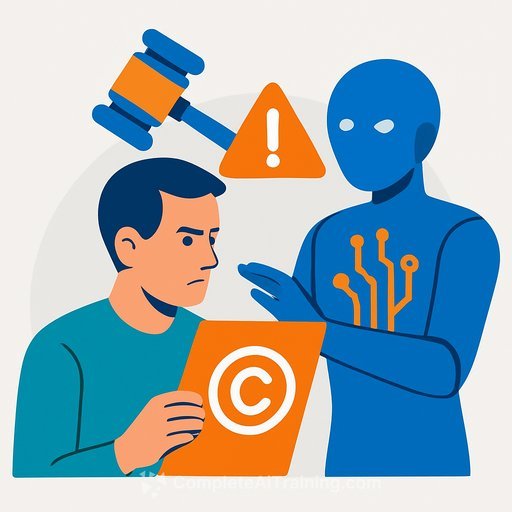
South Korean creator and copyright groups have rejected the Korea AI Action Plan, warning it could let companies train AI on copyrighted works "without legal uncertainty" and, in practice, without paying. Their joint statement frames the government's direction as "use first, pay later," saying it weakens control over creative works and risks hollowing out the cultural sector.
The pushback centers on Action Plan No. 32, which promotes "activating the ecosystem for the use and distribution of copyrighted works for AI training and evaluation." It recommends that by the second quarter, the Culture Ministry and other ministries advance either amendments to the AI Basic Act or a separate "AI Special Act" to enable use of copyrighted works for training with reduced legal friction.
Why the Opposition Is Intensifying
Groups representing literature, broadcasting, screenwriting, music, choreography and visual arts argue the proposal stretches fair use too far in favor of private commercial interests. They say the plan misreads global trends as moving toward looser exemptions and shifts the burden of enforcement onto creators.
They're also wary of "opt-out" protections that rely on machine-readable technical measures. Most individual creators lack the tools or resources to implement and monitor those measures, which could render the protection meaningless in practice.
"This is a declaration that the government is abandoning the sustainability of Korea's cultural industry," the statement said, calling for a fundamental policy review. The Korea Newspaper Association has voiced similar concerns, emphasizing that copyright starts with the right holder's decision on whether a work can be used in advance.
Political and Policy Context
Promoting AI is a core priority for the current administration, which formed the Presidential Council on National Artificial Intelligence Strategy on Sept. 8 to coordinate the national agenda. Standing Vice Chair Lim Mun-yeong and members of the council presented the draft Action Plan on Dec. 15 in Seoul.
The draft strategy lists 98 execution items, spanning compute infrastructure, AI semiconductors, industry adoption, and new rules for AI training and evaluation. Public feedback was open through Jan. 4, and the council says it plans a discussion session on the controversy.
Key Tension: Growth vs. Creative Rights
The debate is less about whether AI should grow-and more about how to build it on fair terms. If unpaid or low-cost use of creative works becomes normalized, the groups warn, meaningful compensation will be hard to restore later.
The coalition of 16 organizations says it will sustain pressure until policy shifts toward a model that protects creator rights and ensures fair compensation as a baseline. They want a framework built on prior permission and clear, workable licensing paths.
Practical Options for Policymakers
- Default stance: Treat commercial AI training on copyrighted works as requiring prior permission, unless clear statutory exceptions apply.
- Licensing pathways: Encourage collective licensing via existing collecting societies or consider a narrowly scoped statutory license with transparent rates and an independent rate-setting mechanism.
- Transparency duties: Require model developers to disclose high-level dataset sources, employ dataset registries, and maintain audit logs for rights-holder verification.
- Data segregation: Use secure data rooms or controlled environments for training on sensitive or licensed content, with access records and retention limits.
- Opt-out that works: If offering opt-out, provide simple non-technical channels (registries, form submissions) alongside machine-readable signals-don't rely solely on technical tags.
- Small creator safeguards: Provide a no-cost route to register exclusions, subsidize tooling, and offer standardized legal templates to reduce friction.
- Content provenance: Promote provenance standards for outputs and training sources to improve traceability and resolve disputes faster.
- Dispute resolution: Stand up a streamlined, time-bound administrative process with statutory damages for non-compliance to deter free-riding.
- Evaluation vs. training: Differentiate rules for evaluation datasets used for benchmarking, with tighter governance for copyrighted material.
- Impact assessment: Mandate cultural and economic impact assessments before finalizing any exemptions or special regimes.
Global Signals to Watch
- WIPO is facilitating international dialogue on AI and IP, with wide divergence across jurisdictions on text-and-data-mining exceptions.
- The U.S. Copyright Office is examining training, fair use, disclosure, and authorship, underscoring the need for transparency and licensing solutions.
Immediate Next Steps for Government Teams
- Convene a multi-stakeholder session led by Culture, Science and ICT, and Justice ministries to stress-test Action Plan No. 32 with real licensing and enforcement scenarios; draw on resources such as the AI Learning Path for Procurement Specialists to inform procurement and governance scenarios.
- Draft options for collective licensing and statutory licensing, including rate-setting methods, transparency rules, and enforcement mechanisms; engage supplier-management expertise through the AI Learning Path for Supplier Relationship Managers.
- Prototype an opt-out registry with both human-friendly and machine-readable inputs; publish an implementation guide for developers.
- Launch a pilot dataset registry and model card standard for public-sector AI procurements to set expectations for the private sector, informed by the AI Learning Path for Purchasing Managers.
- Publish a clear timeline: consultation rounds, draft text, impact assessment, and a transition period for compliance.
Bottom Line
South Korea can grow AI while protecting its creative economy, but the policy design has to make permission, compensation, and transparency the default-not the exception. Building licensing rails now will reduce legal risk for developers and deliver predictable income for creators, which is the basis for long-term industry health.
Your membership also unlocks: