AI in Korea's courts: faster dockets, tighter guardrails
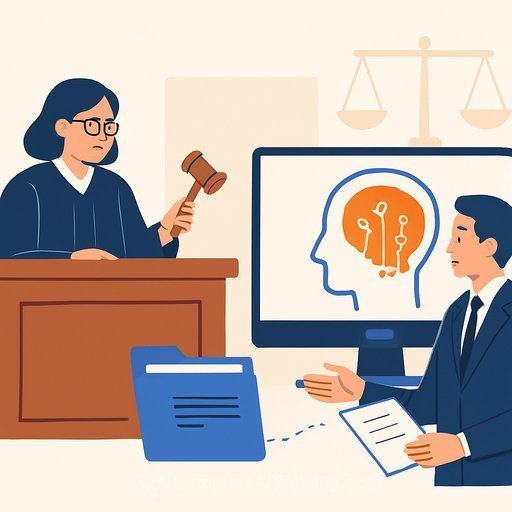
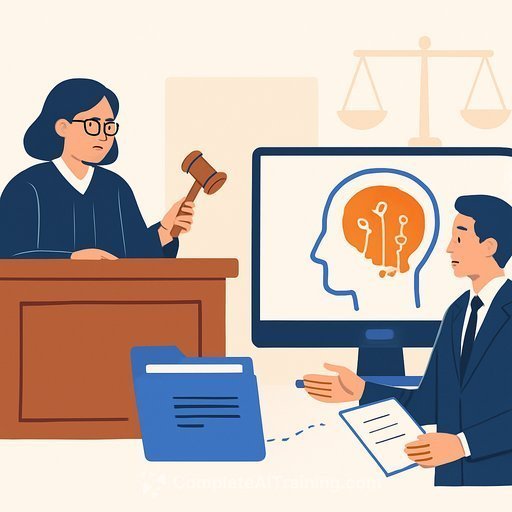
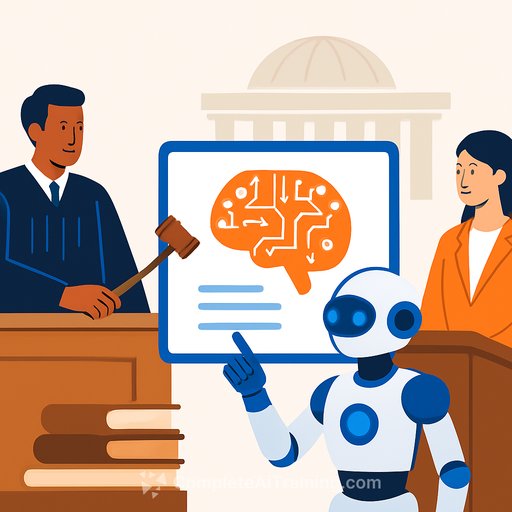
South Korea's judiciary is piloting an AI platform to ease crowded dockets and free judges to focus on cases that need human discernment. The National Court Administration built the system in-house, keeping all trial work inside the courts' secure network.
Early signs point to efficiency gains - but legal scholars warn the upside only holds if the courts set clear limits, document accountability, and keep human judgment at the center.
What the court is piloting
The platform draws on a large body of court records, including every ruling issued since 2013, to speed legal research and streamline trial management. By avoiding public AI services, the judiciary preserves data security and independence while it tunes models for judicial workflows.
The system is in a pilot evaluation. The first phase focuses on improving search accuracy and day-to-day usability for judges and staff.
Planned phases and use cases
Next, the courts plan to analyze and organize filings - complaints, preparatory briefs, and responses - and produce concise summaries of key issues and citations. Later phases are expected to flag logical gaps or awkward phrasing in draft rulings and handle administrative tasks like locating addresses for document delivery.
In practice, that roadmap targets routine, lower-risk work first, reserving final decisions and complex deliberation for humans.
What experts say
"AI will be able to swiftly review case records, identify key issues and quickly locate relevant precedents and statutes, significantly improving work efficiency," said Chung Tae-ho, professor of law at Kyung Hee University. He added, "What matters is how systematically court rulings and other judicial records have been accumulated and organized within the judiciary."
Lee Ho-sun, a law professor at Kookmin University, sees room to offload routine matters: "If AI can deliver conclusions in summary cases, it would reduce the burden on judges and allow more of them to be assigned to substantive trials." But he warned of drift: "Judges may at first review and verify the system's output, but there is a real risk that over time they could grow overly dependent on AI-generated conclusions without adequate cross-checking." His bottom line: "The courts need to set clear guidelines on the scope of AI use."
Guardrails to codify now
- Scope: Define which tasks AI may perform (search, summarization, drafting suggestions) and which remain strictly human (fact-finding, credibility assessments, final rulings).
- Human-in-the-loop: Require documented human review for any AI-assisted analysis or draft language that could influence case outcomes.
- Quality thresholds: Set measurable accuracy and recall targets by task; bench-test against held-out cases before deployment and on a rolling basis.
- Data governance: Limit training and inference to approved judicial datasets; log data lineage and updates to prevent drift or leakage.
- Bias and fairness checks: Test outputs across case types and demographics; escalate anomalies to independent review.
- Auditability: Maintain immutable logs of prompts, model versions, and edits to support appeals and internal oversight.
- Contestability: Give parties a channel to challenge suspected AI errors and request human re-review without prejudice.
- Disclosure: Clarify when and how AI assistance is used in research or drafting; publish policy so counsel know the ground rules.
- Security: Keep models and data on the judiciary's secure network; restrict external integrations and removable media.
- Training and duty of care: Train judges and staff on failure modes, verification techniques, and proper citation practices.
Operational takeaways for legal teams
- Structure filings for machine and human reading: clear issue headings, pin-cites, short summaries up front, and text-based PDFs instead of scans.
- Use consistent formats for exhibits and chronology tables to improve summarization quality and reduce misreads.
- Anticipate AI-assisted review: spotlight dispositive issues, clearly separate law from argument, and avoid burying key facts in footnotes.
- Build internal checklists for verifying AI-suggested citations and quotations before they reach the court.
- Pilot AI on low-risk tasks (case law retrieval, drafting outlines), measure time saved vs. error rates, then expand carefully.
If implemented with clear limits and rigorous oversight, this system can clear backlog without dulling judicial judgment. The test is simple: speed up the work, keep the reasoning human, and make every AI step explainable and reviewable.
Further reading
- OECD AI Principles - widely used baseline for trustworthy AI.
- Council of Europe: Ethical Charter on AI in Judicial Systems - practical guidance for courts.
- AI for Legal - practical workflows for research, document review, and drafting with AI.
Your membership also unlocks: