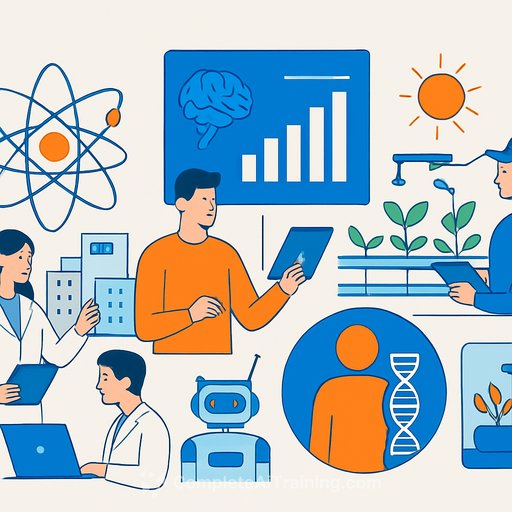
Science x AI: Korea's research system lines up missions, data, and field pilots
Science agencies in Korea are pushing AI from concept to deliverables. A coordinated set of meetings on December 22 put clear missions on the table, tightened the data backbone for AI-Bio, and showcased field adoption in agri-food. For lab leaders and R&D managers, the signal is simple: align projects to AI-enabled roadmaps that produce measurable outputs.
NST roundtable: Missions that tie AI to core science
At the National Research Council of Science & Technology (NST), Deputy Prime Minister and Minister of Science and ICT Bae Kyung-hun met with NST leadership and the heads of 23 government-funded research institutes. KASA, KARI, and KASI also joined to widen scope across space and astronomy. The discussion focused on missions where AI compounds scientific throughput and national capability.
- Build a scientific multimodal foundation model and deploy "AI research colleagues" to speed literature synthesis, experiment design, and analysis.
- Stand up autonomous labs for chemicals and materials to accelerate core materials discovery.
- Advance AI humanoids for research and field tasks.
- Secure a foundation model for bio and develop AI agents for energy, nuclear, and resource sectors.
- Embed AI across manufacturing, construction, and transportation for process control and reliability.
Each institute will refine strategy and missions against these themes to tighten execution and shorten time-to-impact.
Agri-food: From pilots to scaled deployment
Deputy Prime Minister Bae and Minister of Agriculture, Food and Rural Affairs Song Mi-ryung reviewed on-site AI adoption at the Green Tech Innovation Center in Cheonan. Companies working across smart farming, biotech, and pet-related services shared operational use cases. The message: AI is moving equipment, crops, livestock, and QA data in one loop.
- Autonomous agricultural equipment for field operations.
- AI-based growth and environmental control in greenhouses.
- Livestock data analysis with automated actuation.
- Pet behavior and health monitoring with model-driven insights.
- Quality control pipelines in agri-food manufacturing using computer vision and anomaly detection.
AI-Bio data backbone: Linking, access, and regulation
The National Bio Committee Support Group convened to operationalize the National AI-Bio Strategy. Focus areas included a platform for linking and using bio/medical data and tuning regulations to enable secure, high-value access. Experts from major hospitals, universities, and policy bodies exchanged requirements to make datasets analysis-ready and privacy-compliant.
For reference on the policy context, see MSIT's English portal here and NST's overview here.
Geoscience outcomes: Awards tied to industrial and climate needs
KIGAM's 2025 Performance Award Ceremony highlighted application-first research aligned with its "NEO KIGAM, Innovation for the Earth" agenda. Projects emphasized resource recovery, carbon management, and environmental risk.
- Gold: Low-energy, high-efficiency mineral processing to address low-grade complex ores and secondary batteries (resource recovery at industrial scale).
- Silver: Behavioral characteristics of CO2 on the East Sea seabed (inputs for offshore carbon storage assessment and monitoring).
- Bronze: Arsenic impacts on methane-producing microorganisms in wetlands (linking heavy metal dynamics to greenhouse gas emissions).
These studies point to clear tech-transfer paths: process intensification, CO2 storage safety models, and integrated geochemistry-microbiology assessments for climate models.
Public engagement: National Science Museum crosses one million visitors
The National Science Museum passed one million visitors this year, returning to pre-2020 engagement levels during its 80th anniversary. Signature programs like Dinosaur Mania, Tech-Con, national science day events, seasonal festivals, evening programs, and themed exhibitions kept interest high. Strong public demand helps sustain budgets, talent pipelines, and STEM literacy-factors that matter for long-horizon research.
What research leaders can do next
- Map your 2025-2026 portfolio to NST mission themes: foundation models for your domain, autonomous labs, and AI agents tied to sector KPIs.
- Start with data: define gold-standard datasets, labeling protocols, and governance so models can ship into production safely - consider AI Data Analysis Courses for methods on building analysis-ready datasets.
- Pilot, then scale: pick one closed-loop system (e.g., greenhouse climate control or materials synthesis) and prove cycle-time and quality gains.
- Plan for evaluation: add metrology for AI systems-drift checks, uncertainty quantification, and safety constraints-so results stand up in audits.
- Co-develop with end users: field engineers, clinicians, and operators should co-own requirements and acceptance tests.
If your team needs structured upskilling for AI-in-research workflows, see AI Research Courses.
Your membership also unlocks: