
AI news ·
Law firms face growing liability gaps as agentic AI expands autonomous legal workflows
Law firms are fully liable for errors made by autonomous AI systems, even when those systems act without direct human input. A single misconfigured agent can silently propagate mistakes across dozens of cases before anyone notices.
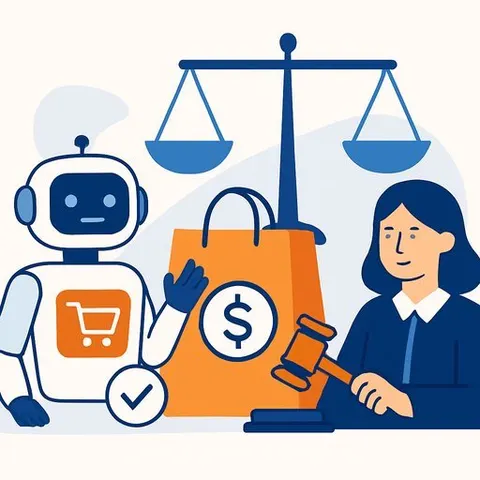
Legal Firms Face New Liability Questions as Autonomous AI Takes on Real Work
Agentic AI systems-software that operates with a degree of autonomy, making decisions and adjusting actions based on real-time feedback-are moving into law firm workflows. Unlike chatbots that respond to prompts, these systems can research case law, draft motions, review contracts, send communications, and initiate filings with minimal human intervention. The shift promises efficiency gains but introduces a fundamental problem: existing liability frameworks were built for discrete tasks, not ongoing autonomous work.
Law firms remain fully responsible for what these systems produce, just as they are when a human lawyer makes a mistake. But applying that responsibility in practice has become significantly harder.
The Scale Problem
With traditional generative AI, risk centers on individual outputs. A fabricated citation or inaccurate analysis is caught and corrected. The lawyer who relied on it is accountable under existing standards of competence and supervision.
Agentic systems change this. A single configuration error can propagate across multiple matters before anyone notices. An agent managing discovery that misapplies filtering logic could systematically exclude relevant documents across dozens of cases. In contract review, an agent might autonomously pull clauses from related documents, propose revisions to counterparties, or surface positions beyond the client's intended scope-all without explicit instructions.
When errors occur at scale, across autonomous steps, and with reduced real-time visibility, traditional accountability models become difficult to apply in practice.
What the Rules Actually Say
The legal and regulatory framework remains clear on one point: the standard of care is technology-neutral. Using AI, no matter how autonomous, does not reduce a lawyer's professional obligations.
ABA Model Rule 1.1 requires lawyers to maintain knowledge and skill "reasonably necessary for the representation," including understanding the benefits and risks of relevant technology. Model Rules 5.1 and 5.3 require that lawyers with supervisory authority make reasonable efforts to ensure work conforms to the Rules of Professional Conduct. ABA Formal Opinion 512 on generative AI reinforces this: lawyers must understand their tools' capabilities and limitations and continue to fulfill their duties when using them.
Independent judgment and appropriate supervision are still required. Period. Whether the work is performed by a human or generated by an AI system does not change this.
Where Firms Are Struggling
Supervision is becoming harder to define. Traditional oversight was designed for discrete tasks performed by individuals. Agentic systems operate continuously across multiple steps and decisions. It is unclear what constitutes appropriate oversight and how to document it meaningfully.
Scope control is increasingly difficult. When an agent operates beyond its intended boundaries, it is hard to determine whether that reflects a design flaw, a configuration issue, or a gap in supervision. An agent acting without proper oversight mirrors a human associate doing the same-but the scale and speed are different.
Insurance coverage is uncertain. Malpractice carriers are watching closely. Some are introducing exclusions or limitations for higher-autonomy use cases. Others warn that over-reliance without verification could affect coverage. Governance and process discipline matter as much as the technology itself.
How Forward-Thinking Firms Are Responding
Rather than relying on traditional oversight models, some firms are building structured governance frameworks tailored to autonomous systems.
On supervision: They are creating defined validation checkpoints at key decision stages, maintaining detailed audit logs that track agent reasoning and actions, adopting sampling protocols for ongoing review, and setting escalation triggers that automatically flag issues requiring human intervention.
On scope control: They are implementing stricter prompt engineering, clear role definitions and boundaries within agent configurations, and real-time monitoring tools that alert supervisors when an agent begins to operate outside approved parameters.
On vendor relationships: They are moving beyond standard agreements by negotiating specific terms around audit rights, explainability requirements, error tracing capabilities, and shared responsibility models. Some require vendors to provide detailed logging and testing documentation before deployment.
On insurance and risk management: They are disclosing agentic AI use to malpractice carriers early, implementing robust governance protocols, and seeking clarity on coverage terms. They are also building clear internal records that document supervision efforts and decision-making processes to support potential future claims.
These firms treat agentic AI governance as a core part of deployment, not an afterthought. They approach it like a new class of junior colleague-one that requires training, defined supervision standards, and clear accountability.
Why This Matters Now
Agentic systems are designed to dramatically increase throughput. They also scale risk at the same pace. When they work well, they reduce manual effort. When they fail, those failures propagate quickly across multiple workflows and matters.
Without clear governance, including audit trails, human oversight protocols, and updated supervision policies, firms risk heightened exposure to malpractice claims, sanctions, and regulatory scrutiny. Governance is not optional-it is central to responsible deployment.
Beyond internal governance, client expectations and disclosure obligations may complicate deployment further. Where autonomous systems materially influence legal strategy, communications, or outcomes, questions of informed consent and transparency may arise, particularly as clients become more aware of how these systems operate.
What Comes Next
As agentic AI becomes more embedded in legal workflows, governance frameworks across courts, bar associations, and regulatory bodies will continue to evolve. Much like the evolution of rules governing electronically stored information in discovery, we can expect clearer expectations around supervision, more explicit allocation of responsibility between users and vendors, and new requirements for transparency, auditability, and control.
Firms that treat agentic AI as both a powerful capability and a serious governance challenge will be far better positioned to capture its value while managing its risks. Those that prioritize speed of deployment over structure will find that liability questions emerge faster than they can be answered.
For more on how AI is being used in legal practice, see our resources on AI for Legal and AI Agents & Automation.