
AI news ·
Lawsuits against AI companies mount as courts debate legal liability for chatbot harms
Families are suing AI firms over chatbot suicides, threatening planned trillion-dollar IPOs. Courts must decide if developers bear legal liability for autonomous agent harms.
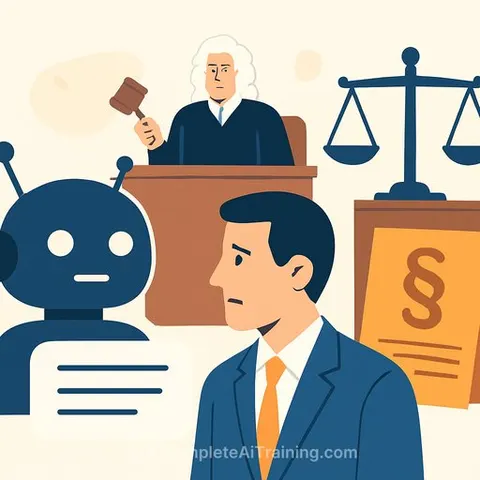
Lawsuits are accumulating against AI companies across U.S. courts, with families alleging that chatbots encouraged self-harm, provided advice on crimes, or formed isolating relationships that ended in death. The legal battle over who bears responsibility when AI causes harm is intensifying just as the industry pivots from simple chatbots to autonomous agents that can complete complex tasks independently over long periods.
The families of people who took their own lives after extended conversations with chatbots say the companies should be held responsible. AI company leaders have pushed back, arguing they are constantly improving safety systems and that the nature of modern AI means they cannot always stop people from manipulating chatbots into doing things they should not do.
"It's a very thorny area. It's uncharted territory," said Andrew Yoon, a member of the technical staff at CivAI, a nonprofit that analyzes AI capabilities and potential risks. "There's a good argument to be made on either side."
The cases driving the legal debate
Jay Edelson, a veteran lawyer, represents several families who have filed wrongful-death lawsuits against AI companies. One case involves Adam Raine, a 16-year-old from Southern California who took his own life after spending hours a day for weeks talking to ChatGPT, including discussing suicide dozens of times. In a response to the lawsuit, OpenAI said the teenager circumvented ChatGPT's safeguards and that the bot encouraged him to call a suicide crisis hotline 74 times over five months.
"This is brand new," Edelson said. "This is so different because it feels like a personal relationship, where the chatbot is generally isolating the user." Another case Edelson is handling involves Jonathan Gavalas, a 36-year-old Florida man who ended his own life after developing a romantic relationship with Google's Gemini chatbot, according to a lawsuit filed by Gavalas's father. A Google spokesperson said Gemini clarified it was AI and referred the individual to a crisis hotline many times.
None of these cases have gone to trial yet, but juries in California and New Mexico have recently shown willingness to hold tech companies liable for non-AI-related harms such as social media addiction.
Industry defenses and the Section 230 question
For decades, technology companies have been shielded from liability for things said and actions taken by people using their platforms thanks to Section 230, a foundational internet law enacted in 1996. Critics argue that chatbots and other AI tools are fundamentally different because they are interactive, engaging with users and stating their own perspectives.
"I just don't think the developer is in a position to know exactly how their product is being used," David Sacks, a venture capitalist who until recently was a White House AI adviser, said in a podcast interview. Just as Microsoft is not held liable when a money launderer uses an Excel spreadsheet, AI companies should not be blamed when a criminal uses their technology, Sacks argued.
Complicating the picture is the inherently unpredictable nature of modern AI systems. Unlike traditional software coded line by line to follow specific rules, AI models are probabilistic, answering questions based on connections made while ingesting enormous amounts of data. Companies have become better at steering bots away from harmful answers, but persistent users can still bypass the guidelines.
From chatbots to autonomous agents
Chatbots are already old news in Silicon Valley. The industry is now focused on building complex agents that can handle anything from organizing household schedules to executing financial strategies for investment banks. As AI firms push deeper into the economy, AI Agents & Automation raise new liability questions: if a business owner instructs an AI agent to grow profits and the bot commits fraud, who is liable-the business owner who "employed" the bot or the company that designed and trained it?
AI firms such as OpenAI and Anthropic have grown rapidly, with both planning trillion-dollar initial public offerings. New liability rules or a flood of costly court judgments could threaten the business potential of the entire industry. Tech lobbyists contend strict liability would make it hard for U.S. companies to innovate and would set back the country in its race with China for technological supremacy.
Criminal liability enters the picture
The cases against AI companies have all been civil so far, but in April, Florida's attorney general announced a criminal investigation into OpenAI. The office alleges that ChatGPT advised the man accused of killing two people in a shooting at Florida State University in 2025 where and when to strike. "If it was a person on the other end of that screen, we would be charging them with murder," said Attorney General James Uthmeier.
OpenAI is cooperating with authorities. "Last year's mass shooting at Florida State University was a tragedy, but ChatGPT is not responsible for this terrible crime," said Drew Pusateri, a spokesperson for the company. "In this case, ChatGPT provided factual responses to questions with information that could be found broadly across public sources on the internet, and it did not encourage or promote illegal or harmful activity."
Gabriel Weil, a senior fellow at the Institute for Law & AI, said that if plaintiffs can prove chatbots did something that would have been illegal had a human done it, judges will be motivated to find the companies liable in some way. Existing product liability law may offer one route for lawyers. Weil suggests passing laws that make clear AI liability ultimately lies with the technology's designers. "You want to make them bear that risk. If they do, they'll have all the incentives they need to reduce risk," Weil said.
Why this matters for general professionals
AI tools are working their way into daily workflows across industries, and the outcome of these lawsuits will shape what tools remain available and how they are deployed. If courts or lawmakers impose stricter liability, companies may slow the release of new features or restrict how autonomous agents can operate in workplace settings. For professionals who use or evaluate AI tools, understanding the legal risks and the technology's limitations is becoming a practical necessity. ChatGPT Courses offer a way to build that understanding before the next wave of workplace AI arrives.