
AI news ·
Leaders risk outsourcing human judgment as AI embeds faster than governance frameworks can keep up
Leaders are embedding AI into core decisions faster than they're building governance to oversee it. ASIC warns the accountability gap is real-and under existing directors' duties, responsibility still lands with leadership.
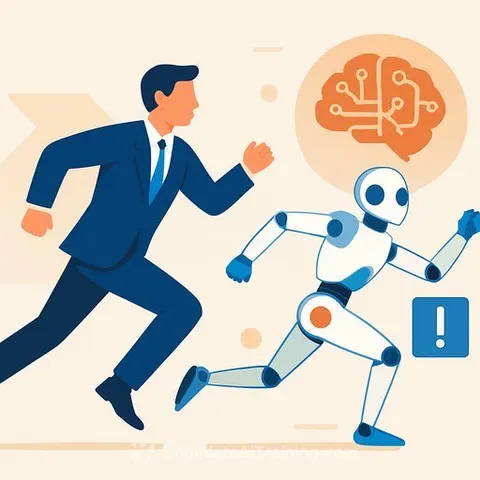
Leaders are outsourcing judgment to AI faster than they can govern it
Many organisations are embedding AI systems into core workflows without their leaders understanding how those systems work or who owns the decisions they make. Australian research shows this gap is already a significant leadership risk, and it will only grow as AI becomes more central to strategy, hiring, customer prioritisation and performance management.
The problem is not technical. It is a leadership accountability problem that most organisations have not yet recognised.
Managing machines is not the same as managing people
For decades, leadership development has focused on one core skill: how to lead people well. Managers learn to motivate, give feedback, build culture and navigate complexity through human relationships. That framework is becoming obsolete.
Leading a person and governing a machine require different capabilities. With people, you motivate through trust and conversation. With machines, you exercise judgment about where automation is appropriate, where human oversight is essential and who is accountable when things fail.
The Governance Institute of Australia has been explicit: AI governance is a leadership and accountability challenge, not a technical task for IT teams. Yet national AI research shows leadership capability is lagging behind the technology itself. Few organisations are training leaders to manage systems that learn, evolve and sometimes fail in unexpected ways.
The risk is not that AI will replace leaders. It is that leaders will outsource judgment too quickly.
Intelligence scales faster than wisdom
AI excels at processing information and identifying patterns. It can produce recommendations that appear objective and authoritative. But intelligence and wisdom are not the same thing.
Wisdom requires context. It considers culture, timing, ethics and long-term consequences. It asks not just "Can we do this?" but "Should we?" and "What does this reinforce over time?" These are leadership questions. They cannot be delegated to machines.
Australian human rights research consistently shows that while AI can support decision-making, it cannot exercise moral judgment or understand lived context. Regulators have warned that over-reliance on AI recommendations without active human oversight can increase organisational risk rather than reduce it.
As intelligence becomes commoditised, the true leadership differentiators are becoming clarity, intentionality and judgment. Yet many organisations reward speed and optimisation while underinvesting in the human capability to slow down, question outputs and hold the moral line.
The accountability gap no one is discussing
When a human makes a poor decision, responsibility is clear. When an AI system does, accountability often becomes blurred.
ASIC has found that AI adoption is accelerating faster than governance frameworks, creating a "governance gap" where accountability still rolls up to leadership under existing directors' duties. Regulators have made it clear that existing accountability frameworks apply even when decisions are mediated by AI systems. Leaders cannot outsource responsibility to technology vendors.
In practice, accountability always rolls up to leadership. Yet many leaders are being handed powerful systems without the governance frameworks, decision rights or ethical guardrails required to oversee them effectively.
What leadership development needs to teach
Preparing leaders to govern both people and machines requires a fundamental shift in how organisations think about leadership development.
First, treat AI as a judgment amplifier, not a judgment replacement. CSIRO's work on responsible AI reinforces that AI should support human judgment, particularly in decisions that affect people's lives. AI should widen thinking, surface alternatives and test assumptions, not close decisions prematurely.
Second, learn to ask better questions of systems. The quality of leadership will increasingly be reflected in the quality of inquiry, not the speed of response.
Third, design human-machine collaboration intentionally. Leaders must decide where empathy, discretion and lived experience must remain human and where automation genuinely adds value. This is not a one-time decision. It requires ongoing judgment as systems evolve.
Fourth, reclaim the role of meaning-maker. As AI removes more transactional work, people will look to leaders for purpose, coherence and trust. Machines can optimise tasks. They cannot create belonging or shared belief.
The real risk is leadership lag
Organisations are preparing leaders for a world that no longer exists. The next generation of leadership will not be defined by technical mastery of AI tools, but by the ability to hold human judgment steady in a machine-accelerated environment.
Leading people and machines is not about choosing between humanity and technology. It is about integrating both intentionally, ethically and with courage. If organisations fail to prepare leaders for this reality, the systems will still move forward. But leadership will lag, and that is where the real risk lies.
For executives responsible for strategy and organisational capability, this is not a future problem. It is a present one. Learn more about AI governance for executives and strategy, or explore how to develop management capability for human-machine collaboration.