Lecturers: Treat AI as a learning partner, not a threat
AI tools like ChatGPT, Copilot, DeepSeek and Gemini are already in your classrooms. They draft essays, summarise readings and complete basic tasks at scale. If the response is only policing, we miss the point: are students actually learning?
The better move is a mindset shift. Use AI to push students into higher-order thinking where machines falter: analysis, evaluation and creation. Students shouldn't just use AI - they should test it, question it and make better decisions because of it.
What the research shows
Most university assessments still reward memorisation and recall. That's exactly what AI handles best. It's fast, confident and often accurate at lower levels.
But push into nuance and context, and the cracks appear. AI often struggles with judgement, originality and situational awareness. That's your cue: redesign assessment so students practice the skills AI can't reliably replicate.
Bloom's taxonomy is a useful lens for this shift - from remembering and understanding to applying, analysing, evaluating and creating. A quick refresher can help you map tasks to thinking levels: Vanderbilt CFT: Bloom's Taxonomy.
Principles to teach in the age of AI
- Redesign for higher-order thinking. Build authentic, context-rich tasks. Use local case studies, field data, debates, portfolios and live projects that require judgement over recall.
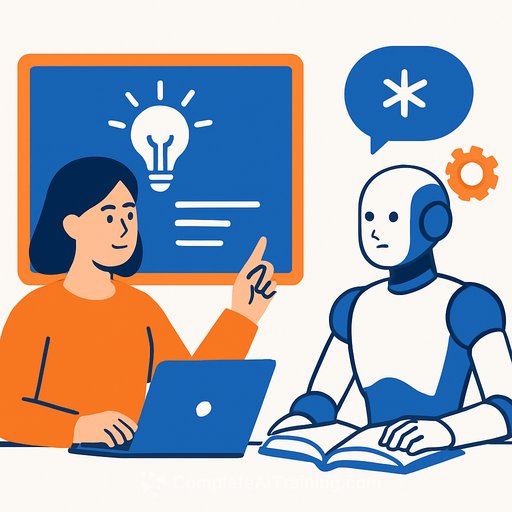
- Use AI as a critique target. Ask students to generate an AI response, then evaluate it. Where is it vague, biased or missing context? How would they improve it for real use?
- Teach AI fluency and ethics. Students must disclose AI use, question outputs and understand bias and limitations. See guidance like UNESCO's recommendations on generative AI in education.
- Build assessment literacy for staff. Train lecturers to design AI-integrated tasks and rubrics that reward reasoning, evidence and reflection.
- Foster self-directed learning. Students should set goals, choose strategies, seek resources and evaluate outcomes. AI can support - not replace - the effort.
Practical assessment ideas you can deploy now
- AI critique memos. Students prompt an AI for a policy brief or lab report, then submit a memo that diagnoses weaknesses, verifies claims with sources and proposes a stronger version.
- Local case studies. Provide messy, real data from your community or industry partners. Students must adapt or correct an AI-generated plan using constraints you supply.
- Debate with receipts. Two teams build arguments with and without AI. They must label where AI contributed and defend final positions with evidence.
- Portfolios with process notes. Require drafts, prompts, sources and decisions at each step. Grade the reasoning and reflection, not just the final product.
- Peer review on AI output. Students exchange AI-generated responses and annotate them for bias, gaps and assumptions, then co-create an improved version.
Rubrics that reward thinking, not shortcuts
- Problem framing: Defines the real question, context and constraints.
- Evidence quality: Verifies claims, cites credible sources, flags AI hallucinations.
- Reasoning: Explains why choices were made; compares options; anticipates trade-offs.
- Original contribution: Adds insight, adaptation to local context, or novel synthesis.
- Transparency: Discloses AI use, prompts, settings and edits.
- Reflection: Evaluates outcomes and identifies what to improve next time.
A 30-day rollout plan
- Week 1: Set a clear AI-use policy. Decide where AI is allowed, guided or restricted. Share examples of acceptable disclosure.
- Week 2: Pick one assessment to redesign. Add an AI-critique step and require source checks.
- Week 3: Build the rubric above into your LMS. Run a small pilot with one class. Collect quick feedback.
- Week 4: Refine prompts, instructions and grading. Share wins and pitfalls with your department.
Prompts students can practice
- Bias check: "List assumptions in your answer. Where could this be inaccurate for [my context]?"
- Evidence demand: "Cite three high-quality sources for each claim. If unsure, say so."
- Counterargument: "Argue against your previous answer using credible sources. Which view is stronger and why?"
- Localization: "Adapt this plan for [local constraints: budget, policy, culture, infrastructure]. Explain trade-offs."
Policy notes to protect integrity
- Require AI-use disclosures: prompts, tools, settings and edits.
- Grade process artifacts: outlines, drafts, annotations and decision logs.
- Use oral defenses or spot checks for high-stakes work.
- Focus less on recall, more on judgement and application.
Why this works
AI handles lower-level tasks well, which frees educators to coach higher-order thinking. When assessments value analysis, evaluation and creation, students grow as independent thinkers who can audit AI, not get replaced by it.
The aim isn't to compete with machines. It's to do what they can't with consistency: reflect, judge and create meaning.
Next step
If you want structured practice and tools for staff development, explore curated AI courses and certifications for educators: Complete AI Training: Latest AI Courses.
Key takeaway
Teach students to use AI - and to question it. Design assessments that demand evidence, reasoning and context. Treat AI as a learning partner, and it becomes a catalyst for the kind of graduates society actually needs.
Your membership also unlocks: