
AI news ·
Legal AI agents take over task execution as lawyers shift to review and strategy
AI agents now complete full legal tasks-drafting markups, comparing disclosures, building witness outlines-and return review-ready work. Lawyers no longer assemble answers into deliverables; they set scope, review output, and make the final call.
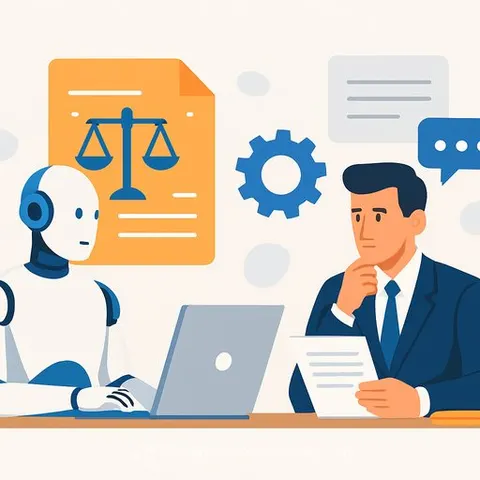
AI Agents Are Changing How Lawyers Work-and What It Means for Your Practice
Legal AI has crossed a threshold. For the first decade, the tools sat beside the work-a lawyer would highlight a clause, ask a question, paste the answer into a draft, repeat. That model is ending. AI agents now take a full task-draft a marked-up agreement, compare a disclosure against regulatory requirements, build a witness examination outline-and return review-ready work. The lawyer reviews and decides what to keep.
This shift changes the unit of legal AI from the prompt to the task. A lawyer no longer assembles answers into a deliverable. The agent receives the goal, maps the steps, gathers sources, does the work, and returns something finished. The lawyer's role moves to scope, strategy, and judgment.
For legal leaders, the practical question is no longer whether agents can do meaningful work. It's where to deploy them first, how to govern them, and what the rollout actually looks like.
What Agents Actually Do
Three categories of agents have emerged in production legal work. Ad hoc agents take a described goal and plan from there, useful for one-off work. Pre-built agents come from vetted libraries built by lawyers for tasks that recur across matters-drafting a witness outline, comparing exhibits against a pretrial order. Custom agents take an organization's own templates, standards, and review steps and turn them into reusable agents the whole team can run.
Every agent runs through five visible stages. Plan. Research. Work. Deliver. Review. Each one is auditable.
Plan: The agent translates a goal into a step-by-step plan. When scope is ambiguous, it asks clarifying questions before starting. The plan is shown back to the lawyer before execution begins.
Research: The agent pulls from trusted sources-the organization's own documents, vetted legal databases, the live web where appropriate. Every claim traces to a citation the lawyer can audit. This is what makes the work reviewable.
Work: The agent performs the substantive task-drafting the markup, building the issues list, comparing the disclosure against regulatory requirements. It applies analysis, not just retrieval.
Deliver: The agent returns the deliverable in the format the work calls for. A markup looks like a markup, with redlines and comments in the right places. A memo reads like a memo. Deliverable quality is where most legal AI fails the practical test.
Review: The lawyer accepts, refines, or rejects. The decisions at this stage shape how the agent performs on the next run. The agent does the work. The lawyer signs the deliverable.
Where Agents Create the Most Value
Agents help most where the work is repeatable and the constraint is hours, not insight. Three traits define these tasks: they run at high volume, follow a consistent structure across matters even when inputs vary, and run into human time as the limit on throughput.
Transactional work is the category most often cited. Diligence, markup drafting, and issues lists across a deal involve thousands of pages that have to be read, compared, and summarized in patterns that recur across deals. Agents now handle drafting issues lists for escrow agreements, identifying issues in underwriting agreements, and drafting markups of acquisition agreements against counterparty first cuts.
Litigation has been slower to absorb agents because the work depends more on judgment. But the high-volume corners are absorbing them quickly. Drafting witness examination outlines, comparing exhibit lists against pretrial orders, drafting responses to requests for production, extracting key allegations from government inquiry letters-these tasks consume associate hours without building the kind of work that builds a litigator's craft.
Compliance and regulatory work is the category where in-house teams are getting the most value. The work is high-volume, jurisdictionally fragmented, and procedurally repetitive in ways that punish manual review. Comparing an ESG disclosure against regulatory requirements, drafting permit application narratives, assessing breach notification obligations across affected jurisdictions-agents get back hours that go straight into strategic work the business needs.
In-house operations are where the practical math matters most. Legal departments are running flat or contracting while work volume keeps growing. Agents close that gap on tasks like assessing MSA renewal terms against business performance, drafting employment agreements from offer letter terms, and identifying issues in counterparty financial statements.
What Changes for Associates and Early-Career Lawyers
If agents handle the first draft, what does a first-year associate do? The easy answer-less work-is wrong. The honest answer reshapes early-career legal work entirely.
Agents shift the early-career skill set toward review, judgment, and source verification. A first-year who once spent 40 hours marking up a services agreement might now spend 5 hours reviewing an agent's markup. The remaining 35 hours is different work: reading the agent's plan and catching where scope is wrong, spotting citations that don't quite support the claim, recognizing the issue the agent didn't flag because it doesn't know what the client cares about. That is judgment work.
The real concern is whether craft survives. Pattern recognition and instinct come from doing the work yourself the first hundred times. An associate who has never drafted a witness examination outline from scratch can't tell when an agent's version is missing the question that matters.
The firms gaining ground are treating this as a curriculum problem. They pair agent deployment with structured review programs that walk associates through what good looks like, line by line. They build intentional friction into training by having associates draft sections by hand before comparing against the agent's output. The goal is to use agents in a way that produces the next generation of partners, not just the next generation of reviewers.
The Governance Questions That Decide Whether Agents Reach Production
Most coverage of legal AI agents focuses on what they can do. The harder questions are different. What happens when an agent gets something wrong? Can the work product stand up to a partner's review, a client's audit, or a regulator's inquiry?
AI governance in legal practice rests on two layers: written policies that set expectations, and programmatic controls-layered permissions, access boundaries, audit trails, adoption visibility-that turn those expectations into practice inside the systems where work happens.
Six governance dimensions matter most.
Scope of Access: What an agent is permitted to read and what tools it is permitted to use. A diligence agent that can access a deal data room but not unrelated client matters is operating within defined scope. Undefined access boundaries are a confidentiality incident waiting to happen.
Authorized Actions: Firms need to distinguish between actions an agent can run without intervention and actions where human sign-off is needed. Drafting an internal issues list is one thing. Preparing materials intended to leave the firm or updating a system of record is another.
Reviewability and Human-in-the-Loop Supervision: Because agents operate across multiple steps, lawyers need to review and supervise the work as it progresses, not only at the end. A lawyer must review all agent output before it is relied on or shared. Citation auditability is the mechanism that makes this supervision practical.
Matter-Level Isolation and Data Governance: Work for one client has to stay walled off from work for another. What is retained from data as it passes through an agent? What, if anything, is used to train the underlying models? The right answer is usually that client data is not used for training, retention is governed by the customer, and storage locations match the regulatory regime of the work.
Deployment and Configuration Governance: As agent libraries grow, the governance question extends to who can configure or publish an agent for others to run. A deployed agent sets the process for everyone who runs it, which means publishing an agent is closer to writing a policy than to sharing a document.
Accountability and Documentation: Agents do not sign documents. Lawyers do. Internal policy needs to spell out who reviews what, what level of agent output requires partner sign-off, and how the firm documents the review. Equally important is the audit trail-inputs, plans, steps, sources, and outputs should be documented to support auditability and operational transparency.
What Production-Grade Agents Look Like
What separates a production-grade legal agent from a demo comes down to three things. The agent has to be built on a vetted library of legal tasks. Its reasoning has to be transparent, with citations the lawyer can audit at every step. And the platform has to let an organization turn its own templates, standards, and review steps into custom agents the whole team can run.
The legal AI category has consolidated around a small number of platforms operating at scale across the largest law firms and in-house teams. The firms running agents in production today are not experimenting at the edges. They are running thousands of agent tasks a day across diligence, drafting, regulatory analysis, and litigation work, with internal policy governing how outputs are reviewed and signed off.
How to Roll Out Agents Successfully
The biggest predictor of whether a legal AI agent rollout produces real value is how the first six months are structured. The failure mode is consistent: a firm announces a top-down mandate, deploys across every practice group at once, and runs into cultural resistance, governance gaps, and uneven adoption.
The pattern that works is almost the opposite. It looks slower at the start and produces more durable results.
Pilot with a single practice group. Start with a high-volume, well-bounded use case where the work is repeatable, the volume produces learning fast, and the partner or department head is genuinely interested. Pilots that meet these criteria produce signal in six to eight weeks.
Measure in lawyer terms, not platform terms. The metrics that matter are quality of output, hours redirected to higher-value work, and partner satisfaction with deliverables. Usage counts and feature adoption tell you whether people are clicking, not whether the agent is producing work the firm trusts.
Build internal champions inside each practice group. Identify two or three lawyers per group who become the people their peers come to with agent questions. Adoption happens lawyer to lawyer.
Expand horizontally before going firm-wide. Once the first practice group is producing trusted output, the next step is a second practice group with adjacent characteristics. Horizontal expansion lets each practice group benefit from the lessons of the last one.
The firms scaling agents fastest aren't the ones with the most ambitious announcements. They are the ones with the most disciplined first six months.
What Comes Next
The first wave of legal AI agents has been about single-task execution-drafting a markup, identifying issues in an underwriting agreement, comparing a disclosure against regulatory requirements. The next phase is already taking shape. Agents will run diligence, drafting, and analysis simultaneously across a single matter, integrate natively with the document management systems and collaboration tools where legal work already happens, and get sharper over time as custom agents trained on a firm's review history become an extension of its institutional knowledge.
The question for legal leaders is no longer whether to use agents. It is what work to delegate, what judgment to retain, and how to train the next generation of lawyers in a profession where the first draft is no longer where craft is built.
For more on how AI is changing legal practice, explore AI for Legal or the AI Learning Path for Paralegals.