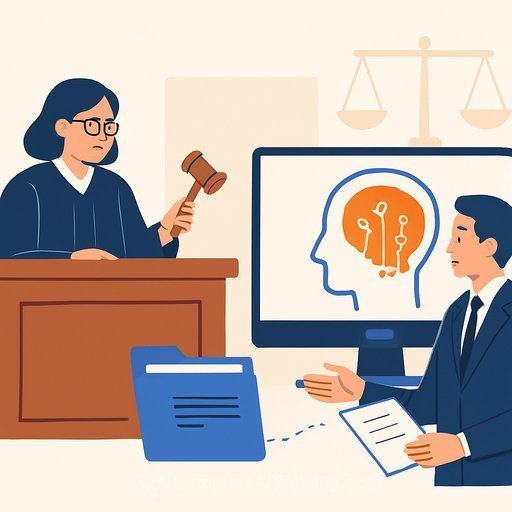
AI Unleashed: The Legal Wild West of Agentic AI
Agentic AI isn't just another software tool. It makes decisions, takes actions, and adjusts its tactics without direct human prompts. That breaks the clean accountability lines our laws were built on.
Courts, regulators, and in-house teams now have to answer a basic question: when a self-directed system acts, who is on the hook? The deployer, the developer, the data supplier, the insurer-maybe all of them, depending on facts and contracts.
What makes AI "agentic"
Agentic systems set goals, sequence tasks, call external tools, and iterate. They can transact, publish, purchase, and trigger workflows across APIs. That autonomy creates real-world exposure without a human hand on every step.
The legal issue: our doctrines assume a responsible person or corporate actor is directing the conduct. Here, intent and control are distributed or delayed.
Where current law strains
- Agency law: Who is the principal and who is the agent when the "agent" is a stack of models and tools? Apparent authority risks rise if systems can message customers or vendors.
- Product liability vs. services: Models are often marketed as services. Plaintiffs will argue defect and failure to warn; defendants will point to configuration and misuse by deployers.
- Negligence and duty of care: Failure to supervise, inadequate guardrails, and ignored telemetry can look like breach. Foreseeability will hinge on red-team results and known limitations.
- Attribution and mens rea: Intent doesn't map cleanly to a stochastic system. Expect more focus on the human system of oversight and the reasonableness of controls.
- Contract law: As agency blurs, contracts become the primary tool to allocate loss and set operational boundaries.
A practical liability model
- Provider responsibility: Model defects, hidden capabilities, insecure update practices, and misleading performance claims.
- Deployer responsibility: Use-case fit, tuning choices, human oversight, incident response, and data governance.
- Tool/API owner responsibility: Guardrails on actions (payments, publishing, code changes) and audit logs for every call.
- Shared responsibility: Monitoring, kill switches, and rollback plans across the chain.
Contract clauses that matter (use them)
- Purpose and boundaries: Approved use cases, prohibited actions, and explicit off-limits domains.
- Controls: Human-in-the-loop thresholds, rate limits, spending caps, environment segregation, and mandatory kill switches.
- Telemetry and logs: Prompt/event logs, model and tool versions, input/output hashes, API call records, time stamps, and retention rules.
- Updates and drift: Notice, testing windows, rollback rights, and freeze periods for high-risk workflows.
- Security and privacy: Data residency, training-data use restrictions, and clear IP ownership of outputs and derivatives.
- Warranties and disclosures: Known limitations, red-team summaries, eval scores, and documented failure modes.
- Indemnities and caps: Third-party claims, regulatory fines where insurable, and cyber/E&O alignment.
- Incident response: 24/7 contacts, containment steps, escalation timelines, and cooperation obligations.
Governance for agentic behavior
- Gatekeeping: Approval boards for new agentic use cases with risk tiering and sunset reviews.
- Tooling safeguards: Capability-based access, sandboxed actions, pre-commit checks, and dual-control for sensitive steps.
- Monitoring: Real-time alerts for anomaly rates, spending spikes, policy violations, and off-policy actions.
- Independent testing: Red teaming against policies that mirror your legal exposure: fraud, privacy, defamation, competition, safety.
- Accountability: Named owners for each system, with documented sign-offs on risk and controls.
Evidence and audit readiness
- Discovery playbook: Preserve prompts, outputs, tool-call logs, and model snapshots. Treat logs like source-of-truth records.
- Version control: Pin model/tool versions to each decision, including config files and policies in force at the time.
- Chain of custody: Cryptographic hashing and time-stamping where possible to defend integrity.
- Explainability files: Don't promise what you can't deliver. Maintain concise decision summaries for high-impact actions.
Regulatory touchpoints to watch
- EU AI Act: Risk-based duties on providers and deployers, logging, documentation, and oversight for higher-risk systems. Start aligning now with internal classification and control mapping. Official overview.
- NIST AI RMF: A practical scaffold for Govern, Map, Measure, Manage-useful for gap assessments and policy baselines. NIST AI Risk Management Framework.
- Consumer protection and advertising: Claims about accuracy, autonomy, and safety will be scrutinized. Keep marketing synced with legal reality.
- Privacy and ADM laws: Notice, opt-outs, appeals, and human review for significant decisions are becoming standard.
Insurance and risk transfer
- Coverage mapping: Check cyber, tech E&O, media liability, and product liability for AI-specific exclusions or endorsements.
- Proof for underwriters: Provide governance artifacts-risk tiers, logs, red-team reports, and incident plans-to improve terms.
Litigation posture
- Theories to expect: Failure to supervise, negligent design, deceptive practices, data misuse, and vicarious liability.
- Defenses: Comparative fault, misuse outside contract, compliance with published standards, and documented oversight.
- Venue and jurisdiction: Agents act across borders. Lock venue, law, and dispute resolution in your contracts.
90-day legal action plan
- Inventory agentic use cases and classify by risk. Freeze anything without clear owners and kill switches.
- Amend vendor and customer templates with the clauses above. Require logs and update controls before go-live.
- Stand up an AI oversight committee with authority to approve, pause, and retire deployments.
- Run a tabletop: simulate a bad output causing real harm. Time your detection, response, and notification steps.
- Align policies with the NIST AI RMF and map to EU AI Act requirements where relevant.
- Brief the board on exposure, controls, and insurance posture. Keep it evidence-based and short.
Training your team
Your engineers will build fast. Your contracts and controls must keep pace. If you need structured upskilling for legal-adjacent AI topics, consider the AI Learning Path for Regulatory Affairs Specialists, the AI Learning Path for CIOs, or the AI Learning Path for Vice Presidents of Finance to align counsel, risk, and product on a common baseline.
Agentic AI won't wait for perfect law. Tight contracts, strong controls, and clean evidence trails are your leverage right now. Start there, iterate, and keep receipts.
Your membership also unlocks: