Leidos and OpenAI bring AI into federal workflows: what Ops and Product leaders need to know
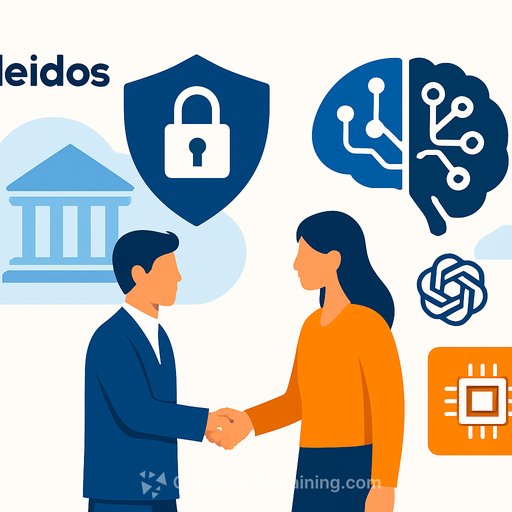
Leidos and OpenAI announced a partnership to put generative and agentic AI into the daily work of U.S. government agencies. The effort targets digital modernization, health services, national security and infrastructure, and defense-core pillars of Leidos' NorthStar 2030 strategy.
The focus is direct: move from pilots to deployment with models configured for security and privacy. Leidos reports thousands of employees already using ChatGPT and OpenAI's API Platform to speed internal work and delivery timelines.
What's new
According to Leidos CTO Ted Tanner, the companies are working with OpenAI's most capable models in a secure setup to protect company and government data. Joseph Larson, OpenAI's VP for government, underscored three starting points for agencies: trust, security, and mission relevance.
Beyond text generation, the plan is to build agentic workflows that take action across systems-think case intake, triage, summarization, validation, and escalation with a human in the loop. The goal is to shorten time-to-decision and compress delivery cycles without sacrificing oversight.
High-impact use cases from the announcement
- Global threat assessments: AI-assisted collection, synthesis, and red-teaming to produce faster briefings.
- Supply chain monitoring: anomaly detection, vendor risk signals, and event summarization across large data streams.
- Deepfake detection: model-assisted media forensics to flag manipulated content for review.
Where this fits in your roadmap
- Augment knowledge work: drafting, summarization, translation, and research with provenance and audit trails.
- Agentic workflows: trigger models from existing systems (case management, CRM, ticketing) to automate routine steps.
- Acceleration of product delivery: AI-assisted requirements, test generation, documentation, and release notes.
- Operations analytics: narrative reports on KPIs, backlog, and risk-generated on schedule or on demand.
How integration may look under the hood
- Secure model access: private routing to OpenAI models with data handling controls and logging.
- Orchestration: policies define when models read, write, or request human approval before action.
- Data governance: PII handling, redaction, and role-based access tied into identity providers.
- Observability: prompt/version control, outcome tracking, and exception handling for audits.
Implementation checklist for Ops and Product
- Pick narrow, high-value workflows with clear SLAs and measurable baselines.
- Stand up a secure "AI gateway" with logging, redaction, and prompt management.
- Design human-in-the-loop steps where errors carry real risk.
- Ship small: weekly releases, A/B tests, and guardrail tuning based on real outcomes.
- Publish guidance: approved prompts, data-use rules, and escalation paths.
Risk, security, and compliance
- Data protection: control retention, encrypt in transit/at rest, and restrict training on sensitive inputs.
- Model behavior: test for bias, leakage, and prompt injection; document known failure modes.
- Records and FOIA: log decisions, prompts, and outputs where records policies apply.
- Governance: align with frameworks such as the NIST AI Risk Management Framework (NIST AI RMF).
Metrics that matter
- Cycle time: time-to-decision, time-to-brief, mean time to resolve.
- Quality: accuracy, recall/precision by use case, false positive/negative rates.
- Throughput and cost: cases per FTE, cost per case, compute spend per outcome.
- Reliability: SLA adherence, intervention rate, rollback frequency.
- Developer velocity: PR lead time, test coverage, defects escaped to production.
Why this matters for procurement and vendors
Agencies will expect secure configurations, clear data boundaries, and evidence of mission impact-not just demos. Vendors should bring reference architectures, audit-ready logs, and measurable outcomes tied to SLAs. If you're selling into federal, show how your product plugs into these AI workflows without creating new risk.
About Leidos and OpenAI
Leidos is a government and commercial technology leader headquartered in Reston, Virginia, with about 47,000 employees and approximately $16.7B in FY2024 revenue. The company focuses on digital and mission solutions across defense, health, and infrastructure.
OpenAI is an AI research and deployment company focused on building useful systems while maintaining safety and alignment. Their models are being integrated here to support secure, real-world agency use cases.
Forward-looking note
This partnership includes forward-looking statements subject to risks and uncertainties, as reflected in Leidos' filings with the SEC. Outcomes may differ, and neither party is obligated to update projections after this date.
Source: PR Newswire announcement
If you're building team capability for these workflows, here are practical learning tracks by job role: AI Learning Path for Project Managers, AI Learning Path for CIOs, and AI Learning Path for Regulatory Affairs Specialists.
Your membership also unlocks: