Leidos and OpenAI Partner to Put AI to Work Across Federal Operations
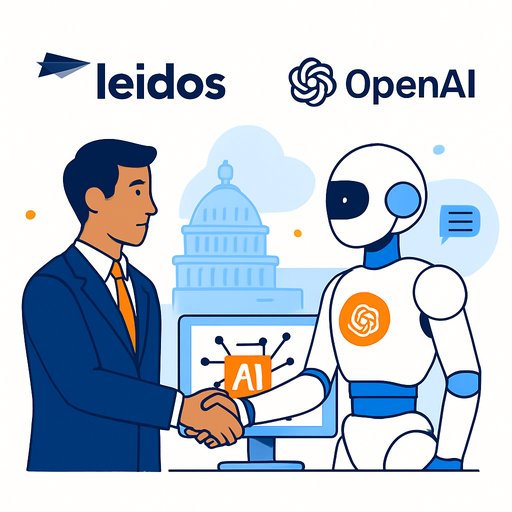
Leidos and OpenAI are joining forces to move AI out of pilots and into day-to-day federal workflows. The effort targets defense, national security, infrastructure, digital modernization and health services as part of Leidos' NorthStar 2030 strategy.
The focus is simple: integrate agentic and generative AI where they reduce friction, boost throughput and shorten delivery timelines, while keeping data protected inside secure environments. CIOs can review the AI Learning Path for CIOs to align governance and security strategy for federal deployments.
What This Means for Operations
Agentic AI will automate multi-step tasks across tools and data sources. Generative models will speed knowledge work and decision support without changing existing systems overnight.
- Global threat assessments: faster intake, triage and synthesis for analysts.
- Supply chain monitoring: anomaly detection, risk scoring and supplier alerts.
- Deepfake detection: flagging manipulated media before it reaches decision-makers.
Trust and Security Come First
OpenAI's Joseph Larson highlighted three adoption drivers for government: trust, security and mission fit. That means model deployment in controlled environments, clear data boundaries and outcomes tied to real workload metrics-availability, accuracy, auditability and latency.
Agencies can align evaluations with the NIST AI Risk Management Framework to standardize risk, testing and monitoring practices; teams responsible for compliance may also find the AI Learning Path for Regulatory Affairs Specialists a practical guide for regulatory alignment and policy automation.
How Leidos Plans to Execute
Leidos is integrating OpenAI models with its existing AI tools to build custom agentic workflows. The goal: reduce manual handoffs, cut cycle times and keep humans in the loop where judgment matters.
Deployments will prioritize secure environments to protect sensitive data while improving productivity and accelerating product development and delivery.
Why It Matters Now
Agencies are moving from experiments to fielded systems. Budgets and leadership attention are tied to measurable gains in resilience, efficiency and public service-exactly where these workflows apply.
Related Moves From Leidos
- Protect AI partnership (2025) to provide end-to-end security for federal AI systems, from data pipelines to model monitoring.
- CargoSeer collaboration to integrate trade-analysis algorithms into the Mezzo platform for improved customs screening.
- Imperium launch with VML, an AI-driven information operations platform for faster analysis, mission planning and decision-making in defense settings.
For Operations Leaders: Quick Checklist
- Map 3-5 high-friction workflows (intel triage, case intake, supply risks) and define success metrics before building.
- Set data boundaries early: what the model can see, log and retain; confirm encryption, access controls and audit trails.
- Choose a deployment pattern (on-prem, GovCloud, secure enclave) that meets your accreditation path and latency needs.
- Stand up a human-in-the-loop review for sensitive outputs; require escalation rules and red-teaming.
- Instrument everything: precision/recall for critical tasks, false-positive costs, throughput, and user satisfaction.
- Align procurement, legal and cybersecurity upfront to avoid delays at go-live.
- Upskill operators and analysts on prompt craft, agent handoffs and exception handling. If you need structured options, explore the AI Learning Path for Project Managers or browse AI courses by job role.
What's Next
The Potomac Officers Club will host its 2026 AI Summit on March 18, bringing government and industry leaders together to dig into at-scale AI deployments. The event is sponsored by OpenAI and will focus on practical adoption across missions.
Your membership also unlocks: