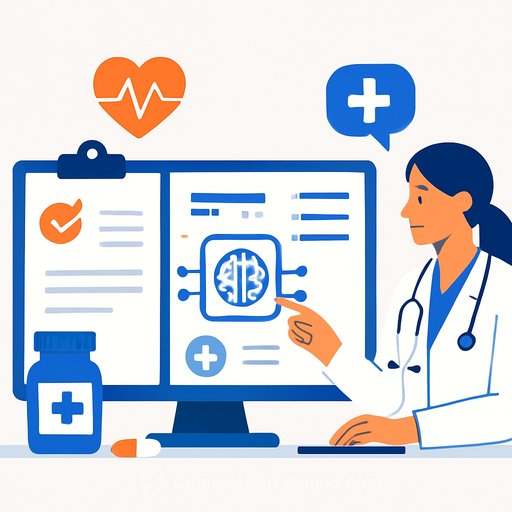
How AI-Powered EHRs Are Finally Delivering On Digital Health
Physician burnout is a daily reality. Documentation, inbox overload and regulatory tasks keep piling up, and more than six out of 10 physicians report stress from information overload. Electronic health records were supposed to help. Instead, most systems added clicks, not clarity.
That's changing. With AI and machine learning embedded into the workflow, EHRs are starting to work like a clinical teammate - surfacing what matters, automating busywork and giving time back for patient care. As one healthcare leader put it, the issue wasn't fear of technology - it was that early EHRs didn't actually help clinicians get the job done.
From Digital File Cabinet To Clinical Partner
Traditional EHRs digitized the paper chart. The work still fell on clinicians to hunt for context, stitch together fragmented history and document by hand after hours. AI changes the model.
By combining natural language processing, predictive insights and automation, the EHR can summarize a patient's story, flag what's important for today's visit and draft notes, orders and follow-ups for clinician approval. "Once you have AI and you can understand the patient's chart, the EHR can give the doctor a summary of the patient, tell them what's important and even draft notes and orders." That's not a prettier chart - that's a different workday.
What This Looks Like In Practice
One concierge emergency care provider connected in-house lab instruments directly to an AI-enabled EHR through a marketplace of more than 600 app developers. Results flowed straight into the chart and into the workflow - no manual entry, no phone tag.
The outcome: more than 3,500 staff hours saved per year. That time was reallocated to patient interaction, care coordination and reducing after-hours documentation. This is the pattern you want: fewer handoffs, fewer clicks, more care.
From System Of Record To System Of Support
EHRs used to be library stacks: all the info was there, but you had to comb through it. AI can parse unstructured notes, messages and labs, convert it into structured data and surface only what's relevant to the current decision.
Clinicians get a quick orientation: what changed since the last shift, what's new since the last visit and what likely needs to happen next. That clarity is "liberating" because it shifts attention from searching to treating - and that's why patients are there.
Reducing After-Hours Work With Ambient Documentation
AI-assisted documentation is moving fast. Tools like Ambient Notes and conversational AI (for example, athenaAmbient) can listen to the visit and synthesize a draft note, orders and follow-ups for the clinician to review. Approval drops the content into the system of record.
The effect is felt both ways. Clinicians reclaim evenings. Patients get more eye contact in the room and faster responses between visits.
Responsible AI Is Non-Negotiable
Security, privacy and confidentiality come first. Any AI inside the EHR must comply with HIPAA, protect PHI, and be transparent. Users should know when AI is involved and what it did.
Continuous evaluation matters: accuracy, bias checks and usefulness should be measured and audited. Clear labels, audit trails and human review keep trust intact.
Adoption Concerns Are Real - And Solvable
Some clinicians worry AI will make care more complicated or fall short of expectations. Those concerns are easing as the benefits become visible in daily work. Adoption succeeds when it's voluntary, embedded in the workflow and obviously helpful.
The formula is simple: prove it saves time, reduces inbox burden and improves the patient visit - and clinicians will use it.
A Practical Playbook For Healthcare Leaders
- Start where friction is highest: documentation, refill protocols, lab interfaces, prior auth, referral tracking.
- Embed AI inside the EHR workflow. No app switching. Drafts should appear where work gets signed.
- Keep humans in the loop. AI drafts; clinicians review and approve. Default to safety on orders and messaging.
- Set guardrails: patient consent where appropriate, clear "AI-assisted" labels, and easy ways to correct outputs.
- Improve data hygiene: structured capture, clean problem lists, reconciled meds, and strong interoperability (APIs, FHIR).
- Measure what matters: time per note, after-hours charting, inbox volume/response time, note quality, and safety flags.
- Train the team and close feedback loops. Short tip sheets, quick wins, and champions on each service line.
- Do the security work: BAAs, encryption, access controls, audit logs and vendor risk reviews.
If burnout is a strategic risk at your organization, align AI initiatives to well-being metrics. The goal is simple: fewer clicks, fewer messages, more care time. For context and resources on clinician well-being, see the National Academy of Medicine's work on clinician burnout.
The Outcome That Matters
Traditional systems helped with compliance and data, but the cost was clinician time and energy. The next wave of AI-enabled EHR tools is reversing that trade-off by automating routine work, improving decision support and supporting better patient communication.
At a moment when many clinicians are considering leaving the profession, this shift can keep teams engaged and focused on patients - not screens. As one executive put it, AI inside the EHR means happier doctors, better visits and fewer late-night notes.
Next Step
If you're planning team upskilling on AI workflows and clinical documentation, explore practical programs by job role here: Complete AI Training - Courses by Job.
Your membership also unlocks: